Safaris
Kilimanjaro
Destinations
Experiences
Travel guide
About
Contact Call +255 764 006 061 Plan Your Safari
Wildlife · 9 min read

The Serengeti Migration, Month by Month

Where the wildebeest herds are through the year, and what that means for when to travel.

January to March — the southern plains

From January to March the herds are best watched from a mobile camp on the plains, because there are few permanent lodges in this area. The camps that do exist range from simple and good value to luxury. Tell us your budget and we will say honestly which suits it.

April and May — the herds move west and north

By May the depleted short grass plains are unable to sustain the endless herds. The migration sweeps west and north, to the Serengeti's Western Corridor and almost to Lake Victoria, where there's long grass and more dependable water. Not all the wildebeest and zebra follow the same route. Some head to the Western Corridor and Grumeti before going north, and large numbers simply head north through Seronera.

In April the herds are usually still around Ndutu and the southern plains, and by May they are moving through the centre, where resident game is good all year. The centre is also the busiest part of the park.

June — the Western Corridor and the Grumeti

The Serengeti migration herds continue westwards, towards the Grumeti River. The riverine forest harbours plentiful buffalo and elephant, while there are many hippo and huge, hungry crocodiles in the river waiting for the wildebeest as they come to drink.

In June the herds are in the western corridor around the Grumeti River. The private reserve on the northern side of the corridor allows walking, off-road driving and night drives, which the national park does not. Camps along the Grumeti inside the park are well placed for the crossings there.

July — spreading north toward the Mara

The wildebeest rapidly deplete the grass and water in the Western Corridor and Grumeti and start to move on. The herds may still be in the Grumeti area during July, but the odds become slimmer as you move through the month. In a typical year the migration can be spread over huge distances, with the first zebra herds arriving in the northern Serengeti by early July and big herds of wildebeest following later in the month.

In a dry year the first wildebeest can be near the Mara River, the only reliable permanent water in the ecosystem, by early July. In a wet year, by mid-August. If conditions are very good, with plenty of grass and water, the herds spread out all the way from Seronera to the Mara River.

Late July to October — the northern Serengeti and the river

Normally from late July to mid October the Serengeti wildebeest reside in the northern Serengeti and Masai Mara. The dry season is well under way and the Serengeti herds congregate near water, especially the Mara River filled with hungry crocodiles. Mid to late October dramatic thunder clouds herald the onset of the short rains and call the migration southward. Wherever rains fall the change is dramatic with thousands of animals arriving almost overnight.

Camps in the far north range from luxury tented camps a few minutes from the main crossing points to simpler mobile camps in the Kogatende area, which work well if you want to keep the cost down. Ask how far a camp is from the river before you book. An hour's drive each way matters here. Tsetse flies can be a real nuisance in the wooded parts of the north, so pack long sleeves and avoid dark colours.

November and December — back to the south

As the rains continue through November, the herds move south and east. Heading into December long lines of wildebeest can be seen moving back to the southern Serengeti and its short, rich grasses. They begin to arrive in late December and early January, and the cycle starts again. Elsewhere in the Serengeti the grass grows fast and tall making wildlife viewing more difficult.

The north-east of the park, towards the Loliondo boundary, has some of the best scenery in the Serengeti and some of its worst tsetse flies. The eastern plains hold good numbers of lion and cheetah all year. With the wildebeest on the move at this time of year, you may or may not see large herds there.

Planning a trip around the herds

Every month above is a long-run average, not a schedule. The herds follow rainfall, rainfall moves by weeks from one year to the next, and no operator can tell you in advance which bank of the Mara they'll be standing on. Use the calendar to choose which region to sleep in for your dates, give that region three or four nights, not one, and take advice from a guide who was in the park last week over anything written a year ahead.

Itineraries

Safaris we run

All safaris
The caveat

Every migration calendar is approximate

Every month in this guide is a long-run average, not a schedule.

The herds move in response to rainfall. Rain shifts by weeks year to year and occasionally by more, and the animals follow the grass, not the calendar. In some years the front of the herd reaches the Mara in early July. In others there's nothing north of the Grumeti until August.

The herds are also not a single body. They spread over enormous distances, split, and move in both directions. During the crossing season animals cross the Mara northward and southward repeatedly across three months, so "the crossing" isn't one event but dozens.

Use this calendar to choose a region for your dates, not to plan a sighting on a day. Give yourself three or four nights in that region, not one. And take advice from a guide on the ground over a calendar written a year in advance.

Anyone guaranteeing you a crossing on a particular date is selling.

Zebra and wildebeest splashing through a river crossing, water flying around their legs.
Planning

Turning the calendar into an itinerary

Use the calendar to decide where you sleep. That is the decision it should drive.

December to March: stay on the southern plains around Ndutu. The herds are there, calving peaks in February, and you can drive off-road in parts of the area, because much of it sits inside the Ngorongoro Conservation Area, not the national park. You get there in two to three hours by road from the crater rim.

July to October: stay in the far north near the Mara River, and fly instead of driving. Kogatende is about eight hours from Seronera by road, so a driving trip spends two days in transit. Ask which side of the river your camp sits on. It is the most important detail in the north, and almost nobody volunteers it.

April to June and November: the herds are moving and spread out. The central Serengeti is the sensible base, and the migration becomes a bonus, not the plan.

Fixed and awkward dates: the central Serengeti works in every month, because it holds resident animals wherever the herds happen to be.

Where the herds are, month by month

A lodge bedroom with a carved wooden bed, striped bedcover and hunting scenes painted directly onto the plaster walls.

Dry Shoulder Green Long rains

January

Southern short-grass plains, around Ndutu and the Salei plains. The herds have arrived and are settling. Calving begins towards the end of the month in most years.

February

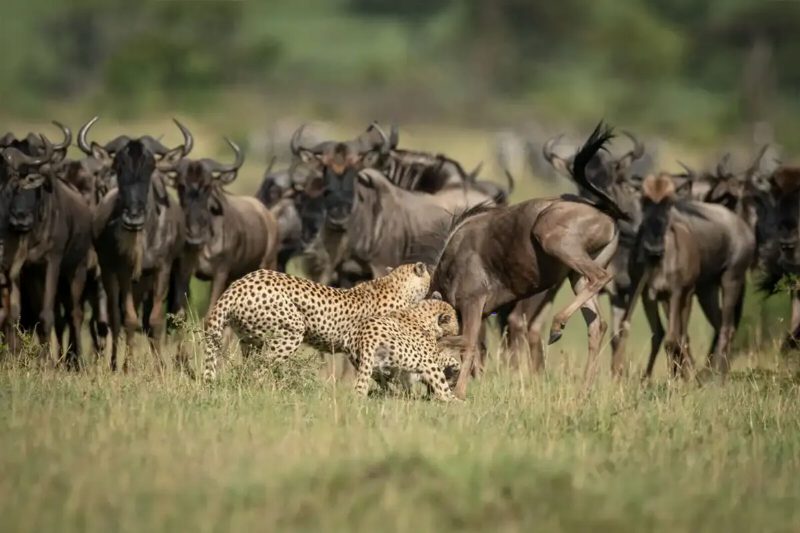
The calving peak on the southern plains. Around four hundred thousand calves in two to three weeks, and the predator activity that follows. This is the most reliable month of the whole cycle, because the animals are stationary.

March

Still on the southern plains early in the month, then beginning to string out north and west as the grass gives out and the rains build.

April

In transit through the central Serengeti in scattered columns. Spread out, not spectacular, and the long rains make following them hard.

May

Moving west toward the Western Corridor and the Grumeti, with significant numbers heading north via Seronera instead. The herds split. Not all of them take the same route.

June

The Western Corridor and the Grumeti River. Crossings here are smaller and far less predictable than the Mara crossings later, and some years produce no real spectacle at all.

July

Spreading north. The first zebra herds usually reach the northern Serengeti early in the month with the wildebeest behind them, but in a wet year there may be nothing north of the Grumeti until August.

August

The far north and the Mara River. One of the two densest crossing months. The herds cross back and forth many times, not once, so a crossing is a matter of patience, not a date.

September

The far north again, and the month many guides prefer for crossings: similar odds on the river with slightly fewer vehicles watching.

October

Still north through most of the month. Late October thunder clouds herald the short rains and call the herds south, sometimes very quickly.

November

Moving south and east through the central and eastern Serengeti as the rains spread. A good month for movement without the crowds.

December

Long lines heading back to the southern plains, arriving from late in the month into early January. The circle closes.

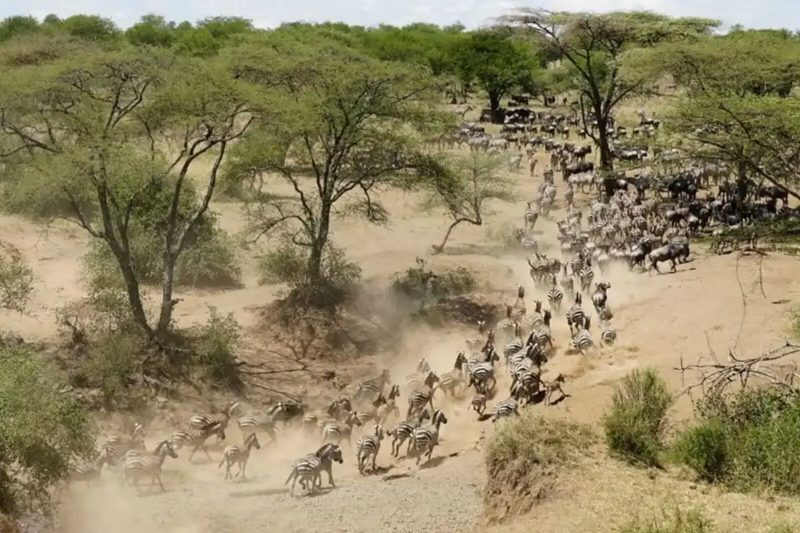
Herds streaming between acacia trees on sandy ground, dust rising behind them.
Worth knowing

The migration, explained

The word "migration" suggests something more organised than what happens, and knowing the mechanism makes the calendar make sense.

Roughly a million and a half wildebeest, with several hundred thousand zebra and gazelle, move continuously around the Serengeti–Mara ecosystem in a broad clockwise loop driven by rainfall and grass. They aren't led, they don't navigate to a destination, and there's no start or finish. At any point in the year they're somewhere in the system, which is why you can see enormous herds in most months if you're in the right region.

The zebra matter more than they're credited for. They graze the longer, coarser grass first and expose the shorter growth the wildebeest prefer, which is why the two species move together.

The calving synchrony is the most remarkable part: around four hundred thousand calves dropped within two to three weeks in February, far more than the predators can consume, which is precisely the strategy.

The river crossings, which get the attention, are incidental. The rivers are obstacles, not destinations.

A cheetah crouching low in the grass in front of a group of wildebeest.
Practical

Booking around the herds

Two windows genuinely sell out, and both fill roughly twelve months ahead: the mobile camps in the northern Serengeti for August and September, and the camps at Ndutu for February.

If your dates are fixed and fall in either window, book about a year out. If they're flexible, the shoulders, late July, early October, December and March, have better availability with much of the same wildlife.

Ask which side of the Mara River a northern camp sits on. Being north of the river means you're on the side the herds are heading to and not dependent on a bridge to reach a crossing point. It is the most consequential detail in the north and it's rarely volunteered.

Ask whether a Ndutu camp is inside the Ngorongoro Conservation Area or inside the national park. Off-road driving is permitted in parts of the conservation area and not in the park, and in the calving season that's the difference between a distant view and a photograph.

And budget three or four nights in whichever region you choose, not one.

Keep reading

Other guides

All guides

Still have a question?

Ask us directly — we answer every message ourselves.

Talk to a safari expert on WhatsApp (opens in a new tab)