Safaris
Kilimanjaro
Destinations
Experiences
Travel guide
About
Contact Call +255 764 006 061 Plan Your Safari
Destination

Lake Manyara National Park

Tree-climbing lions beneath the Rift Valley wall

Size 330 sq km (127 sq miles), of which up to 200 sq km (77 sq miles) is lake when water levels are high
Location In northern Tanzania. The entrance gate lies 1.5 hours (126km/80 miles) west of Arusha along a newly surfaced road, close to the ethnically diverse market town of Mto wa Mbu
Best time July to October for game. November to June for birdlife.
About the park

Game drives, night game drives, canoeing when the water levels is sufficiently high. Cultural tours, picnicking, bush lunch/dinner, mountain bike tours, abseiling and forest walks on the escarpment outside the park.

Contrasting with the intimacy of the forest is the grassy floodplain and its expansive views eastward, across the alkaline lake, to the jagged blue volcanic peaks that rise from the endless Maasai Steppes. Large buffalo, wildebeest and zebra herds congregate on these grassy plains, as do giraffes – some so dark in coloration that they appear to be black from a distance.

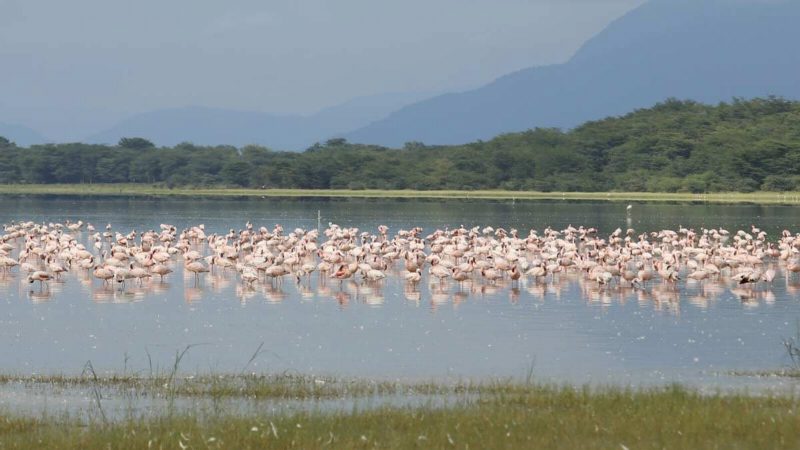
Manyara provides the perfect introduction to Tanzania's birdlife. More than 400 species have been recorded, and even a first-time visitor to Africa might reasonably expect to observe 100 of these in one day. Highlights include thousands of pink-hued flamingos on their perpetual migration, as well as other large waterbirds such as pelicans, cormorants and storks.

Why visit Lake Manyara

Manyara is small and layered. The road in runs through dense groundwater forest fed by springs at the base of the Rift Valley escarpment, with figs, mahogany, blue monkeys and troops of baboon. Then it opens abruptly onto floodplain and the alkaline lake beyond, with the escarpment wall rising behind. That squeeze of habitats into a narrow strip gives the park its character and its bird list.

It is often treated as a half-day on the way to somewhere else, which is fair on a short itinerary. The birding and the chance of tree-climbing lion both reward staying longer.

Itineraries

Safaris that visit Lake Manyara

All safaris
Before you go

Practical notes

Wildlife

Prolific birdlife. Manyara is one of the best introductions to Tanzanian birds anywhere on the circuit, with large flamingo numbers on the lake when levels suit. Elephant in the forest, big baboon troops, blue monkey, hippo, buffalo and giraffe. Lion here are sometimes seen resting in trees. It is a matter of luck, not something you can count on.

What to do there

Game drives, night game drives, canoeing when the water levels is sufficiently high. Cultural tours, picnicking, bush lunch/dinner, mountain bike tours, abseiling and forest walks on the escarpment outside the park.

Getting there

By road west from Arusha, immediately below the Rift Valley escarpment and directly on the route between Tarangire and the Ngorongoro Crater. That is why it so often becomes a half-day stop, not an overnight.

Best time to visit

July to October for game. November to June for birdlife.

A single elephant walking toward the camera through golden grass, tusks catching the low light.
On the ground

A narrow park with five habitats

Lake Manyara is a small park, about 330 square kilometres. When the water is high, as much as two thirds of that is lake. But it feels much bigger than the map suggests, because of how it is arranged.

The park is a narrow strip caught between the alkaline lake on one side and the 600-metre wall of the Rift Valley on the other. In the few kilometres between the two, you pass through more different habitats than most parks contain in total.

You enter through groundwater forest. Tall mahogany and fig trees grow here, fed by springs coming out of the base of the escarpment, not by rain. It is dense and dark. Blue monkeys move overhead, and troops of baboon sit in the road. Manyara has one of the largest baboon populations anywhere. It is a surprising way to start a game drive, because it looks nothing like the safari most people are expecting.

Past the forest the country opens up. First acacia woodland, then floodplain grassland, then the lakeshore with its soda flats and, when conditions are right, its flamingos. Elephant move through the woodland. Buffalo and wildebeest use the flats. Hippo sit in the pools at the northern end.

Manyara is famous for its tree-climbing lions. They are real, and people do see them lying along the branches of acacias. But they are unreliable. Plenty of visitors spend a whole day here and see none. Treat them as a bonus, not as the reason you came.

Two elephants reaching their trunks toward each other among green bushes.
Timing

Water level decides what Manyara gives you

Manyara's two attractions are best at opposite times of year, so the answer to "when should I come" depends entirely on what you want.

For general game viewing, the dry months from July to October are better. The vegetation thins out, animals are easier to spot in the woodland, and the ground is firm enough for the tracks in the south of the park.

For birds, and for the lake itself, the wet season from November to June is far better. The lake refills. Flamingo numbers can climb into the tens of thousands. Migrant birds push the species count up. More than 400 species have been recorded here, and a good day in the green season can produce a hundred of them. The groundwater forest is also at its most dramatic in the rain.

Water level governs everything, and you cannot predict it far ahead. In some years the lake almost dries out. In others it floods the shore tracks and closes them. Flamingos follow the water and the algae that grows in it, so a big flock is luck, not something you can plan for.

Manyara is often given a half day, squeezed between Tarangire and the crater. That is a reasonable use of it. A full day is much better: a picnic lunch on the escarpment side, and time in the south of the park.

A big elephant walking through green grass with white egrets perched on its back.
Also here

The canopy walkway, night drives and the hot springs

Manyara offers several things most northern-circuit parks do not. They matter, because they change what a day here can be.

The treetop canopy walkway is a system of suspended bridges running through the groundwater forest, up to eighteen metres above the ground, with viewing platforms along the way. It costs extra, it takes about an hour, and it puts you level with the forest birds and monkeys instead of looking up at them from a vehicle.

Manyara is one of very few parks in Tanzania that allows night game drives. They run with a park ranger and a spotlight, and they are how you see the animals a daytime drive never produces: genet, civet, white-tailed mongoose, bushbaby, and sometimes leopard hunting. You have to book them in advance, and they cost extra.

At the southern end of the park, Maji Moto is a hot spring where the water comes out at about 60°C. That is hot enough that you cannot hold your hand in it. The drive down there is long, and it is often the quietest part of the park.

Walking safaris are allowed in certain areas with an armed ranger, and the escarpment side gives you views over the whole lake.

None of these are covered by a standard park fee, and all of them need arranging before the day. You cannot ask at the gate.
Questions

Visiting Lake Manyara

Are the tree-climbing lions guaranteed?
No. They are real and they're seen lying along acacia limbs, but plenty of visitors spend a full day in Manyara without finding them. Go for the habitats and the birds and treat the lions as a bonus.
Is half a day enough for Lake Manyara?
Half a day covers the groundwater forest and the northern floodplain, which is the busiest part of the park, and that's what most itineraries allocate. A full day lets you reach the hot springs in the south and take the escarpment side slowly.
When is the best time for flamingos at Manyara?
The wet season, roughly November to June, when the lake refills. Numbers depend on water level and the algae it grows and aren't predictable more than a few weeks ahead.
Can you do a night drive at Lake Manyara?
Yes. Manyara is one of very few Tanzanian parks that permits night game drives, run with a park ranger and a spotlight. They must be booked in advance and carry a separate fee. They are the way to see genet, civet, bushbaby and white-tailed mongoose.
What is the canopy walkway?
A suspended bridge system through the groundwater forest, running at up to eighteen metres with viewing platforms along the way. It takes around an hour, costs extra, and puts you level with the forest birds and monkeys instead of below them.
Where to stay

Lodges and camps nearby

Build it in

Want Lake Manyara in your trip?

Tell us how long you have and we will build an itinerary around it.

Talk to a safari expert on WhatsApp (opens in a new tab)