Safaris
Kilimanjaro
Destinations
Experiences
Travel guide
About
Contact Call +255 764 006 061 Plan Your Safari
Kilimanjaro route

Northern Circuit Route

The longest route on Kilimanjaro. It starts as Lemosho, then swings right round the quiet northern slopes before summiting from the east.

Length About 98 km, the longest route on Kilimanjaro.
Days Nine, sometimes eight.
Start Londorossi Gate at 2,100 m on the western side, the same as Lemosho.
Sleeping Tents, including camps on the northern slopes that almost nobody else uses.
Summit approach Usually Gilman's Point at 5,681 m from School Hut, then the crater rim to Uhuru Peak.
Traffic The quietest ground on the mountain.
Our climb Nine days, camping, starting from Londorossi. Price on request.
Best months January to March and June to October.
Climbers crossing the snowfields near the summit, high above a layer of cloud.

What the Northern Circuit is

The Northern Circuit is the newest route on Kilimanjaro and the longest. It starts as Lemosho, on the western side at Londorossi, and follows that path through the forest and across the Shira Plateau.

Then it turns. Instead of heading south-east to Lava Tower and Barranco with everybody else, it swings north and works its way right round the far side of the mountain, camping on slopes that no other route touches.

It rejoins the main paths near School Hut on the eastern side and summits from there, then drops down the southern side by Mweka.

The whole walk is about 98 km over nine days. Nothing else on Kilimanjaro takes that long or shows you that much of it. You circle the mountain instead of climbing one face of it, and you sleep high for a week doing so.

Two climbers in bright jackets scrambling up a steep rock face.

The route, stage by stage

Londorossi to Mti Mkubwa
About 6 km, three to four hours through the western forest after the drive in.
Mti Mkubwa to the Shira Plateau
Two days of steady climbing east across the floor of Kilimanjaro's oldest cone, from about 3,500 m to 3,850 m.
Shira 2 to Moir Hut
About 7 km to a quiet camp at around 4,200 m in a valley below the Lent Hills, with an afternoon walk higher.
Moir to Buffalo Camp
The circuit proper. The path turns north around Kibo to a camp at about 4,020 m looking out over the plains towards Kenya.
Buffalo Camp to Third Cave
East across the northern slopes at about 3,800 m, over ground almost nobody walks.
Third Cave to School Hut
A climb to the last camp at around 4,750 m on the eastern side, under the summit.
School Hut to Uhuru Peak
About 6 km and 931 m to Gilman's Point, then 214 m round the rim to the summit.
The descent
Down the southern side by Mweka, losing about 2,800 m in a day and a half.
A long line of climbers crossing deep snow on Kilimanjaro's upper slopes under a pale, misty sky.

How hard it is

Day for day, the Northern Circuit is the easiest walking on the mountain, because nine days spread the same climb over more of them. Most days run four to six hours on moderate ground.

There is no scrambling. The Barranco Wall sits on the southern path, and this route leaves that path before it reaches the wall.

The difficulty is time and cost. Nine days is a long trip, and nine days of park fees makes it the most expensive way up Kilimanjaro.

The northern slopes are exposed. There is little shelter on that side and the wind comes straight across open ground at around 4,000 m.

And summit night is still summit night. From School Hut it is 931 m to Gilman's Point in the dark, then the rim walk to Uhuru. No amount of acclimatisation makes that easy. It makes it more likely to end on the top.

Kilimanjaro's summit seen from the air, rising above a thick layer of cloud.

What the Northern Circuit does well

It has the longest acclimatisation profile on Kilimanjaro. Nine days, most of them above 3,000 m, and a slow spiral round the mountain that keeps you high without pushing you higher too fast. Its summit rates are the best of any route.

It is the quietest. The northern slopes take a fraction of the traffic on the southern paths, and there are days on the circuit when you meet nobody at all.

It shows you the whole mountain. You walk the west, the north and the east, and come down the south. No other route comes close to that.

And the views north are unlike anything else on the climb. From Buffalo Camp the ground falls away to the plains and, on a clear day, across into Kenya.

Climbers in heavy jackets walking across snow near the summit.

The trade-offs

Cost. Park fees are charged per climber per day by the park authority and are the same for every operator, so nine days is simply the most expensive climb on this mountain.

Time. Nine days on the mountain plus travel and a rest day makes a two-week trip before any safari is added to it.

Camping every night, some of it at 4,200 m in exposed places where the wind does not stop.

And a long walk with few set pieces in the middle of it. The northern traverse is beautiful and it is repetitive, and climbers who want a new view every morning sometimes find those days long.

There is also less hire gear and fewer scheduled departures on this route than on Machame, simply because fewer people walk it.

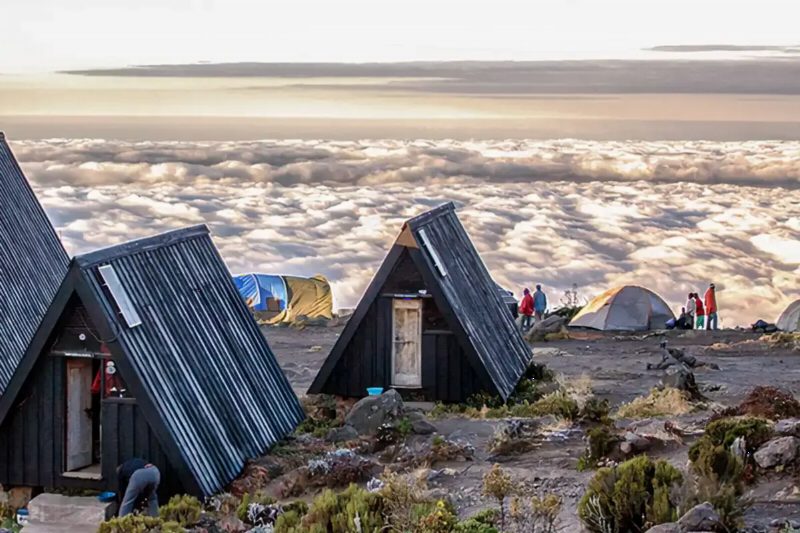
Wooden A-frame huts on a bare ridge above a sea of cloud.

Our nine-day Northern Circuit

We run this route over nine days, camping the whole way, starting from Londorossi on the western side.

The first three days are the Lemosho approach: the western forest, then two days crossing the Shira Plateau. On the fourth day you climb to Lava Tower at 4,630 m for lunch and drop to Moir Hut at about 4,200 m to sleep, which is the climb-high-sleep-low day that does most of the acclimatisation work.

At Moir Hut the routes part. Everyone else turns south for Barranco. You turn north, and spend three days working round the back of Kibo through Buffalo Camp and Third Cave to School Hut at 4,750 m.

Summit night goes up to Gilman's Point and round the rim to Uhuru Peak, and the descent drops south to Millennium Camp and out by Mweka the next morning.

The climb is quoted on request, because group size and season both change what it costs. Send us your dates and how many of you there are.

Two climbers in red and green jackets on a snowy slope above the clouds.

Northern Circuit or Lemosho?

The two routes share their first three days, so the honest comparison starts after the Shira Plateau.

Lemosho turns south-east at Shira 2 and joins the Machame path. Eight days, one climb-high-sleep-low day at Lava Tower, the Barranco Wall, and the summit from Barafu by Stella Point.

The Northern Circuit turns north instead. Nine days, no wall, a week of walking at around 4,000 m, and the summit from School Hut by Gilman's Point.

The circuit acclimatises you better, because it holds you high for longer. It is also a day longer, costs a day more in park fees, and trades the Barranco Wall and the Lava Tower day for quiet northern slopes.

If you want the best odds and have the time, the circuit wins. If you want the best week for the money, eight-day Lemosho is very close behind it. We run both, so tell us which matters more and we will say which one fits your dates.

Both start with the same drive to Londorossi and the same wild western forest.

A line of trekkers in bright jackets on a stony path, with Kibo's summit rising behind them.

Who it suits

The Northern Circuit suits climbers whose first aim is the summit and who have nine days to give it.

It suits people who have climbed Kilimanjaro before on a standard route and want a different mountain out of the second attempt.

It suits anyone who dislikes crowds enough to pay for quiet, because that is exactly the trade it offers.

It does not suit a tight budget. The fees alone put it above every other route before a camp or a guide is counted.

And it does not suit anyone with under two weeks, once flights, a rest day and the drive to Londorossi are all counted in.

A camp of tents spread across a rocky slope, with Kibo's snow and cloud above.

When to climb the Northern Circuit

January to March and June to October, like the rest of the mountain.

The northern slopes are drier than the south, so the circuit holds up better than Machame or Lemosho in a wet spell. It still crosses the western forest on the first day, and that forest is wet whatever the north is doing.

June to September is the reliable window and the coldest. Nights on the northern camps at 4,000 m and above are hard frosts.

January to March is warmer and quieter and works well.

Nine-day itineraries need booking a long way ahead in the peak months, and full-moon dates go first.

On this route

Northern Circuit climbs we run

Questions about the Northern Circuit route

How long is the Northern Circuit route?
About 98 km over nine days, which makes it the longest route on Kilimanjaro.
Does the Northern Circuit have the highest summit rate?
It has the longest acclimatisation profile on the mountain, and routes with more days do better. Reputable operators give summit rates as ranges, and no route guarantees anything.
Do you run the Northern Circuit?
Yes. We run a nine-day version, camping the whole way, starting from Londorossi and summiting from School Hut. It is quoted on request, because group size and season both change what it costs.
Is the Northern Circuit hard?
The daily walking is the easiest on the mountain, because nine days spread the climb out, and there is no scrambling. Summit night is as hard as it is on every route.
Why does the Northern Circuit cost more?
Park fees are charged per climber per day and are identical for every operator. Nine days costs more than seven or eight before anything else is counted.
Which part of the Northern Circuit is quietest?
The northern traverse between Moir Hut and Third Cave. Very few climbers use that ground, and there are days on it when you meet nobody.
Talk to a safari expert on WhatsApp (opens in a new tab)