Safaris
Kilimanjaro
Destinations
Experiences
Travel guide
About
Contact Call +255 764 006 061 Plan Your Safari
Kilimanjaro · 6 min read

Summit night on Kilimanjaro

You leave camp at midnight, climb for six hours in the cold and dark, reach the roof of Africa at sunrise, and then descend for most of the day. This page describes how it really feels.

Summit night is the day everything else has been leading to, and it is unlike any other day of the climb. You start in the dark, you walk for longer than you have ever walked, and you go higher than most people will ever go. It is hard. People also describe it, afterwards, as the best thing they have ever done.

This page walks through it hour by hour, so that nothing about it comes as a surprise. Knowing what is coming is most of the battle.

Itineraries

Kilimanjaro climbs we run

Compare all routes
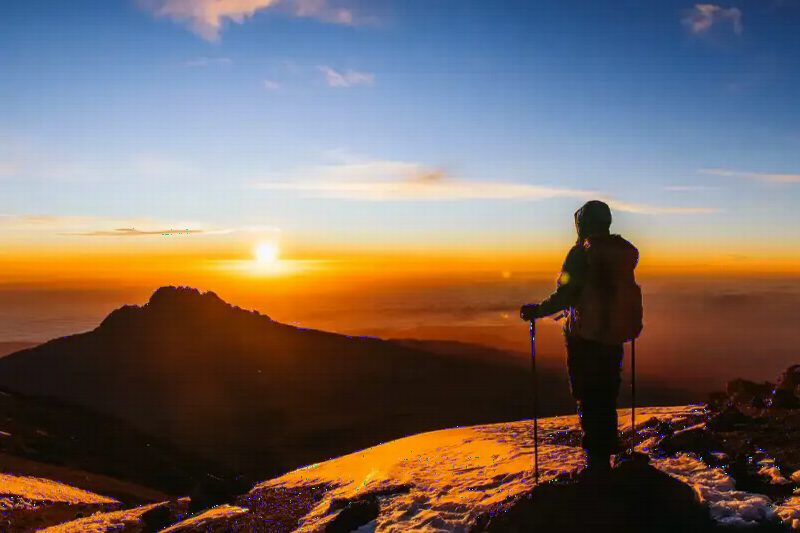
A climber silhouetted against a blazing sunrise high on the mountain, a jagged peak beyond.

At a glance

Start
About midnight, from a high camp at 4,600 to 4,700 metres.
To the crater rim
Five to seven hours of steep, loose scree, in the dark and cold.
Rim to Uhuru Peak
Another one to two hours along the crater edge, at 5,895 metres.
Time at the top
Ten to twenty minutes. It is cold and the air is thin.
Descent
Back to high camp by late morning, then on down to a lower camp by afternoon.
Total
Twelve to sixteen hours on your feet. The longest day of the climb by far.
Climbers walking into a low sun across a snowy summit plateau.

The evening before

You reach your high camp early in the afternoon. Barafu on the southern routes, Kibo Hut on Marangu and Rongai, School Hut on the Northern Circuit. All of them sit around 4,600 to 4,700 metres, on bare rock, with the summit slope in view.

You eat an early dinner, around five, and it is deliberately simple. Your guide briefs you: the timings, what to wear, what to carry, how the night will go. Then you lay out everything for midnight. Every layer, gloves, hat, head torch with fresh batteries, water bottles, snacks in reachable pockets.

You go to bed at about six in the evening, in daylight. Most people sleep little, and that is normal. You are lying down, and resting counts.

Climbers crossing the snowfields near the summit, high above a layer of cloud.

Midnight to the rim

You are woken at about eleven. Tea, biscuits, a last check of the kit. Then you step out into the cold. It is often well below freezing already, and it gets colder.

You walk in a line, guides at the front and back, each person a small pool of torchlight. The pace is very slow, a short step every second or so. That is the right pace. It feels too slow for the first hour and exactly right by the third.

The slope is steep and the ground is loose volcanic scree, so you slide back a little with each step. The guides zigzag to make it bearable. There is nothing to see but the torches ahead of you and the stars above.

Somewhere in the middle of the night the cold and the altitude and the tiredness all arrive at once, and that is the low point. People feel sick, dizzy, or simply empty. The guides know this hour well. They sing, they talk, they check on everyone, and they keep the line moving. You keep putting one foot in front of the other.

After five to seven hours, the slope eases and you come over the crater rim. Stella Point on the southern routes, Gilman's Point on the eastern ones. The sky is getting light. Most people stop here for a few minutes, and many people cry.

A long line of climbers crossing deep snow on Kilimanjaro's upper slopes under a pale, misty sky.

The rim to Uhuru Peak

From the rim it is another hour or two to the true summit, along the edge of the crater on a gentler path. You pass close to the glaciers, which are far bigger and stranger than the photographs suggest, and the sun comes up over the clouds far below.

The air is thinnest here. Every step is slow. But the hardest climbing is behind you, and the summit sign is in view.

Uhuru Peak is 5,895 metres, the highest point in Africa. You take your photographs. You have a few minutes to look. And then your guide moves you on, because it is cold, the air is thin, and staying long at this height does nobody any good.

Climbers in heavy jackets walking across snow near the summit.

The descent

You go back along the rim and then straight down the scree you climbed in the dark. In daylight it looks impossible that you came up it. Going down, you can half-slide on the loose ground, and what took six hours to climb takes about two to descend.

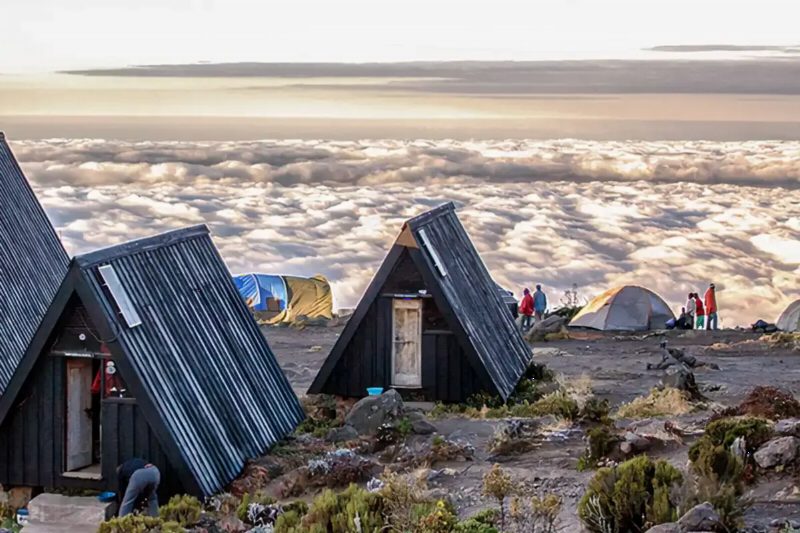
You reach high camp in the late morning. You rest for an hour or two, eat, and pack. Then you walk on down to a lower camp for the night, usually another three to five hours. Mweka Camp on the southern routes, Horombo on Marangu and Rongai.

This is the part people do not expect. Having reached the summit, you still have most of a day's walking ahead of you, on tired legs. Walking poles matter here more than anywhere. So does the knowledge that the lower you get, the better you will feel.

By that evening you are back among vegetation, the air is thick and warm by comparison, and your appetite has come roaring back.

Climbers walking up a snowy ridge toward the summit in the first orange light of dawn.

What to wear and carry

Everything. Summit night is the one time you wear every layer you brought: base layer, fleece, insulated jacket, waterproof shell, warm trousers over your walking trousers, two pairs of gloves, a warm hat and a buff over your face.

Carry as little as possible. Water in bottles, kept inside your jacket so they do not freeze. Bladder tubes freeze solid. A few sweets and a snack bar in a pocket you can reach with gloves on. Your head torch on your head with spare batteries in an inside pocket. Sunglasses and sun cream for the descent, when the sun on the snow is fierce.

Your porters do not come on summit night. Your guides carry the group's emergency kit and oxygen. You carry your own daypack, and it should be light.

Two climbers in red and green jackets on a snowy slope above the clouds.

Turning back

Some people do not reach the summit, and on summit night the reason is almost always altitude. A guide who sees the serious signs will turn a climber around, and an assistant guide will walk them back down to camp. That is not a failure. It is the system working.

If you feel very unwell on the way up, say so. Do not push through confusion, breathlessness at rest, or a headache that is getting worse. Descent is the treatment, and the guides are trained to make that call.

Stella Point and Gilman's Point both count as summits for the certificate, and plenty of people who reach the rim and are struggling choose to turn around there instead of going on to Uhuru. That is a reasonable decision, and it is yours to make with your guide.

Questions

What time does summit night start?
You are woken at about eleven in the evening and leave camp around midnight, from a high camp at about 4,600 to 4,700 metres.
How long does summit night take?
Five to seven hours to the crater rim, another one to two hours to Uhuru Peak, and then a descent that lasts most of the day. Twelve to sixteen hours in total.
Why do you climb at night?
So you reach the summit at sunrise, when the sky is clearest and the views are best, and so the descent happens in daylight. The scree is also firmer when frozen overnight.
How cold is it on summit night?
Often well below freezing before dawn, and colder with wind. You wear every layer you brought. Water bottles freeze unless kept inside your jacket.
Do the porters come to the summit?
No. Your guides walk with you. The porters stay at high camp and prepare for your return and the descent.
What if I cannot make it to Uhuru Peak?
Stella Point and Gilman's Point on the crater rim both count as summits for your certificate. If you are struggling, turning around at the rim with your guide is a reasonable choice.
Keep reading

Other guides

All guides

Still have a question?

Ask us directly — we answer every message ourselves.

Talk to a safari expert on WhatsApp (opens in a new tab)