Rongai Route — 7-Day Kilimanjaro Trek
The only approach from the north, and the…
The Rongai route is the only route that approaches Kilimanjaro from the north, close to the Kenyan…

Machame with the Barranco to Barafu leg split over two days


Seven days is the best way to do the Machame route.
The difference from the six-day version is one extra night. The walk from Barranco to Barafu is split across two days instead of one, which gives you a short, easy day just before you go for the summit.
That matters more than it sounds. Summit day starts around midnight, so you are climbing the hardest part of the mountain on very little sleep. A short day beforehand means you arrive rested, and rested climbers do better.
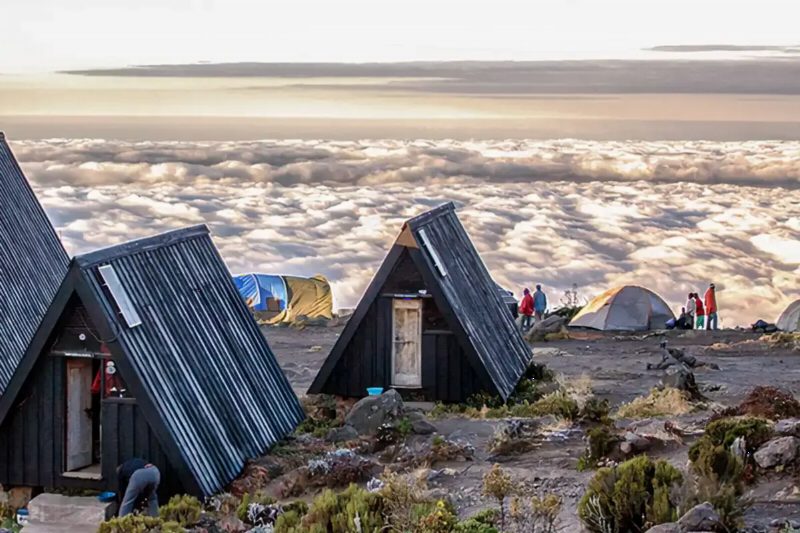
From the Machame gate the trail climbs through thick montane rainforest on the wet southern side of the mountain. Five to seven hours of steady uphill under a closed canopy, on a path that is often muddy and steeper than the Marangu equivalent. Colobus monkeys and a long list of forest birds are around you. The canopy makes them easier to hear than to see. Machame Camp sits at about 3,000 metres at the top edge of the forest. This is a camping route the whole way: a mess tent, sleeping tents, and a crew who arrived ahead of you and set everything up. The evening routine of washing water, tea and a briefing for the next day starts here and repeats every night.
A short, steep day out of the forest and up onto the Shira Plateau. Four to six hours, with rocky sections where you use your hands. The vegetation changes from heather to open alpine moorland as you climb, and the views open out completely. The Shira Plateau is the worn-down remains of Kilimanjaro's oldest cone, a broad high shelf with Kibo standing directly ahead of it. Walking out onto it is the moment the scale of the mountain becomes obvious. Shira Camp sits at about 3,800 metres. Nights are properly cold from here on, and this is usually where people first notice the altitude in their sleep and their breathing.
The Lava Tower day, and the most valuable one on the route for acclimatisation. The path climbs east across the plateau to Lava Tower at about 4,600 metres, where you stop for lunch, and then drops to Barranco Camp at about 3,900. That climb-high, sleep-low pattern is the single most effective thing this route does for your chances on summit night, and it is why Machame does so much better than the five-day Marangu schedule. Feeling poor at Lava Tower and noticeably better at Barranco is the normal pattern, and the intended one. Barranco Camp sits directly beneath the Barranco Wall, with the Southern Icefields hanging above it. Many people call it the finest campsite on Kilimanjaro.
A shorter day, and the reason to choose seven days over six. It starts with the Barranco Wall, a 250-metre face that looks unclimbable from camp and is in fact a scramble on a good path. About an hour, hands used but no equipment, and the highlight of the route for most people. Beyond the wall the path drops into the Karanga valley and climbs the far side to Karanga Camp at about 3,950 metres. Four to five hours in total, arriving early enough for a proper afternoon of rest at altitude. That rest is not idleness. The extra day buys you exactly that, and it shows on summit night in how much you have left.
A short day up to Barafu Camp at about 4,600 metres. Three to four hours across alpine desert, where the vegetation shrinks to lichen and then to nothing at all. Barafu means ice in Swahili, and the camp deserves the name. It sits on an exposed rocky ridge with no shelter, and the wind comes across it hard. You arrive around lunchtime, and that is deliberate. The afternoon and evening are for eating, drinking, sorting your summit kit and sleeping from about seven. Lay out everything you will need in the dark before you lie down. Finding it at eleven at night, in the cold, at 4,600 metres, is genuinely difficult.
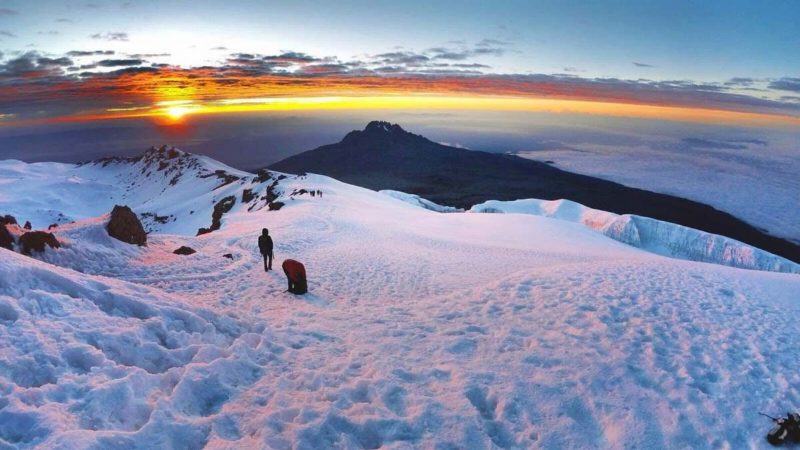
Summit night. Up around eleven, walking by midnight, climbing scree and rock by head torch toward Stella Point at about 5,750 metres. Six or seven hours of the hardest walking most people ever do. Cold that gets into everything, air with about half the oxygen of sea level, and a pace that comes down to one slow step and one deliberate breath. From Stella Point the crater rim rises gently to Uhuru Peak at 5,895 metres, about forty-five minutes more, and you usually arrive close to sunrise with the glaciers alongside. Then the long way down. Scree back to Barafu, food and a short rest, and on to Mweka Hut at about 3,100 metres.
The final descent from Mweka Hut to the Mweka gate. Three to four hours down through heather and back into rainforest. It is steep in places and slippery in others, and your legs have nothing left after summit day, so poles matter. In return, the oxygen comes back. Over those hours it is a physical sensation, and people remember it as clearly as the summit. Certificates are handed out at the gate, gold for Uhuru Peak and green for Stella Point. The drive to Moshi takes under an hour. The tipping ceremony with the crew happens at the last camp or at the gate. Have the cash counted and separated in advance.

Seven-day Machame is the default recommendation for a first Kilimanjaro climb, and it earns that position. The acclimatisation profile is genuinely good, the scenery is varied in a way Marangu's isn't, and the extra night at Karanga puts you at Barafu with something in reserve.
The route climbs the southern flank through rainforest, comes out onto the Shira Plateau, crosses to Lava Tower at around 4,600 metres and drops to Barranco at around 3,900. That is the classic climb-high-sleep-low day. It then takes the Barranco Wall, crosses the Karanga valley, and approaches the summit from Barafu.
It suits first-time high-altitude climbers, anyone who wants the best balance of cost, days and odds, and anyone who wants to see more of the mountain than an up-and-down route allows.
It isn't the quietest route. Machame carries more traffic than any other line except Marangu, and in the July-to-October season the camps are busy. If solitude matters more to you than familiarity, Rongai or Lemosho are the alternatives.
It is a camping route throughout, and the Barranco Wall involves an hour of scrambling with hands. No ropes, no technical skill, but not for anyone genuinely afraid of exposure.
Altitude decides who reaches Uhuru Peak, not fitness. Marathon runners fail on short schedules. Ordinary, reasonably fit people in their sixties reach the top comfortably on long ones. The thing that matters is how many nights you spend going up.
Walk slowly. "Pole pole" is not a local pleasantry. It is the method. A pace that feels absurdly slow at 3,000 metres is the pace that keeps you walking at 5,500. When your guide walks more slowly than you want, your guide is doing the job properly.
Drink three to four litres a day, on purpose, whether or not you feel thirsty. Being dehydrated looks exactly like altitude sickness, and it makes real altitude sickness worse.
The warning signs are headache, nausea, dizziness, loss of appetite and breathlessness while resting. Tell your guide straight away. Do not push through quietly. Guides are trained to judge this, and they cannot judge what you hide. Going down is the only reliable treatment, and turning back is a decision, not a failure.
Talk to your own doctor about any medication, including acetazolamide, well before you travel. That is not a conversation for a guide, and it is not one to have on the mountain.

A Kilimanjaro climb is carried by a crew several times larger than the climbing party. You will have guides, assistant guides, a cook and porters, and every day they move camp, water and food up the mountain ahead of you.
TANAPA sets the park fees. They are charged per person per day and they are the biggest single part of what any climb costs. They are also identical for every operator. Quotes differ only in what is left after the fees, and that money pays the crew.
So if a quote is dramatically cheaper than the others, somebody is paying for that. On this mountain it is usually the porters, through lower wages, heavier loads, or simply fewer of them. It shows on the trail. Know that before you choose on price alone.
Tipping is customary here, and it is a real part of what the crew earns, not a bonus. Guideline totals are usually discussed at your briefing. Bring the cash in small notes, because there is no cash machine on the mountain and none at the gate.
Weigh your own daypack honestly. A porter carrying your camera bag on top of their own load is the difference between a hard day and an unreasonable one.
The only approach from the north, and the…
The Rongai route is the only route that approaches Kilimanjaro from the north, close to the Kenyan…
The shortest Machame itinerary, camping…
Six days on the Machame route, camping throughout. The shortest Machame itinerary, with a steeper daily…
Marangu with an extra acclimatisation day at…
The Marangu route is one of the most popular routes to the summit of Kilimanjaro.
The most scenic approach, with the longest…
Eight days on the Lemosho route, starting in rainforest on the mountain's western side, with the longest…
The hut-based route, with an arrival day in…
Known as the “Coca-Cola” route, the Marangu route is a classic trek on Mount Kilimanjaro. It is the…
The longest way up, and the best…
Nine days and about 98 km, right round the quiet northern side of Kibo. The longest route on Kilimanjaro…
We will confirm availability, adjust anything you want changed and send a full quote.