Safaris
Kilimanjaro
Destinations
Experiences
Travel guide
About
Contact Call +255 764 006 061 Plan Your Safari
6 days, 5 nights

Marangu Route — 6-Day Kilimanjaro Trek

Marangu with an extra acclimatisation day at Horombo

Trekkers picking their way across dark volcanic rock toward Kibo's snow-streaked summit.
Climbers in heavy jackets walking across snow near the summit.
A camp of tents spread across a rocky slope, with Kibo's snow and cloud above.
Two climbers in red and green jackets on a snowy slope above the clouds.
The sun rising over a rocky ridge above a sea of cloud.
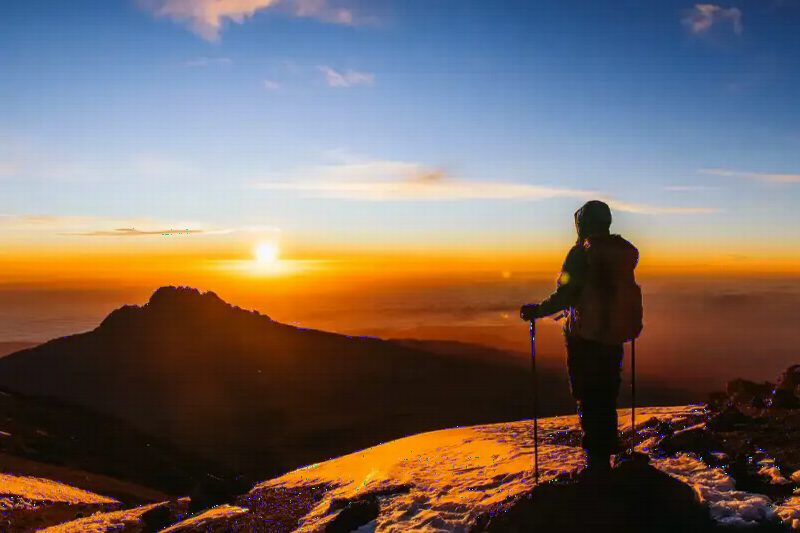
A climber silhouetted against a blazing sunrise high on the mountain, a jagged peak beyond.
Overview

Marangu is one of the most popular ways up Kilimanjaro. It is also the cheapest.

Part of its popularity is that you can do it in five days, which gets you to the summit a day sooner than Machame. That is not usually a good idea. Five days gives your body very little time to get used to the altitude, and fewer people make it to the top.

This is the six-day version. The only difference from the five-day trip is one extra night at Horombo Hut. That single day makes a large difference to your chances.

The other thing that sets Marangu apart is where you sleep. You stay in shared huts the whole way up, not in tents. The camps also sell bottled water, soft drinks, chocolate and beer.

Your team carries all the equipment and supplies, and a cook makes your meals.

Day by day

The itinerary

Marangu Gate to Mandara hut Day 1

From the Marangu gate at 1,860 metres the path goes straight into montane rainforest. The forest is why many people rate Marangu's first day the most beautiful on the mountain. It is closed, wet and green, with colobus monkeys overhead and the trail a muddy track between huge buttressed trees. The slope is gentle and the walking takes four to five hours. The whole difficulty today is discipline. The pace that feels natural at this altitude is roughly twice the pace that will work at 4,000 metres, and getting the habit early matters. Mandara Hut sits in a clearing at the upper edge of the forest. Do the short afternoon walk to Maundi Crater.

Mandara hut to Horombo hut Day 2

The forest gives way to heather and open moorland within half an hour, and on a clear morning Kibo appears ahead for the first time. The day is a long, steady climb over open ground, scattered with giant lobelia and groundsel. These plants grow nowhere else and look like nothing else. Five to six hours of walking and about a thousand metres of height gain bring you to Horombo Hut at 3,700 metres. This is where most people first feel the altitude properly. Headache and breathlessness are common here. Drink more water than feels sensible. Eat even without appetite. And tell your guide how you feel instead of pushing through quietly.

Horombo hut to Acclimatisation day Day 3

This is the acclimatisation day, and it is the whole reason to take six days on Marangu instead of five. You spend a second night at Horombo, but you do not sit still. You walk up toward the Mawenzi ridge, or out to the Zebra Rocks at about 4,000 metres, then come back down to sleep at 3,700. Climbing high and sleeping low is how your body adapts. This one day is the difference between Marangu's poor five-day summit rate and a much better one. It is also a good day in its own right. The Zebra Rocks are striped where mineral-laden water has run down over dark volcanic rock, and they are a genuine curiosity. Walking without a full day's target ahead of you is a rare pleasure on this mountain.

Horombo hut to Kibo hut Day 4

You leave the moorland and cross the saddle between Mawenzi and Kibo. It is a high alpine desert of volcanic rubble and wind, with almost nothing growing, and it is the emptiest and strangest ground on the route. Five to six hours of walking, mostly gently uphill, bring you to Kibo Hut at about 4,700 metres. The air is now thin enough that ordinary things are hard. Unpacking a bag leaves you breathless. Arrive in the early afternoon. Eat what you can, drink steadily, and get into your sleeping bag by early evening. Sleep at this height is broken and shallow for almost everyone, so lying warm and still is the realistic goal, not real rest.

Kibo hut to Uhuru Peak to Horombo hut Day 5

Summit night. You are woken around eleven and start climbing shortly after midnight, up scree in the dark by head torch. The switchbacks up to Gilman's Point at about 5,685 metres take five or six hours, and they are the hardest sustained effort of the trek. Steep, cold, and at a height where every step needs deliberate breathing. From Gilman's Point the crater rim path leads round to Uhuru Peak at 5,895 metres, another hour to ninety minutes, and you arrive close to sunrise. The descent is fast on the same scree, back to Kibo for a rest and food, then on down to Horombo. It is a fourteen to sixteen hour day. It is why the sixth day exists on this route.

Horombo hut to Marangu Gate Day 6

The final descent, from Horombo at 3,700 metres, back down through the moorland and forest to the Marangu gate at 1,860. It takes about six hours and all of it is downhill. It is your knees that suffer, not your lungs. Poles help a great deal. After four days above the treeline, the forest at the end feels almost tropical. Most people physically notice how much more oxygen there is at the gate. Certificates are handed out there, gold for Uhuru and green for Gilman's Point. The drive back to Moshi takes about an hour. Have your tipping money ready, in the right notes, before the ceremony, not during it.

The detail

What's included

Included

  • Kilimanjaro National Park entry and camping/hut fees
  • Rescue fees as required by the park authority
  • Professional mountain guides, cook and porters
  • All meals on the mountain
  • Tents and sleeping mats (camping routes)
  • Transfers to and from the trailhead

Not included

  • International flights and visa fees
  • Travel insurance covering trekking to 6,000 m
  • Personal trekking gear and sleeping bag
  • Tips for guides, cook and porters
  • Accommodation in Arusha or Moshi before and after the climb
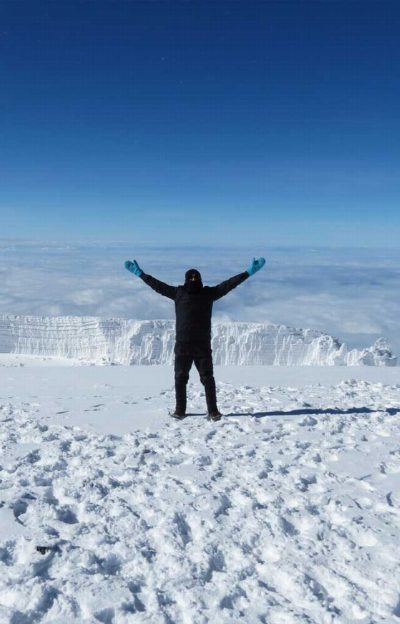
A climber on the summit plateau with both arms raised, a glacier wall behind and cloud to the horizon.
Is this right for you

Why the sixth day changes this route

The six-day Marangu follows the same path as the five-day, with one addition. You get a second night at Horombo Hut at 3,700 metres. You spend that day walking up toward Mawenzi or the Zebra Rocks at about 4,000 metres, then coming back down to sleep.

That single day is the difference between the route with the lowest summit rate on the mountain and one that performs respectably.

Climbing high and sleeping low gets your body used to the altitude, and the five-day Marangu gives you no chance to do it. Adding that day costs you one more day and night of fees, and it gives most climbers a much better chance of standing on Uhuru Peak.

This route suits anyone who wants to sleep in huts instead of camping. Marangu is the only route on the mountain that offers that. It also suits anyone climbing in the wetter months, when a roof and a dining hall matter far more than they sound.

It suits climbers who want a gentler slope too. Marangu is the least steep line up Kilimanjaro and there is no scrambling anywhere on it, which makes it a reasonable choice if the Barranco Wall on the southern routes worries you.

The trade-off is scenery and crowds. You walk the same ground twice, and the huts are the busiest accommodation on the mountain.

Altitude

What actually decides whether you summit

Altitude decides who reaches Uhuru Peak, not fitness. Marathon runners fail on short schedules. Ordinary, reasonably fit people in their sixties reach the top comfortably on long ones. The thing that matters is how many nights you spend going up.

Walk slowly. "Pole pole" is not a local pleasantry. It is the method. A pace that feels absurdly slow at 3,000 metres is the pace that keeps you walking at 5,500. When your guide walks more slowly than you want, your guide is doing the job properly.

Drink three to four litres a day, on purpose, whether or not you feel thirsty. Being dehydrated looks exactly like altitude sickness, and it makes real altitude sickness worse.

The warning signs are headache, nausea, dizziness, loss of appetite and breathlessness while resting. Tell your guide straight away. Do not push through quietly. Guides are trained to judge this, and they cannot judge what you hide. Going down is the only reliable treatment, and turning back is a decision, not a failure.

Talk to your own doctor about any medication, including acetazolamide, well before you travel. That is not a conversation for a guide, and it is not one to have on the mountain.

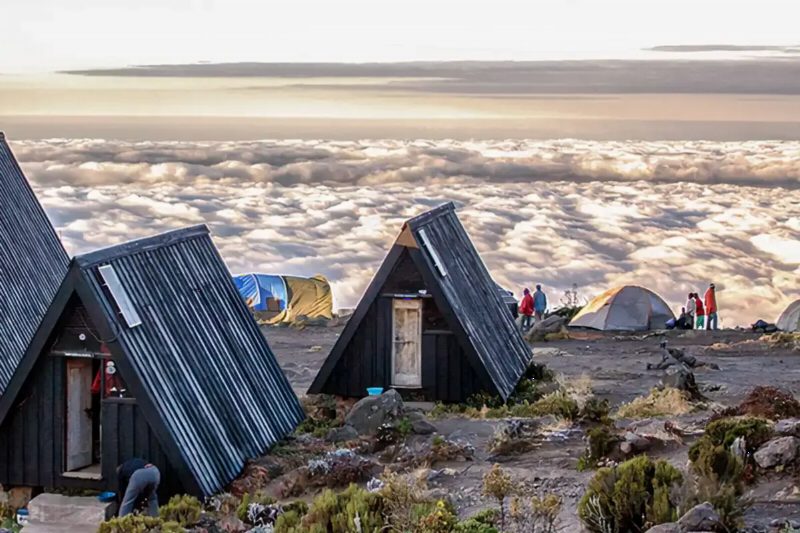
Wooden A-frame huts on a bare ridge above a sea of cloud.
The crew

What your money pays for

A Kilimanjaro climb is carried by a crew several times larger than the climbing party. You will have guides, assistant guides, a cook and porters, and every day they move camp, water and food up the mountain ahead of you.

TANAPA sets the park fees. They are charged per person per day and they are the biggest single part of what any climb costs. They are also identical for every operator. Quotes differ only in what is left after the fees, and that money pays the crew.

So if a quote is dramatically cheaper than the others, somebody is paying for that. On this mountain it is usually the porters, through lower wages, heavier loads, or simply fewer of them. It shows on the trail. Know that before you choose on price alone.

Tipping is customary here, and it is a real part of what the crew earns, not a bonus. Guideline totals are usually discussed at your briefing. Bring the cash in small notes, because there is no cash machine on the mountain and none at the gate.

Weigh your own daypack honestly. A porter carrying your camera bag on top of their own load is the difference between a hard day and an unreasonable one.

Questions

About this trip

What does the extra day on six-day Marangu do?
It adds an acclimatisation day at Horombo Hut. You walk up toward Mawenzi or the Zebra Rocks at about 4,000 metres and come back down to sleep at 3,700. Climbing high and sleeping low is how your body adapts, and it is the single biggest improvement you can make to a Marangu climb.
Is six-day Marangu better than six-day Machame?
They are different trades. Marangu gives you huts, a gentler slope and no scrambling. Machame gives you better acclimatisation and better scenery. If you are a first-time climber worried about camping or exposure, choose Marangu. If you want the best odds at that length, choose Machame.
Are the huts comfortable?
They are dormitory bunks with mattresses in shared rooms, with a communal dining hall. Basic, but dry and warm, which is exactly what you want on a wet mountain.
Do you walk the same path up and down?
Yes. Marangu is the only route that ascends and descends by the same trail, which some people find repetitive and others find reassuring.
Also consider

Other routes up Kilimanjaro

Compare all routes
Ready when you are

Ask us about this trip.

We will confirm availability, adjust anything you want changed and send a full quote.

Talk to a safari expert on WhatsApp (opens in a new tab)