
Arusha National Park
Mount Meru, crater lakes and walking safaris

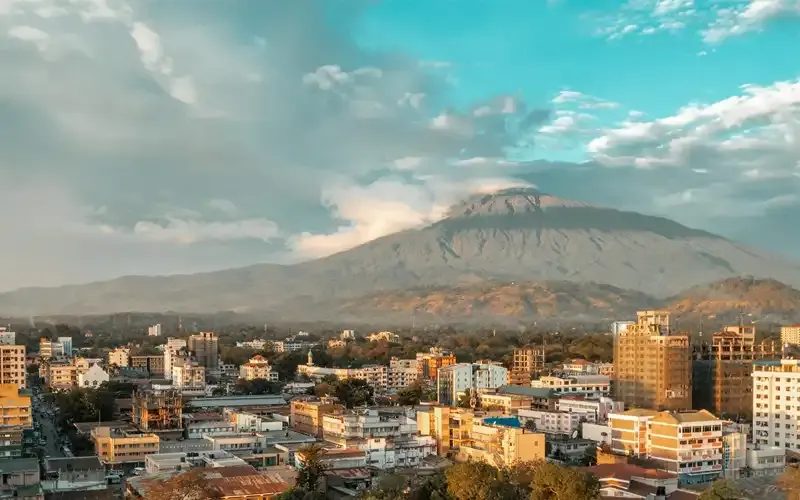


Arusha National Park is the closest park to Arusha town, and the one most people drive past. That is a pity, because it holds several completely different landscapes inside a couple of hours.
The gate opens into montane forest. It is shadowy and loud with birds, and it is the one place on the northern circuit where you can reliably expect to see the black-and-white colobus monkey. Blue monkeys are usually along the road too, along with turacos and trogons. Deeper into the forest is the Ngurdoto Crater, a bowl with steep rocky cliffs and a wide marshy floor. Buffalo and warthog graze down there, watched from the rim.
Further north the ground opens into rolling grassy hills and the Momela Lakes. There are several of them, and each one is a different shade of green or blue. Flamingos turn the shallows pink when the numbers are up, and the lakes hold a long list of resident and migrant waterfowl. Waterbuck stand on the wet edges with their heavy lyre-shaped horns. Giraffe move across the hills between herds of zebra, and dik-dik dart into the scrub in pairs.
There are no lions here, and elephants are uncommon. Leopard and spotted hyena are around. You will only really see them early in the morning or late in the afternoon. Those are also the hours when the cloud on the eastern horizon is most likely to lift and show you Kilimanjaro, only 50 km (30 miles) away.
Mount Meru dominates the park. At 4,566 metres (14,990 feet) it is the fifth highest mountain in Africa, and its peaks and eastern footslopes sit inside the park. It gives you the best views of Kilimanjaro there are, and it is a fine climb in its own right.
The park is also good for forest walks and has plenty of picnic sites. The Meru climb takes three or four days, and it is one of the better ways to acclimatise before Kilimanjaro.
Why visit Arusha
The closest park to Arusha town, and the one most safari itineraries skip. That is a shame on a first or last day, because it packs several distinct landscapes into a small area: montane forest at the entrance gate, the Ngurdoto Crater, the Momela Lakes strung across rolling grassland in different shades of green and blue, and Mount Meru rising behind all of it.
Meru itself is a serious mountain and a three- or four-day climb, widely used as acclimatisation before Kilimanjaro. Walking is permitted in parts of the park, which is unusual on the northern circuit and makes for a genuinely different day out.
Practical notes
Wildlife
Blue monkey, black-and-white colobus, giraffe, buffalo, warthog, bushbuck and waterbuck. Flamingo on the Momela Lakes. Turacos and trogons in the forest. Elephants are uncommon here and lion are absent altogether. Leopard and spotted hyena are present. The absence of big predators makes walking safaris possible.
Getting there
Northeast of Arusha town and the closest park to it, which is why it works as a day trip on an arrival or departure day, not as part of a longer circuit.
Best time to visit
Year-round. Clearest views of Meru June to February.

Three landscapes in one small park
Most visitors drive straight past Arusha National Park, and they are missing something good. The park is small, only 552 square kilometres. But it holds three completely different landscapes, and you can be inside the gate less than an hour after breakfast in town.
The first is Ngurdoto Crater. This is a collapsed volcano with a swampy floor, and you look down into it from a rim road that runs through montane forest. Buffalo and warthog graze far below you. Nobody is allowed to drive down, which is why it stays undisturbed and why it looks a little like a model of itself.
The second is the Momella Lakes. These are shallow alkaline lakes, and each one is a different shade of green or blue. The colours come from the minerals and algae in each lake. Flamingos feed in the shallows. This is also where the park's canoeing happens, and it is one of very few places in northern Tanzania where you can be on the water among wildlife instead of in a vehicle.
The third is Mount Meru. At 4,566 metres it is the second highest mountain in Tanzania and the fifth highest in Africa, and it rises straight out of the park. Its lower slopes are thick montane forest, home to black-and-white colobus monkeys, blue monkeys and a long list of forest birds. The upper mountain is a serious multi-day climb.
There are no lions in the park. That is exactly why you are allowed to walk and canoe here.

The best first or last day of a trip
There are two days on a safari that normally go to waste: the day you arrive and the day before you fly home. Arusha National Park is unusually good at filling both.
Most international flights land at Kilimanjaro International in the evening, and most leave late at night. That leaves you a first morning and a final day with nothing much in them. The park gate is about 40 kilometres from Arusha town and about 60 from the airport, so a half day fits into either slot without putting your flight at risk.
It is also a better first game drive than the bigger parks. The animals are plentiful and close: giraffe, zebra, buffalo, bushbuck, waterbuck, warthog and colobus. The drives are short. And nobody feels short-changed about not seeing a lion, because there are no lions here to miss. If you have just come off a long flight, you get a genuinely good day without the six hours of driving that Tarangire or Manyara involve.
If you are climbing Kilimanjaro, a day here first is the standard advice, for a different reason. The Momella gate sits at about 1,500 metres, and a walk on Meru's lower slopes is a useful, gentle first taste of altitude before the real climb.
Walking safaris with an armed ranger, canoeing on the Momella Lakes and the Meru trek all have to be arranged in advance. You cannot ask for them at the gate.

Far fewer people climb Meru than Kilimanjaro, and most who have done both say Meru is the better walk.
The normal route takes three or four days. You start at the Momella gate, climb to the summit at Socialist Peak and come back down. You sleep in mountain huts at Miriakamba and Saddle, not in tents.
An armed ranger has to come with you for the whole trek, because there are buffalo and elephant in the lower forest. This is not a formality. The first few hours of day one really are a walking safari, and you will often see giraffe and colobus monkeys from the path.
Summit day is the hard part. You leave Saddle Hut at about two in the morning and follow a narrow ridge, which is the rim of Meru's own collapsed crater. There is a big drop on one side. You reach the top for sunrise, with Kilimanjaro floating above the cloud to the east.
That ridge is more exposed than anything on Kilimanjaro's normal routes. If you are uneasy with heights, this is not the mountain for you.
People often climb Meru to get used to the altitude before Kilimanjaro, and that makes good sense. It is 4,566 metres, it takes three or four days, and it is real altitude. Leave a rest day between the two. Also be honest with yourself about doing the harder summit night first.
April and May are the rainy months, and they make the ridge unpleasant and sometimes dangerous. June to February is the practical window.
Visiting Arusha
Are there lions in Arusha National Park?
Is Arusha National Park worth a visit?
How far is it from Arusha town and the airport?
Can you walk in Arusha National Park?
How hard is climbing Mount Meru?
Want Arusha in your trip?
Tell us how long you have and we will build an itinerary around it.