Safaris
Kilimanjaro
Destinations
Experiences
Travel guide
About
Contact Call +255 764 006 061 Plan Your Safari
Kilimanjaro · 5 min read

Altitude sickness on Kilimanjaro

Altitude sickness is why people turn back on Kilimanjaro. This page explains what it is, what it feels like, how to lower your risk, and when to go down.

Altitude sickness is the single biggest reason climbers do not reach the top of Kilimanjaro. It is not about fitness. It happens because the air above 2,500 metres holds less oxygen, and your body needs time to adjust. Go up too fast and it cannot keep up.

This page explains what altitude sickness is, what it feels like, what reduces the risk, and the one rule that keeps people safe. It is general information about a well-understood condition. It is not medical advice. Talk to your own doctor before you travel, especially about any medication and any existing condition.

Itineraries

Kilimanjaro climbs we run

Compare all routes
Trekkers crossing high, bare desert on the mountain, with a dusty ridge behind them.

At a glance

What it is
Your body reacting to less oxygen at height. Called AMS, for acute mountain sickness.
Who gets it
Anyone. Fitness, age and experience make little difference.
When it starts
Usually above 2,500 to 3,000 metres. On Kilimanjaro, often from the second or third night.
Common signs
Headache, feeling sick, dizziness, poor sleep, no appetite, tiredness.
Serious signs
Confusion, staggering, breathlessness at rest, a cough with frothy spit. These need descent now.
The only sure cure
Going down.
Trekkers picking their way across dark volcanic rock toward Kibo's snow-streaked summit.

What it feels like

Mild altitude sickness feels like a bad hangover. You get a headache, often in the evening at camp. You feel sick and you do not want to eat. You sleep badly and wake up often. You feel tired and a little dizzy, and you are out of breath on slopes that would be nothing at home.

Most people on Kilimanjaro get some of this. It is normal, and on its own it is not dangerous. It must not get worse as you go higher. If you rest, drink and walk slowly and the symptoms stay mild or ease, you can usually carry on.

If they get worse, that is your body telling you it has not adjusted, and going higher will make it worse still.

Trekkers walking a path through low heath toward Kilimanjaro's long summit ridge.

The serious forms

Two rarer conditions can develop from altitude sickness, and both are dangerous.

One affects the lungs. Fluid builds up and you become breathless even when resting, with a cough that may bring up frothy or pink spit. You may hear a crackling sound when you breathe.

The other affects the brain. You become confused, clumsy, or unable to walk in a straight line. You may behave oddly or be very drowsy. Someone with this often does not realise anything is wrong, which is why the people around them need to know the signs.

Both of these need immediate descent, and both are emergencies. Guides are trained to spot them, and this is one reason you should never hide symptoms or wander off from your group.

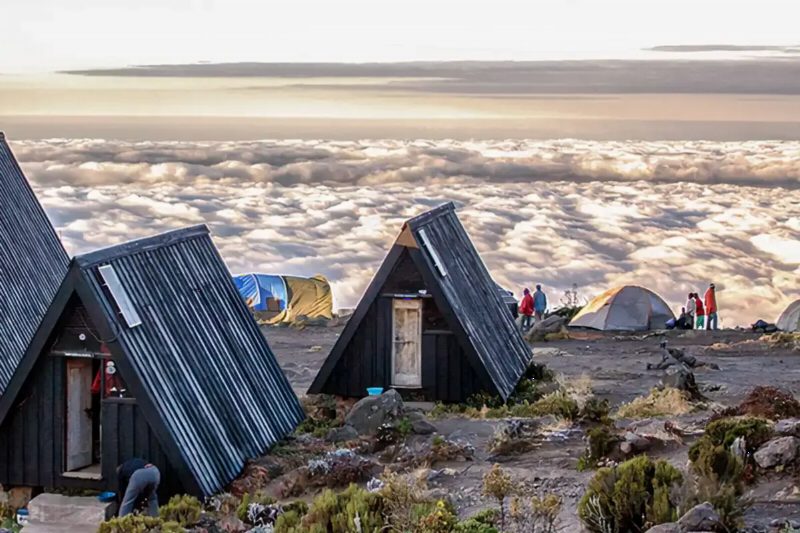
Orange tents pitched on a rocky shelf below Kibo, with cloud drifting across the mountain's flank.

What reduces the risk

Days. Take the longest version of your route that you can afford. Every extra night is a night your body uses to adjust, and nothing else works as well. Five-day climbs have the most altitude problems. Eight and nine-day climbs have the fewest.

Pace. Walk slowly, all the time, even when you feel fine. The guides set a pace that feels far too slow on the first days. Trust it.

Water. Drink three to four litres a day. Being dehydrated makes altitude symptoms worse and feels like them, so you cannot tell the two apart.

Food. Keep eating even when you do not want to. Your body is working hard and needs the fuel.

Climb high, sleep low. Routes that take you up during the day and back down to sleep help you adjust faster. Machame and Lemosho are built around this.

No alcohol, and no sleeping tablets, on the mountain. Both make the problem worse.

Honesty. Tell your guide how you feel, every day, especially at the evening check.

A line of trekkers in bright jackets on a stony path, with Kibo's summit rising behind them.

Medication

Some climbers take a medicine called acetazolamide, often known by a brand name, to help their bodies adjust. It is widely used on Kilimanjaro. It has side effects, it is not suitable for everyone, and it does not replace taking enough days.

Whether to take it is a decision for you and your own doctor, well before you travel. It is not a decision for a guide, and it is not one to make on the mountain. The same is true of any other medication you carry. Tell your doctor exactly where you are going and how high, and follow what they say.

Painkillers can ease a mild headache. They do not treat the cause, and a headache that needs more and more painkillers is a headache you should tell your guide about.

Climbers with heavy packs pausing on rocks high on the mountain.

Sleeping at altitude

Poor sleep is one of the first things people notice at height, and it feeds into everything else.

Above about 3,500 metres most climbers sleep badly. You wake often. You may notice your breathing pause and then restart with a gasp, which is common at altitude and unsettling the first time it happens. You may have vivid dreams. You will probably need to get up in the night, because drinking three or four litres a day has consequences.

None of this is dangerous on its own. But tiredness makes altitude symptoms feel worse, and it makes it harder to tell whether a headache is the altitude or just a bad night.

A few things help. Go to bed warm, with dry clothes on, and keep tomorrow's clothes inside the sleeping bag so they are not freezing in the morning. Use a good sleeping bag rated well below zero, and a proper sleeping mat, because most of the cold comes up from the ground. Keep a pee bottle in the tent if you can bear the idea, so you do not have to go outside at three in the morning at 4,600 metres. Avoid sleeping tablets, which slow your breathing and make the altitude worse.

And accept it. Broken sleep is part of the climb. Most people manage on far less than they think they need, and the tiredness lifts quickly once you start walking.

A group of trekkers with poles and heavy packs walking up a rocky mountain path.

When to go down

The rule on Kilimanjaro is simple. If symptoms are mild, do not go higher until they ease. If symptoms are getting worse, go down. If there are any serious signs, go down immediately, whatever time of day or night it is.

Descending even a few hundred metres often brings fast relief. Guides carry oxygen and a first-aid kit, and on most routes there are emergency descent paths and rescue arrangements through the park. But none of that replaces the simple act of walking down.

Turning back is not a failure. It is the decision that keeps you alive to come back another year with more days. The mountain is not going anywhere.

Questions

Will I get altitude sickness on Kilimanjaro?
Most people get mild symptoms somewhere above 3,500 metres: a headache, poor sleep, less appetite. That is normal. Whether it stays mild depends mostly on how many days your route gives you and how slowly you walk.
Does being fit stop altitude sickness?
No. Fitness makes the walking easier, but it does not help your body adjust to less oxygen. Very fit people on short routes are at more risk than average people on long routes.
Should I take altitude medication?
That is a question for your own doctor, before you travel. Some people use acetazolamide and find it helps. It has side effects and is not right for everyone. It never replaces taking enough days on the mountain.
What are the danger signs?
Breathlessness while resting. A cough that brings up frothy spit. Confusion, clumsiness or an inability to walk straight. Severe headache that painkillers do not touch. Any of these means descend now, and tell your guide at once.
Do guides carry oxygen?
Guides on the standard routes carry emergency oxygen and a first-aid kit, and they do daily health checks. Oxygen is for emergencies during descent. It is not used to push a sick climber higher.
Can I go back up after descending?
If you descend for mild symptoms, rest, and feel better, it is sometimes possible to continue. That is your guide's call. If you descend for serious symptoms, the climb is over for this trip.
Keep reading

Other guides

All guides

Still have a question?

Ask us directly — we answer every message ourselves.

Talk to a safari expert on WhatsApp (opens in a new tab)