Safaris
Kilimanjaro
Destinations
Experiences
Travel guide
About
Contact Call +255 764 006 061 Plan Your Safari
Smaller camps, better siting, more space

Luxury Tanzania Safaris

What the premium actually buys on a Tanzanian safari, and what it doesn't.

Luxury is an overused word in this industry, so it's worth being specific about what it buys in Tanzania, because it isn't what most people expect.

Itineraries

Trips of this kind

All safaris
Tables laid for dinner around a campfire in the bush at dusk, a safari vehicle parked behind.

What you are actually paying for

Location. The best camps are inside the parks, not outside the gate, which means you're on a game drive within minutes of waking instead of driving an hour to get there. In the Serengeti in particular, being inside the park at dawn and dusk is the single biggest difference in what you see.

Fewer guests. Smaller camps mean fewer vehicles leaving in the morning and less chance of arriving at a sighting to find six other cars there.

Space and staff. Larger tents, better food, more people looking after fewer guests.

It doesn't buy different wildlife. The animals don't know what you paid. A camping safari and a luxury one through the same parks in the same week see much the same things. The difference is in comfort, position and how early you can be out.

A guest in a white robe looking through binoculars over a breakfast table laid with fruit and juice.

Where to spend

If the budget is finite, the general advice is to spend it on the Serengeti nights instead of spreading it evenly. A well-sited Serengeti camp changes the trip more than an upgrade at Manyara.

A table set for dinner beside a campfire in the bush.

Mobile camps

During the migration, some of the best options are mobile camps that move with the herds through the year. They aren't permanent structures and they aren't cheap, but being able to sleep where the wildebeest actually are, instead of driving to them, is a real advantage.

A couple standing on lamplit rocks at dusk beside a table set for dinner, the bush dark below.

Itineraries

The longer trips below suit this tier best, because a luxury upgrade on a four-day trip spends a large part of the premium on nights you're barely awake for.

An outdoor bed under a white mosquito net on a wooden deck, hung with glowing lanterns at dusk.
What it means

What the money actually buys

At the top of the market the differences aren't really about thread count, and it helps to know what you're actually paying for.

Siting is the main one. The best camps hold concessions or positions inside the parks that put you on a game drive within minutes of waking, in areas with fewer vehicles. On a trip where the first hour after dawn is the best hour, that's worth more than any amount of interior decoration.

Space is the second. Fewer tents means fewer people at breakfast, fewer vehicles from the same camp on the same track, and a guide who isn't managing a group.

Guiding is the third, and the least visible in a brochure. The difference between a good guide and an exceptional one is the difference between finding animals and understanding what they're doing.

You don't get a change in the rules. Off-road driving is still prohibited in the Serengeti, the crater floor is still a six-hour visit, and the tracks are still public.

Mobile camps that move with the migration are usually the better luxury choice over permanent lodges, because being in the right place beats being in a nicer building in the wrong one.

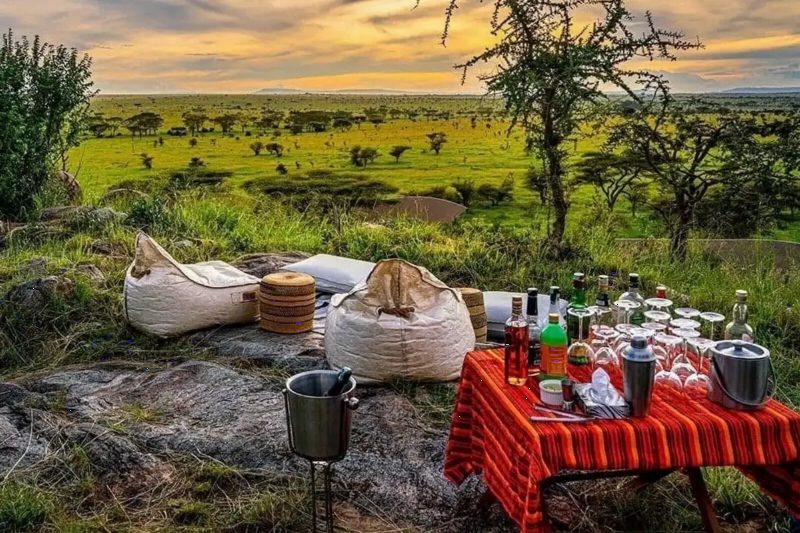
A bush picnic laid on a red cloth on the grass, with a wine cooler and cushions under the trees.
Planning

Where to spend the upgrade, and where not to

If the budget will stretch some of the way but not all of it, spend the upgrade unevenly, not evenly.

Spend it in the Serengeti. This is where you'll spend the most nights, where camp position most affects your game viewing, and where the gap between a mid-range lodge on the park edge and a well-sited camp inside it's largest.

Spend it on a mobile camp in the migration months. Being where the herds are is the whole product, and a permanent lodge can't follow them.

Spend less on the crater rim. The crater day is dictated by the gate and the six-hour rule regardless of where you slept, and rim lodges are expensive for what they're. A comfortable place in Karatu, forty minutes below, costs much less and changes almost nothing.

Spend less on the first and last nights in Arusha. They are transit nights and you'll be asleep for most of them.

And consider fewer days at a higher standard instead of more days at a lower one. Eight good days generally beat ten adequate ones, particularly if the alternative involves long transfers.

Reality check

What luxury cannot fix

No standard of camp changes the drive. Northern-circuit roads are corrugated murram and a transfer between parks is three or four hours of it regardless of what you're paying. The genuine fix is flying a leg, not a better vehicle.

No camp changes the animals. Sightings aren't for sale, and an expensive trip in the wrong month sees less than a modest one in the right month.

Power is limited almost everywhere inside the parks. Solar, limited charging hours, and no hair dryer, at any price point.

Mobile signal is patchy and mostly absent away from Seronera. Camps that advertise wifi generally mean a satellite connection in the main tent, which is slow and shared.

And the crater rim is cold at 2,300 metres whatever you paid. Several of the more expensive rim lodges have very little heating.

Luxury does deliver reliably on space, position, food and guiding. Those are real, and on a once-in-a-lifetime trip they're usually where the money should go.

Guests on a lodge terrace with sofas and lanterns, looking out across a green valley at dusk.
Planning

Booking windows and what fills first

The best-sited camps are small, and small camps fill early. This is the practical constraint that catches people out at the top of the market more than budget does.

Mobile camps in the northern Serengeti for August and September fill twelve months ahead, and so do the Ndutu camps for February. If your dates are fixed and you are travelling for those seasons, book roughly a year out.

Christmas and New Year fill early everywhere on the circuit, and the rates over that fortnight are the highest of the year.

June and July fill next. April, May and November have availability much later and are where the value is.

Balloon flights over the Serengeti have limited capacity and sell out in the high season. Book at the same time as the camps, not on arrival.

If your dates are flexible, ask what's available before deciding the route. A slightly different week can be the difference between the camp you want and a compromise, and on a trip at this price the camp position matters more than most other variables.

A four-poster bed on a raised wooden deck under a thatched frame, open to the bush beyond.
Planning

A shape that uses the budget well

If the budget is genuinely open, the trip that gets the most out of it isn't the one with the most expensive camps in it. It's the one built around position and time.

Fly the long legs. Replacing the drive from Arusha to the Serengeti, or from the centre to the far north, with a short flight buys back whole days of game viewing. On a two-week trip this beats any upgrade in accommodation.

Stay inside the parks, in small camps, in the region the animals are actually in for your dates. Mobile camps that move with the migration beat permanent lodges in the wrong place.

Give each place three nights, not two. The third night is when you stop orienting and start seeing.

Add the things a normal itinerary skips: a balloon flight over the Serengeti, a walking day in the far north, an Empakaai descent, a full day at Ndutu with off-road permission.

And spend on the guide. A private guide who travels with you for the whole trip, instead of a different camp guide each time, is the least visible and most valuable upgrade available.

A couple embracing in silhouette against an orange sunset over water.

What to ask before paying the premium

The gap between two expensive camps is usually not the thing the brochure is selling.

Ask how far the camp is from the gate, and how long the drive to the good ground takes in the morning. Ask how many tents there are, and how many vehicles go out at once. Ask whether the vehicle is yours or shared, and whether the guide stays with you for the whole trip or changes at each camp.

Those four answers explain most of the difference in what a week actually feels like. The furniture and the wine list rarely do.

Questions

Common questions

What does a luxury safari actually get you?
Camp siting inside the parks, fewer tents and fewer people, and better guiding. Those three things change your actual game viewing. Interiors change how the photographs look.
Is a luxury camp worth it on the crater rim?
Less than elsewhere. The crater day is governed by the gate and the six-hour rule regardless of where you slept, and rim lodges charge a premium for the view. Karatu, forty minutes below, costs much less and changes almost nothing.
Do expensive camps get off-road access?
No. Off-road driving is prohibited in the Serengeti except in designated areas, for everyone. A well-sited camp buys time, not exemptions.
How far ahead should we book?
Around twelve months for the mobile camps in the north in August and September, or Ndutu in February, and for Christmas and New Year anywhere on the circuit.
What is a mobile camp?
A camp that's put up for a season and struck afterwards, so it can sit where the herds actually are. In the migration months a well-placed mobile camp beats a more comfortable permanent lodge in the wrong region.

Interested in luxury tanzania safaris?

Tell us your dates and we will put something together.

Talk to a safari expert on WhatsApp (opens in a new tab)