Safaris
Kilimanjaro
Destinations
Experiences
Travel guide
About
Contact Call +255 764 006 061 Plan Your Safari
Kilimanjaro · 6 min read

Porters, guides and tipping on Kilimanjaro

A Kilimanjaro climb is carried by a crew that outnumbers the climbers. Here is who they are, what they do, how they are protected, and how tipping works.

You do not climb Kilimanjaro alone. Behind every group is a crew of guides, assistant guides, a cook and porters, and there are usually three or four of them for every climber. They carry the tents, the food, the water and your duffel bag. They pitch camp ahead of you and take it down behind you. They cook, they check your health, and on summit night they walk beside you.

This page explains who does what, how porters are protected by park rules and by their own association, and how tipping works, because it is a real part of what the crew earns and every climber wants to get it right.

Itineraries

Kilimanjaro climbs we run

Compare all routes
Kilimanjaro's summit seen from the air, rising above a thick layer of cloud.

The crew at a glance

Lead guide
Licensed by the park. Sets the pace, makes the safety decisions, does the daily health checks. Has summited many times.
Assistant guides
One for every two or three climbers. Walk with the group, help on summit night, and take anyone who needs to descend.
Cook
Feeds the climbers and the crew. Carries the kitchen.
Porters
Carry tents, food, water, fuel, and the climbers' duffel bags. The park limits each porter's load to 20 kilograms.
How many
Typically three porters per climber on camping routes, plus a guide for every two or three climbers. A group of four might have fifteen crew.
Tipping
Customary, expected, and a real part of crew income. Given at the end, usually in a short ceremony.
A long line of climbers crossing deep snow on Kilimanjaro's upper slopes under a pale, misty sky.

What porters do

A Kilimanjaro climb works because of the porters. Each one carries a load of up to 20 kilograms on his head or back, plus his own kit. That load is your tent, or the mess tent, or the food, or a water container, or your duffel bag.

They leave camp after you, pass you on the trail, and reach the next camp before you do. When you arrive, your tent is up. In the morning they take it down behind you. They do this every day, at altitude, on the same paths you find hard with a small daypack.

Most porters come from the villages around the mountain. For many it is the main income for their family. A good porter who learns English and takes the training can become an assistant guide and then a lead guide. That is the normal path.

Trekkers walking a path through low heath toward Kilimanjaro's long summit ridge.

How porters are protected

Porters were badly treated on Kilimanjaro for a long time. Overloaded, underpaid, sent up without proper clothing or shelter. That has improved, and the reason is rules that climbers can check.

The park sets a maximum load of 20 kilograms per porter, and loads are weighed at the gate. Porters must have proper footwear and clothing. They must be given shelter and food on the mountain.

The Kilimanjaro Porters Assistance Project, known as KPAP, is an independent organisation that monitors how operators treat their crews: wages, loads, food, shelter and tipping. Operators who meet its standards can be listed as partners. When you compare operators, ask whether they are.

You can help too. Keep your duffel under the weight limit your operator gives you. Do not ask a porter to carry your daypack. And if you see a porter in trainers and a thin jacket at 4,000 metres, ask questions.

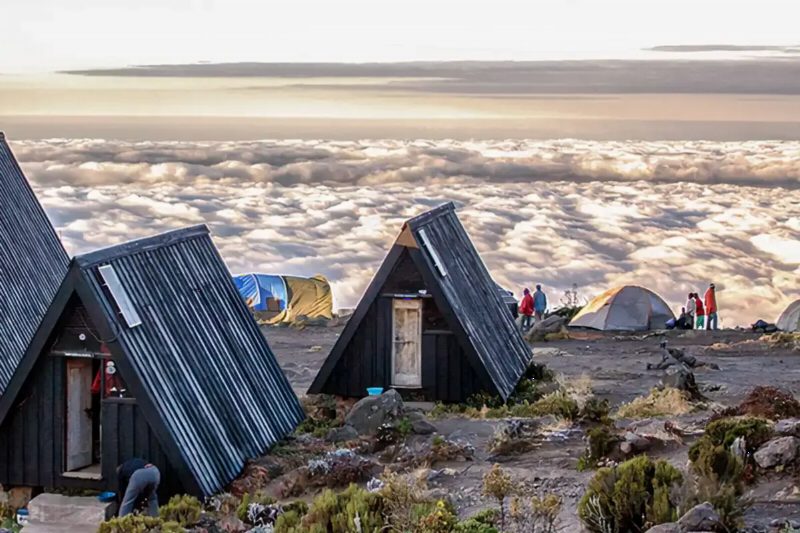
Wooden A-frame huts on a bare ridge above a sea of cloud.

The cheapest climb is usually paid for by the porters

Park fees are set by the authorities and are the same for every operator. They are the largest single part of the cost of any climb. The rest pays the crew, the food and the equipment.

So when one quote is far cheaper than the others, the saving has to come from somewhere. On this mountain it usually comes from the crew: lower wages, heavier loads, fewer porters, worse food and gear. It shows on the trail. Know that before you choose on price alone.

This is not an argument for the most expensive climb. It is an argument for asking what the crew is paid and how many of them there are.

Climbers in heavy jackets walking across snow near the summit.

How tipping works

Tipping is customary on Kilimanjaro and the crew expects it. It is not a bonus for good service. It is a real part of their income, and they budget for it.

Tips are usually given on the last day, at the gate or the last camp, in a short ceremony. The crew sings, the climbers hand over the money, and everyone shakes hands. It is a good moment.

The usual approach is for the group to pool the tips and give one total, split by role: more for the lead guide, then the assistant guides and the cook, then the porters. Your operator will give you a guideline for the amounts at the briefing before the climb. Bring the cash with you in small notes, in US dollars or Tanzanian shillings, because there is no cash machine on the mountain and none at the gate.

If you want to be sure the porters receive their share, you can hand the porters' portion to a porter representative instead of to the lead guide, and say so in front of the group. Good operators are happy with this. Some have a formal system for it.

A line of trekkers in bright jackets on a stony path, with Kibo's summit rising behind them.

What a good guide does

The lead guide is the person who decides whether your climb succeeds, and the difference between a good one and an average one is easy to see once you know what to look for.

A good guide sets a slow pace from the first hour and holds it, even when the group wants to go faster. They stop often. They check that everyone is drinking. They watch how people walk, not just what they say, because the first signs of altitude trouble show in the feet before they show in the face.

A good guide does a proper health check every evening, asks direct questions, and writes the answers down. They know the emergency descent routes on their mountain and they have used them. They carry oxygen and a first-aid kit and know when to use each. They are willing to turn a climber around, and to say so plainly, even when the climber does not want to hear it.

A good guide also makes the climb better. They know the names of the plants and the birds. They tell you what tomorrow looks like before you go to sleep. On summit night they walk beside the slowest person and sing to keep them moving. They know when to talk and when to be quiet.

All lead guides on Kilimanjaro are licensed by the park, and most came up through the ranks as porters and assistant guides over years. When you meet yours at the briefing, ask how many times they have summited and which routes they know best. A good guide is happy to tell you.

A group of trekkers walking through green heath toward Kilimanjaro's snow-capped summit.

Being a good climber to your crew

Learn their names. It sounds small and it matters.

Keep your duffel light. The limit your operator gives you exists to protect the porter carrying it.

Say thank you at camp, and mean it. The person who put your tent up walked past you carrying it.

Do not give away kit you will need. But if you have good gear you will not use again, giving it to your crew at the end is welcome, and often more useful than money.

Ask about them. Where they are from, how many times they have been up, what they do in the off season. The crew are the mountain's real experts, and most climbers never find that out.

Questions

How many porters will I have?
Usually about three per climber on the camping routes, plus a guide for every two or three climbers and a cook. A group of four might have fifteen crew in total.
How much should I tip on Kilimanjaro?
Your operator will give you a guideline at the briefing, split by role: lead guide, assistant guides, cook, porters. Bring the cash in small notes. There is no cash machine on the mountain or at the gate.
What is KPAP?
The Kilimanjaro Porters Assistance Project, an independent organisation that monitors porter treatment: wages, loads, food, shelter and tipping. Operators that meet its standards can be listed as partners. Ask about it.
How much can a porter carry?
The park limit is 20 kilograms per porter, weighed at the gate, plus their own kit. Keeping your own duffel under the limit your operator sets is part of respecting that.
Can I give my crew clothing or equipment?
Yes, and it is often more useful than money. Good boots, jackets, gloves and head torches are always welcome at the end of a climb. Do not give away anything you still need on the mountain.
Will my porter carry my daypack?
No. You carry your own daypack with water, snacks and layers. The porters carry everything else. Asking a porter to take your daypack adds to a load that is already at the limit.
Keep reading

Other guides

All guides

Still have a question?

Ask us directly — we answer every message ourselves.

Talk to a safari expert on WhatsApp (opens in a new tab)