Safaris
Kilimanjaro
Destinations
Experiences
Travel guide
About
Contact Call +255 764 006 061 Plan Your Safari
Kilimanjaro · 5 min read

The Barranco Wall and Lava Tower

Two landmarks on the southern routes that every climber asks about. One is a scramble with your hands. The other is the day that gets you ready for the summit.

If you climb Machame, Lemosho or Umbwe, two names come up before you go: Lava Tower and the Barranco Wall. Lava Tower is a rock formation at about 4,600 metres that the route climbs to and then descends from, on the same day, for the sake of your acclimatisation. The Barranco Wall is a steep rock face the next morning that you climb with your hands.

Both sound worse than they are. This page explains what each one is, why the route goes that way, and what the day is like.

Itineraries

Kilimanjaro climbs we run

Compare all routes
Two climbers in bright jackets scrambling up a steep rock face.

At a glance

Lava Tower
A volcanic plug at about 4,600 metres. The high point of the day before Barranco. You climb to it and then descend 700 metres to camp.
Why
Climb high, sleep low. The single most useful acclimatisation day on the route.
Barranco Wall
A rock face of about 250 metres above Barranco Camp, at around 3,900 to 4,200 metres. Climbed the next morning.
Difficulty
A scramble, using your hands. No rope, no equipment, no technical skill. Ninety minutes to two hours.
Exposure
Some. Enough to notice, not enough to need protection.
The reward
The view from the top, and one of the best hours on the mountain.
Trekkers crossing high, bare desert on the mountain, with a dusty ridge behind them.

Lava Tower day

On Machame it is the third day, on Lemosho the fourth or fifth. You leave Shira Camp at about 3,800 metres and walk east across the plateau toward Kibo, rising steadily through alpine desert to Lava Tower at about 4,600 metres.

Lava Tower itself is a tall plug of dark rock, the remains of a vent from an old eruption. You reach it around midday, have lunch at its base, and feel the altitude. A headache at Lava Tower is normal. Most people are quiet over lunch.

Then you turn south and descend. The path drops steeply into the Barranco valley, past the giant groundsels, and reaches Barranco Camp at about 3,900 metres in the mid-afternoon. You have climbed 800 metres and come down 700, and you sleep only a little higher than you woke.

That is the whole idea. Your body has spent hours at 4,600 metres and now gets a night lower down to adapt. By the next morning most people feel better than they did at lunch.

Climbers picking their way up a steep, rocky slope under a cloudy sky.

Why the route does this

The climb-high-sleep-low pattern is the best tool there is for adjusting to altitude without adding days. Lava Tower day is the clearest example on the mountain.

Without it, the route would go from Shira Camp straight along the southern circuit at around 3,900 metres and arrive at the high camp having never been above 4,700. The body would meet the summit slope cold. With it, you have already been to 4,600, felt it, and recovered.

It is also why the southern routes send more people to the summit than Marangu, which has no equivalent day. The extra effort on Lava Tower day pays back on summit night.

Barranco Camp

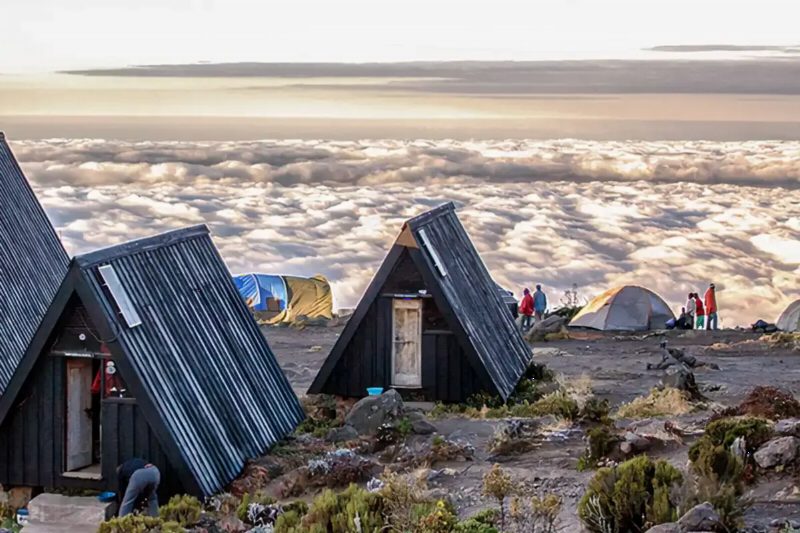
Barranco Camp sits in a valley at about 3,900 metres, under the Barranco Wall, among the giant groundsels that grow nowhere else on earth. Many people name it their favourite camp on the mountain.

From the camp you see the wall you climb in the morning. It looks vertical. It is not, but it is steep, and the first sight of it worries people who have not scrambled before.

The evening here is usually good. You have come down from Lava Tower feeling better, the camp is sheltered, and the sunset on Kibo above the wall is one of the views of the trip.

Climbers scrambling up a steep rock step, using their hands and poles.

Climbing the Barranco Wall

The wall is about 250 metres high and the path up it takes ninety minutes to two hours. It is a scramble: a steep, rocky trail with sections where you use your hands to pull up or steady yourself. There is no rope and no equipment. Porters go up it with loads on their heads.

The route zigzags and there are a few short exposed moves, the best known being a spot where you hug a rock and step around it with a drop below. It is called the Kissing Rock. It looks dramatic in photographs and takes about three seconds.

Go slowly, keep your poles stowed so both hands are free, and follow the guide's line exactly. In the busy months there is a queue, and the guides manage it. If you are uneasy with heights, say so beforehand and your guide will stay close.

At the top the ground levels out onto a shelf at about 4,200 metres with a wide view south over the clouds. Most people stop, look back down at what they just climbed, and feel very pleased with themselves.

After the wall

From the top of the wall the route continues east along the southern circuit, dipping into the Karanga valley and up the other side. On the seven-day Machame and eight-day Lemosho schedules you stop at Karanga Camp, a short day that leaves you fresher for what follows. On the six-day schedule you carry on to Barafu the same afternoon, which is a long and tiring day.

Either way, the wall is done by mid-morning, and it is usually the part of the climb people talk about most afterwards. Not because it was hard, but because it was the one place on the whole mountain where the walk turned, briefly, into something that felt like climbing.

A group of trekkers with poles and heavy packs walking up a rocky mountain path.

If it worries you

The Barranco Wall stops nobody who can walk the rest of the route. Thousands of first-timers go up it every year, including people who describe themselves as bad with heights, and almost all of them say afterwards it was easier than they feared.

If it genuinely troubles you, the Rongai and Marangu routes avoid it completely. They have other trade-offs, covered on the routes page. But most people who worry about the wall in advance are glad, afterwards, that they did not let it decide their route.

Questions

Is the Barranco Wall dangerous?
No. It is a steep scramble of about 250 metres where you use your hands, with a few short exposed spots. There is no rope or equipment, and thousands of first-timers climb it every year. Go slowly and follow the guide.
How long does the Barranco Wall take?
Ninety minutes to two hours, in the morning after Barranco Camp. Longer in busy months when there is a queue.
What is Lava Tower?
A tall plug of volcanic rock at about 4,600 metres on the southern routes. You climb to it for lunch and then descend 700 metres to Barranco Camp, which is the climb-high-sleep-low day that helps you adjust to altitude.
Do I need to be a climber for the Barranco Wall?
No. It is scrambling, not climbing. You use your hands for balance and to pull up on a few rocks. No technical skill is needed.
Which routes avoid the Barranco Wall?
Marangu and Rongai. They climb the eastern side and never reach the wall. Machame, Lemosho, Umbwe and the Northern Circuit all include it.
Why do you go up to Lava Tower and then back down?
To help your body adjust. Spending hours at 4,600 metres and then sleeping at 3,900 is the most effective acclimatisation pattern there is, and it is why the southern routes have better summit rates than Marangu.
Keep reading

Other guides

All guides

Still have a question?

Ask us directly — we answer every message ourselves.

Talk to a safari expert on WhatsApp (opens in a new tab)