Safaris
Kilimanjaro
Destinations
Experiences
Travel guide
About
Contact Call +255 764 006 061 Plan Your Safari
Travel Advice · · 7 min read

What to Pack for a Tanzania Safari

The short version: layers, soft bag, binoculars, and less than you think.

Last updated

Most packing lists for Africa are too long. These are the things that actually matter on a northern circuit safari.

The thing people get wrong

Temperature. Visitors picture uniform heat and pack for it, then spend the Ngorongoro Crater rim genuinely cold at night and at dawn. It sits at altitude, and a pre-dawn game drive in an open vehicle is bracing at any time of year.

Pack layers, not warm-weather clothes: a fleece or light down layer, and something windproof. You will be glad of both at six in the morning and won't need them by ten.

Bag

A soft duffel, not a hard suitcase. Vehicle storage is shaped for soft bags, and if any part of your trip involves a light aircraft there will be a weight limit and a strict no-hard-cases rule. Check the limit before you pack if you're flying between parks.

Clothing

  • Neutral colours: khaki, olive, brown, grey. Not for camouflage, but because they show dust less.
  • Long sleeves and long trousers for early mornings and evenings, when mosquitoes are active.
  • A wide-brimmed hat and sunglasses. The equatorial sun is stronger than it feels through a vehicle roof.
  • Comfortable closed shoes. You won't be walking far on most safaris. Trainers are fine unless you're doing a walking day.
  • Avoid dark blue and black if you can. Both are known to attract tsetse flies.

The things that make a real difference

Binoculars, one pair per person. This is the single best thing you can bring and the most commonly under-packed. Sharing one pair between two people is a reliable source of frustration.

A dust-proof bag for camera gear. Dry-season roads are very dusty and changing lenses in an open vehicle is how sensors get dirty.

Power. Camps often run on generators or solar with limited hours. A power bank removes the problem. Tanzania uses UK-style three-pin sockets.

A head torch. Useful in camp, essential if you're camping.

Health and documents

Take proper medical advice on vaccinations and antimalarials well before you travel. That advice should come from a travel clinic or your doctor, not from a safari operator. Bring any prescription medication in its original packaging and enough for the whole trip.

Check your passport's validity and blank pages, and check the current visa requirements for your nationality before you book flights, since these change.

Get travel insurance that covers medical evacuation anywhere in this region.

What to leave behind

Most of your clothes. Laundry is available at many camps and lodges, often same-day, and a week's worth of outfits is unnecessary. Drones are restricted and generally not allowed in the parks without formal authorisation. Don't assume you can fly one.

Itineraries

Safaris we run

All safaris
Two travellers sitting on a rock at sunset with drinks, a red blanket spread beside them.
Clothing

What to wear, and why

Neutral colours: khaki, olive, grey, brown, stone. Not for camouflage, which is irrelevant from a vehicle, but because pale colours show dust less and because tsetse flies are strongly attracted to dark blue and black. Avoid both.

Layers, not bulk. Mornings in an open vehicle at 1,500 metres are genuinely cold from June to August, and by ten in the morning it's hot. A long-sleeved shirt, a fleece and a windproof cover almost every situation. Long sleeves and trousers in the evening also reduce mosquito bites.

A proper sun hat with a brim, not a cap. The sun is equatorial and you're at altitude.

Closed shoes for the vehicle and for any walking. Sandals for camp.

One smart-casual outfit if you're staying anywhere upmarket. Nobody dresses up on safari.

Do not bring camouflage clothing. It is restricted in Tanzania and can cause real problems at borders and checkpoints.

Most camps do laundry, so pack for three or four days, not for the whole trip. The exception is underwear, which many camps won't wash.

A family watching the plains from an open safari vehicle, the sun low behind them.
Kit

The things that change your trip

Binoculars, one pair per person
The single most under-packed item on safari and the one that most changes what you see. Sharing a pair between two people means one of you is always waiting. Eight or ten times magnification is right.
A soft bag rather than a hard suitcase
Essential if any leg is flown. The light-aircraft limit is typically 15 kilograms in a soft bag and it's enforced.
Cash in small denominations
For tips, curio stalls and community fees. Cards aren't usable in the parks.
A power bank that charges from a 12v socket
Camps run on solar with limited charging hours.
Sun cream, lip balm, insect repellent
All harder to buy locally than you would expect.
A head torch
Camps are unlit at night and power is often switched off.
A dust-proof bag for cameras
Dust is the real enemy on the northern circuit.
Any personal medication, in its original packaging, with enough for the whole trip.
Practical

What to leave at home

Camouflage clothing. It is restricted in Tanzania and wearing it can cause genuine problems.

Drones. Prohibited in the national parks for photography, filming or any other purpose, at any size, and confiscation is a real outcome.

Plastic bags. Tanzania banned single-use plastic carrier bags, and they can be taken off you on arrival. Ziplock bags for toiletries are generally tolerated, but keep them to a minimum.

Hair dryers and anything else with a heating element. Camps run on solar and won't power them.

A hard suitcase, if any part of the trip is flown.

More clothing than you need. Most camps do laundry, and the light-aircraft weight limit is real.

Expensive jewellery, which has no use on safari and is one more thing to worry about.

And leave the expectation of connectivity at home too. Mobile coverage is patchy away from the main towns and Seronera, and the camps that advertise wifi generally mean a slow shared satellite connection in the mess tent.

Wildebeest walking in a long line past a safari vehicle on open grassland.
Practical

Packing for internal flights and laundry

Two practical things change a safari packing list more than any decision about clothes.

The first is the luggage limit on light aircraft. If any leg of your trip is flown, and on anything over a week it probably should be, the limit is usually 15 kilograms in a soft bag. It is enforced at the airstrip, not negotiated. A hard suitcase is a genuine problem, because many aircraft holds will not take one. Most people leave a bag at their Arusha hotel and travel with soft luggage for the flying legs. Arrange that in advance.

The second is laundry. Most camps do it, usually the same day, so you can pack for three or four days, not for the whole trip. The usual exception is underwear, which many camps will not wash for cultural reasons. Bring enough.

Between them, those two facts normally halve what people think they need.

Pack anything you cannot replace in your hand luggage: medication, glasses, camera batteries, chargers. A checked bag going astray on a connection is the most common way a trip starts badly.

Safari vehicles trailing dust along a track across a wide, dry plain.
Practical

A short list, if you read nothing else

Binoculars, one pair each. The single most under-packed item and the one that most changes what you see.

A fleece and a windproof. Mornings in an open vehicle at 1,500 metres are cold from June to August, and this surprises almost everybody.

Neutral colours, and specifically not dark blue or black, which attract tsetse flies.

A soft bag if any leg is flown, with a 15-kilogram limit that's enforced, not negotiated.

Cash in small denominations. Cards aren't usable in the parks.

A brimmed sun hat, sun cream and lip balm. Equatorial sun at altitude, in a moving vehicle, doesn't feel as strong as it's.

Insect repellent for dusk, and long sleeves in the evening.

A head torch, and a 12v power bank for the vehicle.

Any medication in original packaging, in your hand luggage.

And leave behind: camouflage clothing, drones, plastic carrier bags and hair dryers. All four are either restricted, prohibited or useless here.

Travellers in an open-roof vehicle watching two elephants a few metres away on dry ground.

Trying it on before you go

Put the whole lot on at home, once, before it goes in the bag.

It sounds unnecessary and it catches a surprising number of problems: the fleece that doesn't fit over the shirt, the trousers that need a belt you didn't pack, the boots that rub once you've walked in them for an hour. All of that is fixable at home and none of it is fixable in Karatu.

Do the same with the daypack. If everything you want with you in the vehicle doesn't fit, better to find out now.

A safari vehicle driving along a dirt track toward the camera, with green hills behind.
In short

If you pack nothing else

Binoculars each, a fleece and windproof for cold mornings, neutral colours that aren't dark blue or black, a soft bag if you're flying any leg, and cash in small denominations.

Leave behind camouflage clothing, drones and plastic carrier bags. All three are restricted or prohibited in Tanzania and all three cause real problems at exactly the wrong moment.

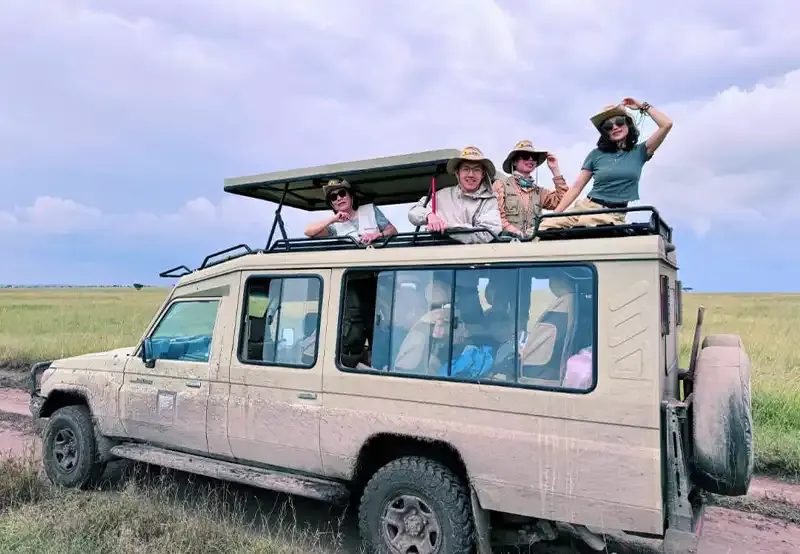
Three travellers standing up through the roof of a safari vehicle, laughing and waving.
One more thing

A note on laundry

Most camps do laundry, usually the same day, which means packing for three or four days, not for the whole trip. The common exception is underwear, which many camps won't wash. Bring enough of that and less of everything else.

More from the journal

Keep reading

All stories

Journal

Altitude on Kilimanjaro

Altitude, not fitness, stops most people. The way acclimatisation is managed on the mountain, and why this article…

Talk to a safari expert on WhatsApp (opens in a new tab)