Safaris
Kilimanjaro
Destinations
Experiences
Travel guide
About
Contact Call +255 764 006 061 Plan Your Safari
Safaris that visit Serengeti National Park

Serengeti National Park safari packages

5 of our itineraries spend time in Serengeti National Park. Every one is private, and every one can be changed.

A safari vehicle parked in long grass as the sun sets red behind flat-topped acacias.

The Serengeti is on almost every itinerary

The Serengeti is the largest park in northern Tanzania and the one most people come for. It covers close to 15,000 square kilometres of grass plains, woodland and rocky kopjes. That size matters. Animals here live in the numbers the land can hold, not the numbers a fence allows.

The wildebeest migration moves through it all year. Around 1.5 million wildebeest and several hundred thousand zebra and gazelle follow the rain in a loose loop around the ecosystem. Wherever they are, the predators are close by. The Serengeti has one of the highest lion densities in Africa, and it is one of the better places to see cheetah and leopard on the same trip.

You do not need the migration to have a good safari here. The resident game in the central Seronera valley is there every month of the year. Rivers, kopjes and permanent water keep lions, elephants, giraffe and buffalo in place whatever the herds are doing.

Every package on this page spends at least one full day inside the park. Most spend two or three. That is our recommendation, and the sections below explain why.

Travellers standing in an open-roof vehicle, photographing elephants a few metres away.

How many days to spend in the Serengeti

Two nights is the minimum that makes sense. One night means you drive in, drive out, and spend most of your time on the road. Two nights give you one full day of game drives from your camp, plus the drives in and out, which are game drives too.

Three nights is the sweet spot for a first visit. You can cover the central valley properly and still have time for a longer drive to wherever the herds are that month.

Four or more nights suit anyone who wants two areas of the park. The Serengeti is big enough that the south, the centre, the west and the north feel like different places. Moving camp once lets you see two of them without long daily drives.

The drive from Arusha to the central Serengeti takes most of a day. The road through Ngorongoro is slow, and the gate at Naabi Hill is a natural stop. Many people break the trip with a night at the crater on the way in or out. The packages above do exactly that.

If your time is short, a flight from Arusha to one of the Serengeti airstrips saves a day each way. Ask us about that when you enquire.

The migration, month by month

Dry Shoulder Green Long rains

January to March

The southern plains and Ndutu. Calving season. Around half a million calves are born in a few weeks, and predators are everywhere.

April to May

The herds start to move north and west. Long rains. Fewer visitors, green grass, and lower rates at many camps.

June to July

The western corridor and the Grumeti River. The first river crossings of the year, smaller than the Mara ones.

August to September

The northern Serengeti and the Mara River. The famous crossings. This is the busiest time in the north.

October

The herds are still in the north. Crossings continue as the animals move back and forth before the rains.

November to December

The short rains start and the herds head south again through the centre and east, back to the calving grounds.

Wildebeest walking in a long line past a safari vehicle on open grassland.

Which part of the park to base yourself in

The Serengeti has four main areas. Each has its own camps, its own season and its own feel.

The central Seronera valley is the year-round choice. It has the most resident game, the most camps and the most vehicles. It is the right base for a first visit in any month.

The southern plains and Ndutu are for December to March. This is where the herds calve. The land is open, the grass is short, and you can see for miles. Outside those months the area is quiet.

The western corridor is for June and July. The herds cross the Grumeti River here. It is a long drive from the centre, so it suits a trip with a spare day.

The northern Serengeti is for July to October. The Mara River runs through it, and the crossings happen here. It is far from Arusha, so most people fly at least one way.

The packages on this page are built around the central area, with the south added in the calving months. Tell us your dates and we will place the nights where the animals are.

A safari vehicle on a red dirt road winding across the crater floor, with the forested rim behind.

How the Serengeti fits with Ngorongoro and Tarangire

Almost every Serengeti safari passes through the Ngorongoro Conservation Area. The main road runs across the crater highlands and drops onto the plains at Naabi Hill. That makes a crater day easy to add, and most of our itineraries do add one.

Tarangire and Lake Manyara sit on the same road, closer to Arusha. Tarangire is best from June to October, when the elephants gather on the river. Manyara is a good half day on the way through. A trip that starts at Tarangire, stops at the crater and ends in the Serengeti sees the whole northern circuit in one line, with no backtracking.

The order can run either way. Starting in the Serengeti and ending at the crater means flying in and driving out. Starting at Tarangire and ending in the Serengeti means driving in and flying out, or driving both ways.

A beach at the end is a short flight away. Morning flights leave the Serengeti airstrips for Zanzibar most days of the year.

Travellers in an open-roof vehicle watching two elephants a few metres away on dry ground.

Getting there: drive or fly

By road, the Serengeti is a full day from Arusha. The tarmac ends at Lodoare Gate, the Ngorongoro entrance. From there the road is gravel across the highlands, past the crater rim and down to Naabi Hill Gate. Allow seven to eight hours with stops, longer in the rains. The drive is part of the safari. You pass Maasai villages, the crater viewpoint and the open plains before you reach the park.

By air, it is about an hour. Small planes fly from Arusha and Kilimanjaro airports to Seronera, Ndutu, Grumeti, Kogatende and other airstrips. Luggage is limited to soft bags of about 15 kilograms. Flying makes sense when your time is short or when you want the northern park without two long driving days.

Many people drive in and fly out. That way the road takes you through Tarangire and the crater on the way, and the flight gives you a full last morning in the park.

The packages on this page are driving safaris. Tell us if you would rather fly one leg and we will rebuild the itinerary around it.

A family of elephants crossing a red dirt track just ahead of an open safari vehicle.

What a Serengeti game drive looks like

A Serengeti game drive is long. Distances here are big, and a morning can cover 60 kilometres of track. You leave camp at first light with a packed breakfast, drive until late morning, and come back for lunch and a rest through the hot hours. A second drive runs from mid-afternoon to sunset. On days when the herds are far off, you take a full-day drive with a picnic lunch instead.

The central valley is a network of tracks along the Seronera River and out onto the plains. The river line is where the leopards are, in the sausage trees and the big figs. The kopjes are where the lions sit. The open plains are for cheetah, and for the herds when they pass through.

Off-road driving is not allowed inside the park. Sightings happen from the track, and a good guide reads the land to be in the right place when the animals move. Radios between vehicles help, and they also draw crowds. Tell your guide if you would rather sit with one sighting than chase the next.

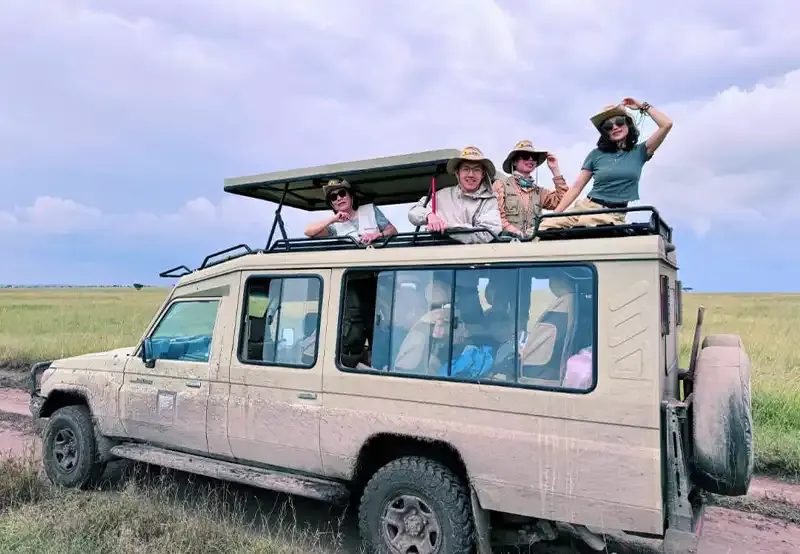
Three travellers standing up through the roof of a safari vehicle, laughing and waving.

Choosing between these packages

Short on time
Pick the shortest itinerary with two Serengeti nights. One crater day, two park days, and you are back in Arusha.
First safari
Choose a package that adds Tarangire or Manyara at the start. You see the small parks first and save the biggest for last.
Migration first
Tell us your month. We move the Serengeti nights to the area where the herds are.
Photography
Ask for a third Serengeti night. Time gets you the light and the sightings.
Families
Look at the itineraries with shorter driving days. Children do better with a rest afternoon at camp.
Beach at the end
Any of these can fly out of the Serengeti to Zanzibar. Ask when you enquire.

Questions people ask

How many days do you need in the Serengeti?
Two nights is the minimum. Three is better for a first visit. Add more if you want to see two areas of the park, for example the centre and the northern river.
When is the best time to visit the Serengeti?
June to October for dry weather and the river crossings in the north. January to February for calving in the south. The central park is good all year.
Can I see the migration on these packages?
Yes, if your dates match where the herds are. Tell us your month and we place the Serengeti nights in the right area. See the month-by-month section above.
Is the Serengeti better than Ngorongoro Crater?
They are different. The crater is one intense day in a small space. The Serengeti is days of driving across open plains. Most itineraries include both, and that is the right answer for a first trip.
Do I drive or fly to the Serengeti?
Most people drive in through Ngorongoro and many fly out. Driving takes most of a day. Flying takes about an hour. Every package here is a driving safari, and we can swap a leg for a flight.
Are these safaris private?
Yes. Every itinerary on this page is private, with your own guide and vehicle. Nothing is shared with other guests.
Nothing quite right?

Every one of these can be changed.

Add a day, swap a park, upgrade the lodges, travel in a different month. Tell us what you want and we will rebuild the itinerary around it.

Talk to a safari expert on WhatsApp (opens in a new tab)