Safaris
Kilimanjaro
Destinations
Experiences
Travel guide
About
Contact Call +255 764 006 061 Plan Your Safari
Kilimanjaro · 6 min read

Kilimanjaro routes compared

Six routes go up Kilimanjaro. They differ in days, scenery, crowds and how well they help you get used to the altitude. This page puts them side by side.

There are six standard routes up Kilimanjaro, and choosing between them is the first real decision of the climb. They start from different sides of the mountain, take between five and nine days, and vary a lot in how busy they are and how well they help your body adjust to the altitude. That last point matters more than any other, because it is the main thing that decides whether you reach the top.

This page compares them plainly. For the day-by-day of each one, see the route pages: Marangu, Machame, Rongai and Lemosho.

Itineraries

Kilimanjaro climbs we run

Compare all routes
A line of trekkers in bright jackets on a stony path, with Kibo's summit rising behind them.

The six routes at a glance

Marangu
5 or 6 days. The oldest route. Huts instead of tents. Gentle slope, same path up and down, the busiest and the lowest success rate on 5 days.
Machame
6 or 7 days. The most popular route. Camping. Steeper, more scenic, with a good climb-high-sleep-low profile. The Barranco Wall is a scramble.
Lemosho
7 or 8 days. Starts in the west in quiet rainforest, crosses the Shira Plateau, joins Machame for the summit. Widely called the most beautiful route, with one of the best success rates.
Rongai
6 or 7 days. The only route from the north, near Kenya. Drier, quieter, less varied scenery. Descends by Marangu.
Northern Circuit
9 days. The longest route. Goes right around the northern side of the mountain. The best acclimatisation and the fewest people.
Umbwe
6 days. The steepest and hardest. Very direct, very quiet, and not recommended for a first time at altitude.
Climbers walking up a snowy ridge toward the summit in the first orange light of dawn.

Days on the mountain matter most

The single biggest difference between the routes is not the scenery or the gradient. It is how many nights you spend going up.

Your body needs time to get used to the thin air. Every extra night is another night of adjustment, and there is no substitute for it. This is why the five-day Marangu has the lowest success rate on the mountain and the nine-day Northern Circuit has among the highest. It is not because one is harder to walk. It is because one gives you three nights of climbing and the other gives you seven.

So the first question to ask about any route is not "is it hard" but "how many days is it". If two routes look similar and one has an extra day, take the extra day. It is the best-value day on any Kilimanjaro itinerary.

A useful rule: six days is the minimum that gives most people a fair chance. Seven or eight is where the odds get good. Five is a gamble unless you already know how you respond to altitude.

Trekkers crossing high, bare desert on the mountain, with a dusty ridge behind them.

Climb high, sleep low

Some routes help you adjust better than others for a second reason. On the best routes you walk up high during the day and then come back down to sleep lower. Your body gets a taste of the altitude and then a night to recover from it.

Machame does this on the day you climb to Lava Tower at about 4,600 metres and then drop to Barranco Camp at about 3,900. Lemosho does the same, and adds two gentle days across the Shira Plateau at altitude first. Rongai does it a little. Marangu barely does it at all, because you go up the same path in one direction.

That profile is why Machame and Lemosho send more people to the summit than Marangu, even though Marangu is the gentler walk.

A camp of tents spread across a rocky slope, with Kibo's snow and cloud above.

Huts or tents

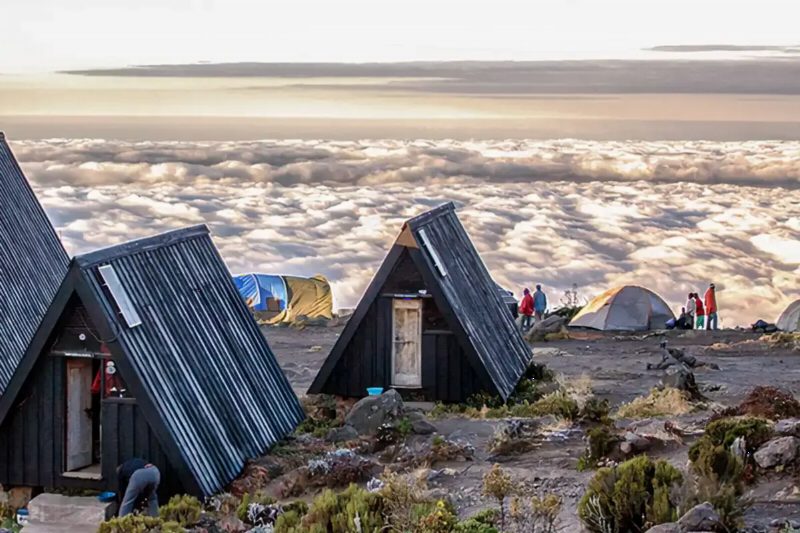
Marangu is the only route where you sleep in huts. They are shared dormitories with bunks and mattresses, and there is a dining hut at each camp. Every other route is camping. Your crew carries the tents, pitches them ahead of you, and takes them down each morning.

Huts matter most in the rainy months, when a dry roof counts for a great deal. They also suit anyone who simply does not want to sleep in a tent. The trade-off is that the huts are the busiest accommodation on the mountain, and the route that uses them has the weakest acclimatisation profile.

On the camping routes you get a proper sleeping tent, a mess tent for meals, and usually a private toilet tent. It is more comfortable than most people expect.

Trekkers picking their way across dark volcanic rock toward Kibo's snow-streaked summit.

Crowds and scenery

Marangu and Machame carry the most people. In the peak months of August and September, the camps on both are full. If you want space, Rongai, Lemosho and the Northern Circuit are quieter, and the Northern Circuit is the quietest of all.

For scenery, Lemosho and the Northern Circuit are usually rated highest. Both cross the Shira Plateau, a wide high moorland with Kibo in front of you the whole way. Machame is close behind, and its Barranco Wall morning is many people's favourite hour on the mountain. Rongai is the least varied. Marangu is the same path twice.

All six pass through the same five zones: farmland, rainforest, moorland, alpine desert and the arctic summit. The difference is how long you spend in each and which side of the mountain you see them from.

Climbers crossing the snowfields near the summit, high above a layer of cloud.

Where each route starts and finishes

The routes begin on different sides of the mountain, and that shapes the whole trip.

Marangu starts at Marangu Gate on the south-east side, at about 1,860 metres. You go up through Mandara, Horombo and Kibo huts, and you come back down the same way.

Machame starts at Machame Gate on the south-west, at about 1,800 metres. It climbs to Shira Camp, swings east along the southern circuit through Barranco, Karanga and Barafu, and comes down the Mweka trail on the south side. Umbwe joins the same southern circuit at Barranco after a steeper start.

Lemosho starts further west, at Londorossi Gate near 2,100 metres, and spends two days crossing the Shira Plateau before joining Machame at Barranco. It also descends by Mweka.

Rongai is the only northern start, near the Kenyan border at about 1,950 metres. It goes up the drier side to Kibo Hut and descends the Marangu route to the south-east.

The Northern Circuit starts with Lemosho, then turns north at Lava Tower and circles the quiet northern slopes through Moir, Buffalo and Third Cave camps before the summit from School Hut. It descends by Mweka.

So on every route except Marangu you finish on a different side of the mountain from where you started, and the transfer at the end is part of the plan.

Climbers with heavy packs pausing on rocks high on the mountain.

Which route suits you

If this is your first time at altitude, choose seven-day Machame or eight-day Lemosho. Both give you the days and the profile that make the summit likely.

If you have the time and the budget, take the nine-day Northern Circuit. It has the best acclimatisation and the fewest people.

If you are climbing in the rainy season, look at Rongai for the drier northern side, or Marangu for the huts.

If you do not want to camp, Marangu is your only option. Take the six-day version, not the five.

If you have climbed high before and know your body handles it, six-day Machame or Umbwe will work. Umbwe is steep and exposed, and it is not a first mountain.

Whatever you choose, one rule holds across all of them: if a longer version of your route exists, take it.

Questions

Which Kilimanjaro route has the highest success rate?
The longer routes do. The nine-day Northern Circuit and eight-day Lemosho give your body the most time to adjust, and the most people reach the summit on them. The five-day Marangu has the lowest success rate of any standard route.
Which route is the easiest?
Marangu has the gentlest slope and no scrambling, so it is the easiest to walk. But it is also the route on which fewest people reach the top, because five days is not enough time to adjust to the altitude. Easy to walk and easy to summit are different things.
Which route is the most scenic?
Most people say Lemosho or the Northern Circuit. Both cross the Shira Plateau with Kibo ahead of you, and both start in quiet rainforest on the western side. Machame is close behind.
Which route is the quietest?
The Northern Circuit, then Rongai and Lemosho. Marangu and Machame are the busiest, especially in August and September.
Can I sleep in huts?
Only on Marangu. Every other route is camping, in tents your crew carries and pitches for you.
Do I need climbing equipment?
No. None of the standard routes involves technical climbing. The Barranco Wall on Machame and Lemosho is a scramble where you use your hands, but you need no rope, ice axe or special skills.
Keep reading

Other guides

All guides

Still have a question?

Ask us directly — we answer every message ourselves.

Talk to a safari expert on WhatsApp (opens in a new tab)