Safaris
Kilimanjaro
Destinations
Experiences
Travel guide
About
Contact Call +255 764 006 061 Plan Your Safari
Kilimanjaro · 5 min read

Your daypack on Kilimanjaro

The porters carry your main bag. Each day you carry a small pack with water, layers, snacks and a few essentials. Here is exactly what goes in it, and what stays out.

On Kilimanjaro you carry a daypack and nothing else. Everything you do not need between breakfast and camp goes into a duffel bag that a porter carries. The daypack holds what you might need on the trail: water, food, a warm layer, rain gear, sun protection and a few small things.

Getting it right matters more than it sounds. Too heavy and every hour is harder. Too light and you are cold, thirsty or sunburnt an hour from camp. This page lists what goes in, day by day and on summit night.

Itineraries

Kilimanjaro climbs we run

Compare all routes
A group of trekkers with poles and heavy packs walking up a rocky mountain path.

At a glance

Size
25 to 35 litres. Big enough for a jacket and three litres of water, no bigger.
Weight
Five to seven kilograms with water. Keep it under eight.
Always in it
Water, snacks, a warm layer, waterproof shell, sun cream, sunglasses, hat, head torch, small first-aid items, toilet paper and a bag for it.
Summit night extra
Every layer you own, spare gloves, spare batteries, sweets in a pocket.
Never in it
Your sleeping bag, spare clothes, books, the camera tripod. Those go in the duffel.
The porter limit
Your duffel is capped, usually around 15 kilograms. The daypack is yours to carry.
Trekkers picking their way across dark volcanic rock toward Kibo's snow-streaked summit.

Water

Two to three litres of water, every day, from the start. A hydration bladder with a tube is convenient for sipping as you walk. A bottle or two is more reliable, and you need at least one bottle anyway for summit night, when bladder tubes freeze solid.

Most people carry a bladder for the ordinary days and switch to bottles inside the jacket for the summit. Wide-mouthed bottles are easier to fill from the crew's water containers and easier to handle in gloves.

Add electrolyte tablets or powder to some of it. Plain water gets dull by day three, and the electrolytes replace what you lose.

A line of trekkers in bright jackets on a stony path, with Kibo's summit rising behind them.

Layers for the day

The weather on the mountain changes within an hour, so the daypack carries whatever you are not wearing.

On a warm morning in the forest you walk in a shirt, with a fleece and a waterproof shell in the pack. By the afternoon in the moorland you may be wearing both. Above 4,000 metres you start the day in the fleece and add the insulated jacket when the sun goes behind cloud.

So the pack always holds one warmer layer than you are wearing, plus the waterproof shell, plus a hat and light gloves once you are above the forest. It is the first thing to check before you leave camp.

Orange tents pitched on a rocky shelf below Kibo, with cloud drifting across the mountain's flank.

Sun, snacks and small things

The sun at altitude is fierce. Sun cream with a high factor, lip balm with sun protection, a brimmed hat and proper sunglasses that block the sides. On the summit day, with snow reflecting the light, this is safety equipment.

Snacks for between meals: nuts, dried fruit, bars, sweets. A couple of handfuls a day. Something from home that you know you like, for the days when the altitude takes your appetite.

A head torch, always, with the batteries checked. Toilet paper and a sealable bag to carry the used paper out. Hand sanitiser. Blister plasters and any personal medication. A small camera or your phone in a pocket you can reach. Walking poles, strapped to the outside when not in use.

And a pack cover or a dry bag inside, because rain arrives without much warning in the forest.

Trekkers crossing high, bare desert on the mountain, with a dusty ridge behind them.

Summit night

For summit night the daypack changes. The porters stay at high camp, so you carry everything for a twelve to sixteen hour day, and it must be light enough to manage at 5,500 metres.

Water in bottles, inside your jacket, not in the pack, or it freezes. Two litres is usually enough, topped up at high camp on the way back down.

Every layer you are not already wearing, which by the top is nothing. Spare warm gloves, because a dropped glove at four in the morning is a real problem. Spare head torch batteries in an inside pocket, warm.

Sweets and a snack bar in a pocket you can open with gloves on. Sun cream and sunglasses for the descent in daylight. Your camera, kept warm. That is all. Leave everything else in the tent.

Climbers with heavy packs pausing on rocks high on the mountain.

Choosing the pack

Twenty-five to thirty-five litres is right. A hip belt helps on the long days. A hydration sleeve is useful. A rain cover is essential. Beyond that, the pack you already own and are used to is better than a new one.

Pack it the same way every day so you can find things without unpacking: water and snacks where you can reach them, layers at the top, small things in the lid. On summit night you will be finding things by torchlight with cold hands, and a system you know makes that far easier.

Weigh it before you go. Five to seven kilograms with water is the aim. If it is over eight, something in it belongs in the duffel.

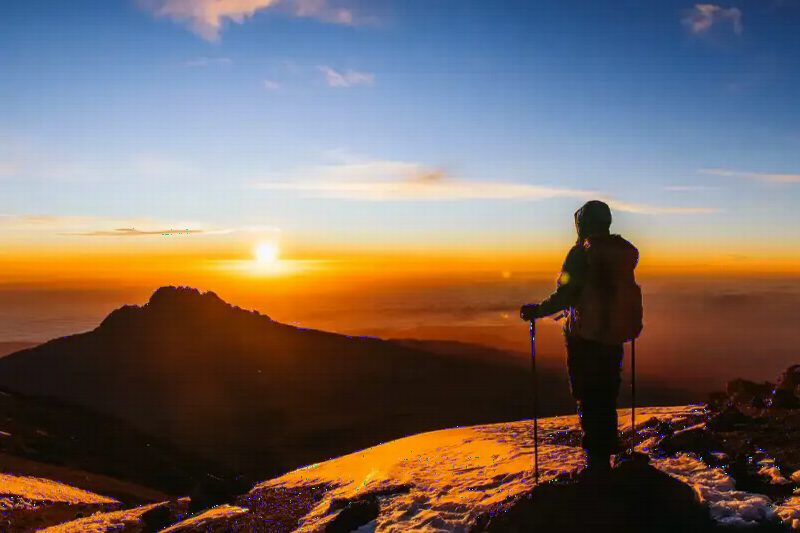
A climber silhouetted against a blazing sunrise high on the mountain, a jagged peak beyond.

The duffel, briefly

The duffel is the bag the porters carry. It holds your sleeping bag and mat if you brought your own, all your spare clothes, washing things, and anything you only need at camp.

It should be a soft duffel, not a suitcase, with no wheels. Operators set a weight limit, usually around 15 kilograms, to keep porter loads within the park rule. Pack in dry bags inside it, because it will be carried in rain.

You see the duffel at camp each evening and hand it over each morning. Anything you might want during the day has to come out of it and into the daypack before you leave.

Questions

How big should my daypack be for Kilimanjaro?
Twenty-five to thirty-five litres. Big enough for three litres of water, a warm jacket, a waterproof and snacks, and no bigger. It should weigh five to seven kilograms with water.
How much water should I carry?
Two to three litres a day, refilled at camp. On summit night, two litres in bottles inside your jacket, because hydration bladder tubes freeze.
Do porters carry my daypack?
No. Porters carry your duffel bag. The daypack, with water, snacks and layers, is yours to carry every day, including summit night.
What should I carry on summit night?
Water in bottles inside your jacket, spare gloves, spare torch batteries, sweets in a reachable pocket, sun cream and sunglasses for the descent, and your camera. Wear everything else. Leave the rest in the tent.
Can I use a hydration bladder?
On ordinary days, yes. On summit night, no, because the tube freezes. Carry at least one wide-mouthed bottle for the summit, and keep it inside your jacket.
What goes in the duffel bag?
Sleeping bag and mat, spare clothes, washing kit, and anything you only use at camp. It is carried by a porter, capped at about 15 kilograms, and should be a soft bag without wheels.
Keep reading

Other guides

All guides

Still have a question?

Ask us directly — we answer every message ourselves.

Talk to a safari expert on WhatsApp (opens in a new tab)