Safaris
Kilimanjaro
Destinations
Experiences
Travel guide
About
Contact Call +255 764 006 061 Plan Your Safari
Kilimanjaro · 5 min read

The glaciers of Kilimanjaro

There is ice on the equator, and it is disappearing. What the glaciers are, why they exist, how much has gone, and what you actually see on summit morning.

Kilimanjaro has glaciers. That is the strangest thing about a mountain three degrees south of the equator, and it is the image most people carry: white ice on a black volcano above a green plain. The glaciers are real, you walk past them on the way to Uhuru Peak, and they are far smaller than they were.

This page explains what they are, why they are there, what has happened to them, and what you see on the summit.

Itineraries

Kilimanjaro climbs we run

Compare all routes
Climbers crossing the snowfields near the summit, high above a layer of cloud.

At a glance

Where
On and around the crater rim and inside the crater of Kibo, above about 5,500 metres.
The main ones
The Northern Icefield, the Southern Icefield, the Furtwängler glacier inside the crater, and the Rebmann glacier near Stella Point.
How much has gone
More than 85 per cent of the ice cover since 1912, by the usual measurements.
Why they exist
Height and cold, not snowfall. Most of the ice is old.
Why they are going
Less cloud, less snow, more sun, and warming. A mix.
What you see
Walls of ice, often tens of metres high, close to the path near Stella Point and on the way to Uhuru.
Climbers walking up a snowy ridge toward the summit in the first orange light of dawn.

Ice on the equator

Kilimanjaro is high enough that its summit sits above the freezing line all year. At nearly 5,900 metres the air is thin and cold, and ice that formed long ago has survived there for thousands of years.

The glaciers are not fed by heavy snowfall the way Alpine glaciers are. The summit gets little precipitation. Most of the ice is old, built up in wetter periods long ago, and what you see now is the remains of a much larger cap that once covered the whole top of the mountain.

That is why they look the way they do: not smooth tongues flowing down valleys, but blocks and walls with vertical faces, sitting on flat ground, slowly shrinking from every side.

A long line of climbers crossing deep snow on Kilimanjaro's upper slopes under a pale, misty sky.

What has happened to them

The first survey of the summit ice was in 1912. Since then the ice cover has shrunk by more than 85 per cent, and the rate has been fastest in recent decades. Glaciers that were joined are now separate. Some that appear on older maps are gone.

The causes are a mix. Less cloud over the summit means more direct sun on the ice, which turns it to vapour without melting. Less snowfall means the ice is not replaced and the bright snow that reflects the sun is missing. And the climate has warmed. Scientists argue over the proportions and agree on the direction.

Predictions for when the last ice goes vary, and they keep being revised. It is fair to say that someone climbing now sees far less than someone who climbed in 1990, and that the trend has not reversed.

Two climbers in red and green jackets on a snowy slope above the clouds.

What you see

On summit morning, coming up from Stella Point toward Uhuru Peak, the Rebmann glacier is on your left, close to the path. It is a wall of ice, layered and blue-white, higher than a house, and the low sun lights it from the side. People stop here as much as at the summit.

From the rim you look across the crater to the Furtwängler glacier, a smaller block sitting on the crater floor, and to the Northern Icefield on the far side. On the Marangu and Rongai approach from Gilman's Point you see the eastern ice first.

The ice is close enough to touch in places, and some climbers do. It is not safe to walk on, and guides will keep you off it.

Climbers walking into a low sun across a snowy summit plateau.

The crater

Inside the rim, the crater of Kibo is a flat, ash-covered plain about two kilometres across, with the Furtwängler glacier on one side and the ash pit, the mouth of the inner cone, in the middle. The ash pit is a steep-sided hole, and it still gives off a faint smell of sulphur. The mountain is dormant, not extinct.

Some long itineraries include a night at Crater Camp, inside the crater at about 5,700 metres, so that climbers can visit the ash pit and walk to the glaciers. It is a serious undertaking at that altitude and is not for a first climb. Most people see the crater from the rim, which is enough.

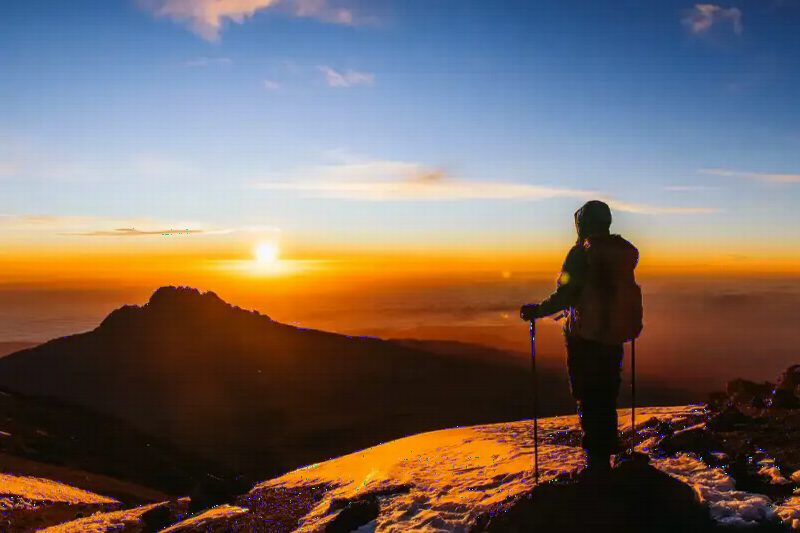
A climber silhouetted against a blazing sunrise high on the mountain, a jagged peak beyond.

Why it matters to a climber

Practically, the glaciers do not affect your climb. You do not walk on them, they do not block the path, and they do not change the difficulty. Their effect is on what you see and on why you came.

Many people climb Kilimanjaro now because of the sense that the ice will not be there much longer, and they want to see it. That is a fair reason, and the mountain does not disappoint. The glaciers on summit morning, in that light, are among the most striking things most people will ever see.

Expect walls of ice, not a white summit, and you will not be let down.

Climbers in heavy jackets walking across snow near the summit.

Seeing them at their best

Arrive at the rim at dawn, which the midnight start is designed to do. The low sun lights the ice from the side and the colours are at their strongest.

Climb in the months when there is likely to be fresh snow on the summit, roughly December to March, if the sight of a white top matters to you. In the mid-year dry season the summit is often bare rock and ice.

Bring the camera, keep it warm inside your jacket, and have the battery charged. Cold kills batteries quickly at 5,800 metres, and this is the one place on the climb where you will want photographs more than anywhere else.

Questions

Are there really glaciers on Kilimanjaro?
Yes. Several remain on and around the crater rim above about 5,500 metres, including the Rebmann glacier near Stella Point and the Furtwängler glacier inside the crater. They are much smaller than they were.
How much of the ice has gone?
More than 85 per cent of the ice cover since the first survey in 1912, with the fastest loss in recent decades. Some glaciers on older maps no longer exist.
Will I walk on the glaciers?
No. The path passes close to the Rebmann glacier near Stella Point, close enough to touch in places, but you do not walk on the ice and guides keep climbers off it.
Is there snow on the summit?
Often in December to March, and sometimes after the rains. In the mid-year dry season the top is frequently bare rock and ice. The glaciers are there in every month.
Is Kilimanjaro an active volcano?
It is dormant. The ash pit inside the crater still gives off a faint smell of sulphur, but there has been no eruption in recorded history.
When will the glaciers be gone?
Predictions vary and keep being revised. It is fair to say the trend has not reversed and that someone climbing now sees far less ice than someone who climbed a generation ago.
Keep reading

Other guides

All guides

Still have a question?

Ask us directly — we answer every message ourselves.

Talk to a safari expert on WhatsApp (opens in a new tab)