Safaris
Kilimanjaro
Destinations
Experiences
Travel guide
About
Contact Call +255 764 006 061 Plan Your Safari
Safari Planning · · 7 min read

What Drives the Cost of a Tanzania Safari

Why quotes for apparently identical trips differ so much, and which parts of a safari price are fixed for every operator.

Last updated
Safari quotes for what looks like the same trip can differ by a factor of three, which makes them very hard to compare. It helps to know which parts of the price no operator controls, and which parts are genuinely a choice.

Park fees, which nobody controls

Tanzania charges entry fees per person per day for its national parks, with separate charges for the Ngorongoro Conservation Area, for camping, and for the vehicle. These are set by the government and are identical for every operator, from the cheapest to the most expensive.

They are also a large share of a safari's cost, often the single biggest line. This is the main reason a Tanzanian safari can't be cheap, and why a quote far below the others should raise a question, not excitement. Something is usually being left out: fewer park days, nights outside the park where fees don't apply, or a shared vehicle.

Accommodation, the biggest genuine lever

This is where most of the spread comes from. Public campsites, mid-range lodges and small luxury camps can differ several-fold per night for the same route through the same parks. The animals are unaffected.

Position matters as much as comfort. A camp inside the park costs more than one outside the gate, and what you buy is the hour of driving you don't do at dawn.

Group size

The vehicle and driver-guide are a fixed daily cost divided among the people in the car. Two people pay far more each than six for exactly the same service. When you see a very low per-person figure, check whether it assumes a shared vehicle with strangers.

Season

Peak season rates in the dry months can be much above green season rates at the same properties. If your dates are flexible, this is the easiest saving available.

Length, and why the first days cost most

Fixed costs, such as airport transfers, the day you arrive and the day you leave, are spread across however many days the trip runs. A four-day safari carries those costs over four days. A nine-day trip spreads them over nine. Per day, longer trips are usually better value. Weigh that against the total.

How to compare two quotes

  1. Count the nights inside the parks, not just the nights.
  2. Check whether the vehicle is private or shared.
  3. Check park fees are included, not payable on arrival.
  4. Check the accommodation by name and look it up. "Luxury lodge" means nothing on its own.
  5. Check what's excluded: tips, drinks, flights, visa, insurance, the balloon.

Every proposal we send itemises these, and lists what isn't included just as plainly. If a quote you've from anyone doesn't, ask for the breakdown before comparing it with anything.

Itineraries

Safaris we run

All safaris
Travellers in an open-roof vehicle watching two elephants a few metres away on dry ground.
Where the money goes

What you are actually paying for

The structure of a safari price is unusual, and understanding it explains why quotes cluster the way they do.

Park fees are the largest single component and they aren't negotiable by anybody. TANAPA charges entry per person for each 24-hour period. The Ngorongoro Conservation Area charges separately for the conservation area and for crater descent, the latter per vehicle as well as per person. These are set by government agencies, they're identical for every operator, and they typically account for a substantial share of a mid-range daily rate.

Accommodation is the widest variable, from a public campsite to a camp inside a park concession. This is where two quotes for the same route diverge most.

Vehicle, fuel and guide are charged once and divided by the number of people in the vehicle, which is why per-person prices fall steeply from two travellers to four.

Everything else, meals, water and transfers, is comparatively small.

The consequence is that there's a floor below which a legitimate operator can't go, because the fees are fixed. A quote well under it's cutting something.

A family watching the plains from an open safari vehicle, the sun low behind them.
Comparing

How to compare two quotes properly

Which camps, by name
Not "mid-range lodge" but the actual property, and how far it's from the park gate. This explains most of the difference between two prices for the same route.
Which fees are included
Particularly crater entry, which is charged per vehicle as well as per person and is the single largest daily fee on the circuit.
How many nights in each place
Two quotes covering the same parks in the same total days can move you every night or give you two nights in each. The second is a better trip for the same money.
How many people in the vehicle
Six adults with camera bags for eight days is a materially worse experience than four.
Whether any leg is flown
And if so, what the luggage limit is.
What happens if something changes
A road closed, a camp overbooked, a flight cancelled. The answer tells you more about an operator than the price does.
Whether it's per person sharing
And what the single supplement is if you're travelling alone.
Safari vehicles trailing dust along a track across a wide, dry plain.
Saving money

Where to economise, and where not to

Some savings cost you nothing. Others cost you the trip. Know which is which.

Do these. Travel in April, May or November, when rates fall sharply and the parks are at their emptiest. Camp in the Serengeti instead of staying in a lodge. Stay in Karatu instead of on the crater rim, which saves a great deal and changes almost nothing about your crater day. Travel as a group of four instead of two. And cut a whole park instead of cutting nights.

These are not worth doing. Choosing a lodge outside the park gate to save money in the Serengeti, which costs you the best hour of every single day. Squeezing six adults into one vehicle for a long trip. And cutting the trip so short that transfer days take it over.

Be careful of any quote well below the others. Park fees are fixed and identical for everyone, so a price under that floor is being funded somewhere. Usually it is accommodation much further out than the quote implies, or a vehicle shared with more people than you expect.

The cheapest genuine saving of all is a day in Arusha National Park instead of a wasted arrival day.

A family of elephants crossing a red dirt track just ahead of an open safari vehicle.
Common mistakes

What people get wrong about safari pricing

The most expensive mistake is choosing on headline price without asking which camps a quote uses. Two prices for the same route can differ by a third purely on lodge position, and the cheaper one often puts you forty minutes outside a park gate. That costs you the best hour of every day for the whole trip.

The second is counting travel days as safari days. A "seven-day safari" often means five days that begin inside a park. Count those instead.

The third is assuming a longer trip costs proportionally more. Adding a night in a region you're already in costs accommodation and fees but no transfer day, so the marginal day is cheaper than the average one.

The fourth is booking two people when four are travelling separately. Vehicle, fuel and guide are charged once and divided, so per-person cost falls steeply from two to four.

The fifth is treating a quote well below the rest as a bargain. Park fees are fixed and identical for every operator, so a price under the floor is being funded somewhere. Usually it is accommodation much further out than implied.

A safari vehicle driving along a dirt track toward the camera, with green hills behind.
Planning

Getting the most from a fixed budget

If the number is fixed, a few choices give you noticeably more safari for it.

Travel in April, May or November. Rates fall much and the parks are at their emptiest. On a longer itinerary the green-season weather costs you far less than the saving gives you.

Travel as four, not two. Vehicle, fuel and guide are divided, so the per-person price falls steeply.

Camp in the Serengeti and take a lodge on the crater rim. Being inside the park boundary at dawn is where the value is. The crater day is governed by the gate whatever you paid.

Cut a park, not nights. Fewer places with more nights in each is a better week and costs less in transfers.

Skip the crater if the budget is genuinely tight. It is the largest single daily fee on the circuit, and the money buys two extra Serengeti nights instead.

And use the arrival day. Arusha National Park is cheap and turns a wasted morning into a game drive.

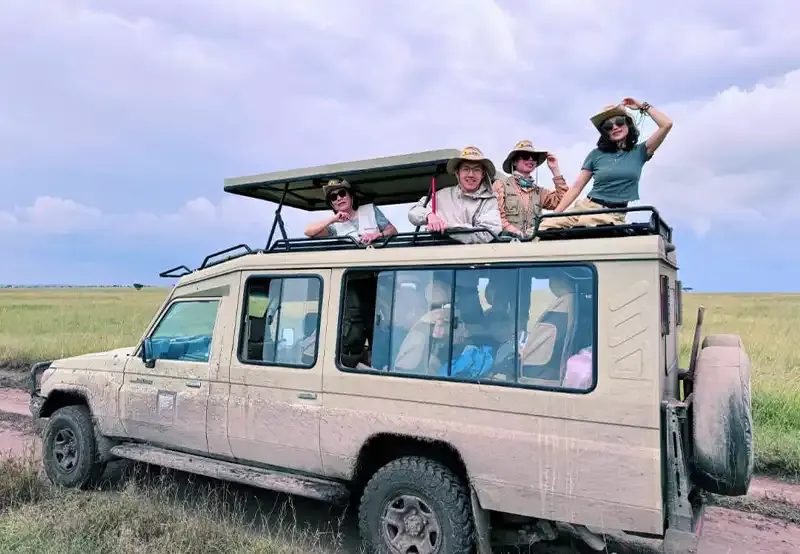
Three travellers standing up through the roof of a safari vehicle, laughing and waving.

Budgeting for what is not in the quote

A quote covers the trip. It doesn't usually cover everything you'll spend.

The things that sit outside almost every quote are visas, travel and medical insurance, international flights, drinks beyond what's included, laundry, souvenirs, and tips for your guide and camp staff. None of these are hidden. They're listed as exclusions. But people read the inclusions carefully and skim the exclusions.

Add them up before you commit, and carry the tipping money in cash in small notes. It's the one item on that list you can't sort out later.

More from the journal

Keep reading

All stories

Journal

Altitude on Kilimanjaro

Altitude, not fitness, stops most people. The way acclimatisation is managed on the mountain, and why this article…

Talk to a safari expert on WhatsApp (opens in a new tab)