Safaris
Kilimanjaro
Destinations
Experiences
Travel guide
About
Contact Call +255 764 006 061 Plan Your Safari
Trips that work with children in the vehicle

Family Safaris

What changes when children come along: pace, distances, and which parks suit a short attention span.

Safaris and children can work extremely well, and the thing that makes the difference is having your own vehicle. On a shared safari a child who has had enough is everyone's problem. In a private one it's nobody's, because you can simply go back.

Itineraries

Trips of this kind

All safaris
A safari vehicle driving along a dirt track toward the camera, with green hills behind.

What we change

Shorter driving days. The gap between parks is where family trips come apart. We would rather add a night than push a six-hour transfer with tired children in the car.

A slower start where it helps. Dawn game drives produce the best sightings, but not every day needs to begin at six.

Parks that reward short attention spans. The crater floor is ideal. It is dense, varied and reliably full of animals within minutes. Tarangire in the dry season is similar. The long open stretches of the Serengeti, where the reward comes from patience, are harder for younger children.

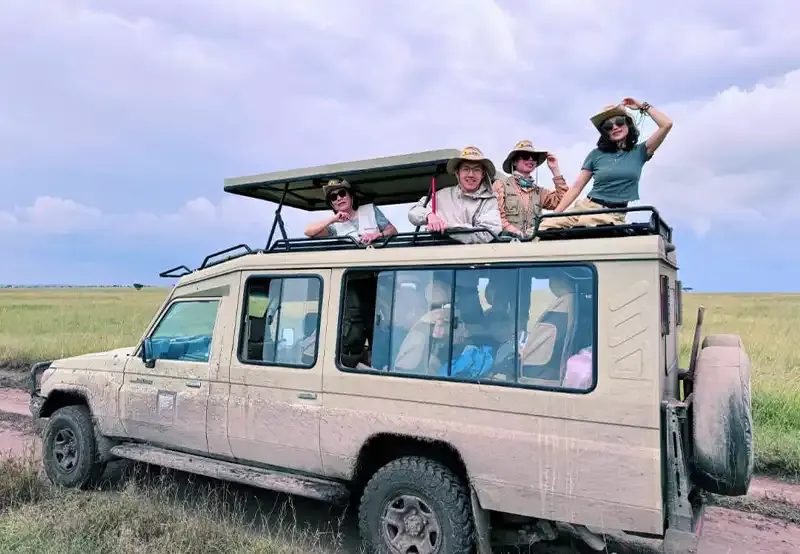
Three travellers standing up through the roof of a safari vehicle, laughing and waving.

Ages

There is no single right age, but the experience changes a lot around seven or eight, when children can hold binoculars steady, follow a guide's explanation and stay interested through a quiet hour. Younger than that, the trip works but leans more on the crater, the lodges and the pool than on long game drives.

Some camps set minimum ages, and a few won't take children at all. That constrains where a family trip can sleep, and it's worth raising early because it shapes the itinerary.

A safari vehicle on a red dirt road winding across the crater floor, with the forested rim behind.

Practical things

Bring layers. The crater rim is cold at night and at dawn, which catches families out. Bring more than one pair of binoculars, because sharing one is a reliable source of argument. Tell us about ages and any medical needs when you enquire. It changes what we recommend.

A family watching the plains from an open safari vehicle, the sun low behind them.
Planning

What actually works with children

The thing families underestimate isn't the animals, the food or the safety. It is the driving.

Northern-circuit transfer days involve three or four hours on corrugated road, and that's what small children find hardest. Everything else about a safari is well suited to them. The animals are genuinely thrilling, the days are outdoors, and the guides are usually excellent with children. But a route built for adults ticking off parks will produce a difficult week.

The fixes are straightforward. Fewer parks and more nights in each. Two nights minimum everywhere, three where possible. Base yourself in one region of the Serengeti instead of moving between them. Consider flying a leg to replace a full driving day with an hour.

Shorter drives on the ground help too: morning game drives with a return to camp for the middle of the day work far better than a picnic lunch and a full day out.

Arusha National Park is the underrated family day. It is close, the drives are short, there are no lions so walking is permitted, and giraffe and colobus are close and plentiful. It is a much gentler first game drive than Tarangire.

A private vehicle is close to essential, not a luxury. You can turn round when you need to.

Practical

Ages, safety and the practical questions

Minimum ages are set by individual camps, not by us, and they vary widely. Many camps in unfenced areas set a minimum of six or twelve for that reason. Some have family units with connecting rooms and no minimum at all. This is the first thing to establish, because it determines where you can stay.

Children under five generally do better on a short trip close to Arusha than on a full circuit. That isn't a rule, it's what the driving does to them.

Vehicles have lap belts and a pop-up roof. Children must be seated with the roof down while the vehicle is moving between areas. Explain that rule before the trip instead of negotiating it on day one.

Malaria prophylaxis for children is a conversation for your own doctor, well before you travel, and the answer depends on age and weight.

Camps will cater for children's tastes if you tell them in advance. Telling them on arrival is much less effective.

Balloon flights have minimum ages and heights. Walking safaris almost always require a minimum age of twelve or above.

A safari vehicle parked in long grass as the sun sets red behind flat-topped acacias.
Planning

Building a route that works

The route matters more than the camp when children are involved, and the principle is simple: fewer places, more nights.

Two nights minimum everywhere, three in the Serengeti. Moving every day means packing every morning and a long drive every afternoon, which is exactly the pattern that produces a difficult week.

Base yourself in one region of the Serengeti instead of moving between them. The regions are a full day's drive apart and there's no version of that day that a seven-year-old enjoys.

Consider flying a leg. Replacing a day of corrugated road with an hour in the air is the single most effective thing you can do for a family itinerary, and it usually costs less than the vehicle days it saves.

Shape the days differently too: a morning game drive with a return to camp for lunch and a swim works far better than a picnic and a full day out. Most animals are inactive in the middle of the day anyway, so you lose very little.

Start at Arusha National Park. Short drives, no lions, walking permitted, and giraffe and colobus close enough to satisfy anybody.

A line of safari vehicles parked along a track on the crater floor.
What to expect

What children actually enjoy

Set expectations before the trip, because a child expecting a lion every ten minutes will be disappointed and a child expecting an adventure won't.

The things that land reliably: elephants at close range, giraffe, zebra and wildebeest in numbers, hippo, the sheer size of a buffalo herd, and, often more than the big animals, dung beetles, termite mounds, weaver colonies and the business of tracking. Guides who are good with children lean into the small things, and they're right to.

What doesn't land: long searches for a leopard that may not appear, and the middle of the day in a hot vehicle.

Camps are usually the highlight, not the compromise. Being told to stay inside the tent at night because buffalo walk through camp is, to most children, the best thing that has ever happened to them.

Give them a job. A pair of binoculars each, a checklist, a camera. Children who are looking for something behave completely differently from children being driven around.

And be realistic about the youngest ones. Under five, a short trip close to Arusha usually works better than the full circuit.

Wildebeest walking in a long line past a safari vehicle on open grassland.

Keeping children occupied in the vehicle

The driving between parks is the hard part of a family safari, not the game drives.

Something that works: a pair of binoculars each, so nobody is waiting for a turn. A checklist of animals to spot. A window seat with a job. One child on birds, another on anything with horns. Snacks that don't melt.

What doesn't: relying on a screen the whole way, which tends to make the game drives feel flat by comparison. Save it for the longest transfer and keep it for then.

Travellers in an open-roof vehicle watching two elephants a few metres away on dry ground.
In short

The short version

Fewer parks, more nights in each, and fly a leg if you can. Children find the driving hardest, not the animals. Start at Arusha National Park, establish camp minimum ages before choosing where to stay, and take a private vehicle so you can turn round.

Questions

Common questions

What is the hardest part of a safari with children?
The driving, not the animals. Transfer days involve three or four hours on corrugated road. Fewer parks, more nights in each, and flying a leg all help far more than anything else.
Is there a minimum age?
Camps set their own, and they vary widely. Many in unfenced areas set six or twelve, and some have family units with no minimum. Establish this first, because it determines where you can stay.
Which park is best for a first day with children?
Arusha National Park. It is close, the drives are short, there are no lions so walking is permitted, and giraffe and colobus are close and plentiful.
Can camps cater for children?
Yes, if told in advance. Telling them on arrival is much less effective.
What age is best for a first safari?
Six and up generally works well, and eight to twelve is close to ideal. Old enough for the drives, young enough to be genuinely thrilled. Under five, a short trip near Arusha usually works better than the full circuit.
Are safaris safe for children?
Yes, with the standard rules: seated with the roof down while the vehicle is moving, no getting out except at designated places, and staying inside the tent at night in unfenced camps.
Can children go on game drives all day?
They can, and most do better with a morning drive and a return to camp for the middle of the day. Animals are inactive at midday anyway, so very little is lost.
Do we need our own vehicle?
Close to essential with children. A private vehicle means you can turn round, take a break, or change the plan when someone has had enough.
Do camps provide cots or extra beds?
Some do and some can't. It varies by camp. Check it before booking, not on arrival, along with the minimum age.

Interested in family safaris?

Tell us your dates and we will put something together.

Talk to a safari expert on WhatsApp (opens in a new tab)