Safaris
Kilimanjaro
Destinations
Experiences
Travel guide
About
Contact Call +255 764 006 061 Plan Your Safari
Kilimanjaro · 6 min read

Climbing Kilimanjaro as a beginner

You do not need to have climbed a mountain before. Most people on Kilimanjaro have not. This page covers what a first-timer needs to know, and what to choose.

Most people who climb Kilimanjaro have never climbed a mountain before. That is not a problem. Kilimanjaro is a walk, it has no technical sections, and it is set up for first-timers with guides, porters, camps and meals all arranged for you. A beginner does not need experience. It is the right route, enough days, and an honest idea of what the week involves.

This page is for the person who has never done this and is wondering whether they can. The short answer is yes, on the right route. The longer answer follows. For the routes themselves, see the routes compared.

Itineraries

Kilimanjaro climbs we run

Compare all routes
Trekkers walking a path through low heath toward Kilimanjaro's long summit ridge.

At a glance

Experience needed
None. It is a walk with one short scramble on the southern routes.
Best routes for a first climb
Seven-day Machame or eight-day Lemosho.
Routes to avoid the first time
Five-day Marangu (too short to adjust) and Umbwe (too steep and exposed).
Fitness
Able to walk five or six hours on hills, several days in a row.
The real challenge
Altitude and the summit night, not the walking.
Who reaches the top
Ordinary, reasonably fit people of all ages, on routes long enough to let their bodies adjust.
A group of trekkers with poles and heavy packs walking up a rocky mountain path.

Why beginners succeed

Kilimanjaro is the highest mountain in the world that ordinary walkers can climb without ropes, ice axes or mountaineering skills. That is why so many people choose it as their first big mountain, and why so many of them reach the top.

Everything difficult about a normal mountain expedition is done for you. Guides choose the path and set the pace. Porters carry the tents, food and your main bag. A cook makes three meals a day. The camps are in fixed places with water nearby. You carry a small daypack and you walk.

You cannot outsource your own body's reaction to altitude. That is the same for everyone, beginner or expert. The people who fail are usually not the least experienced. They are the ones who chose a route with too few days.

Climbers scrambling up a steep rock step, using their hands and poles.

Choose a route by how many days it takes

The single most important decision a beginner makes is how many days to spend on the mountain. More days means more time for your body to adjust to the thin air, and that gets you to the top.

The five-day Marangu route sounds attractive because it is short, cheap and has huts. It also has the lowest success rate on the mountain, because three nights of climbing is not enough for most people to adjust. It is not a beginner's route. It is an experienced climber's shortcut.

Seven-day Machame or eight-day Lemosho are the routes to look at first. Both have the climb-high-sleep-low pattern that helps your body adjust, both are camping routes with full crews, and both give you the days you need. If money and time allow, the nine-day Northern Circuit is better still.

If you really do not want to camp, take the six-day Marangu, never the five.

Climbers walking up a snowy ridge toward the summit in the first orange light of dawn.

Fitness, honestly

You do not need to be an athlete. You do need to be able to walk for five or six hours a day on hills, for a week, without it wrecking you.

If you already walk regularly and can manage a long day in hilly country, you are close to ready. If you do not, give yourself three or four months. Walk more each week. Find hills or stairs. Carry a daypack with a few kilograms in it. Build up to two long walks on consecutive days, because the mountain asks exactly that.

General fitness from running, cycling or swimming helps, especially for summit night. Strong legs help on the descent. But the mountain does not reward speed. It rewards the ability to keep going slowly for a long time.

One thing to be clear about: fitness does not protect you from altitude. Very fit people fail on short routes all the time. The days matter more than the training.

A giraffe on the plains with Kilimanjaro's snow-capped summit rising above the cloud behind it.

What surprises first-timers

The cold. People pack for Africa and are shocked by nights below freezing. Above 4,000 metres it is genuinely cold from late afternoon onwards, and summit night is often well below zero with wind. You need proper warm layers, a good sleeping bag and real gloves.

The pace. Your guide will walk more slowly than you have ever walked. It feels absurd on day one. By day four you understand.

The sleep. Above 3,500 metres almost everyone sleeps badly. You wake often, you need the toilet in the night, and you feel the altitude most in the evening. It is normal.

The food. There is a lot of it and it is better than you expect. Eating it when the altitude takes your appetite is the hard part.

The summit night. Nobody is really prepared for a midnight start, seven hours of cold darkness, and then a full descent the same day. Knowing it is coming helps.

And the crew. First-timers are often surprised how many people it takes, and how much they come to like them.

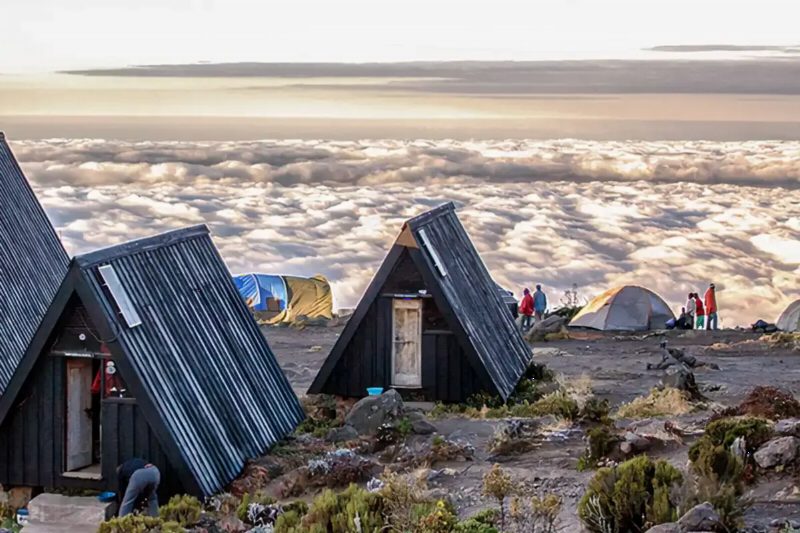
A camp of tents spread across a rocky slope, with Kibo's snow and cloud above.

Kit for a first climb

You do not need to buy an expedition wardrobe. You need the right layers, good boots that are worn in, a warm sleeping bag, and a few specific things.

Boots. Waterproof walking boots that you have already walked a lot of miles in. New boots on Kilimanjaro is the most common avoidable mistake.

Layers. A base layer, a fleece, a warm insulated jacket, a waterproof shell, and warm trousers for the summit. Plus a hat, a buff, and both liner gloves and warm outer gloves.

A sleeping bag rated to well below freezing, and a sleeping mat.

Walking poles. Not optional for the descent.

A head torch with spare batteries, sun cream, sunglasses, water bottles or a bladder plus a bottle, and a small daypack.

Much of the expensive kit can be hired in Moshi or Arusha. The packing list page covers all of it in detail.

Climbers walking into a low sun across a snowy summit plateau.

A first-timer's plan

Book seven-day Machame or eight-day Lemosho, in a dry month, with a rest day either side of the climb.

Spend three or four months getting used to long walks on hills. Break in your boots on them.

See your own doctor before you go, especially about altitude and any medication.

Arrive a day or two early, sleep, and go to the briefing with questions.

On the mountain, walk slowly, drink a lot, eat even when you do not want to, and tell your guide the truth every evening.

Go into summit night expecting it to be the hardest thing you have done. Then do it one step at a time.

And if the mountain says no this time, come down. It will still be there.

Questions

Can a complete beginner climb Kilimanjaro?
Yes. Most people on the mountain have never climbed before. There is no technical climbing. A beginner needs a route with enough days, seven or eight, and a realistic level of walking fitness.
Which route is best for a first climb?
Seven-day Machame or eight-day Lemosho. Both give your body time to adjust and both have the climb-high-sleep-low pattern that helps. Avoid five-day Marangu and Umbwe the first time.
How fit do I need to be?
Fit enough to walk five or six hours a day on hills for a week. That is achievable for most active people with three or four months of regular walking. You do not need to be an athlete.
I have never camped. Is that a problem?
No. The crew pitches and strikes the tents, and there is a mess tent for meals. If you really do not want to sleep in a tent, the six-day Marangu route uses huts.
What is the biggest mistake beginners make?
Choosing a route with too few days to save money or time. Five-day climbs fail far more often than eight-day ones, and the reason is almost always altitude, not fitness.
Should I climb Kilimanjaro or do a safari first?
Climb first. Coming off the mountain is tiring, and a safari afterwards is the gentler half. If the climb runs a day over, it eats into a safari day, not a flight home.
Keep reading

Other guides

All guides

Still have a question?

Ask us directly — we answer every message ourselves.

Talk to a safari expert on WhatsApp (opens in a new tab)