Marangu Route — 5-Day Kilimanjaro Trek
Places Kilimanjaro
Known as the “Coca-Cola” route, the Marangu route is a classic trek on Mount Kilimanjaro. It is the…
Tents on every route but one, huts on Marangu, and a high camp on bare rock the night before the summit. A tour of the camps, from the rainforest to the crater rim.

On Kilimanjaro you sleep in a different place every night, and the places change as much as the scenery. The first camp is in forest or moorland with running water nearby. The last one before the summit is a rocky shelf at 4,600 metres with nothing growing. Between them are camps on plateaus, in valleys and on ridges, each with its own character.
This page explains what a camp is, the difference between tents and huts, and what to expect at the main stops on each route.
Places Kilimanjaro
Known as the “Coca-Cola” route, the Marangu route is a classic trek on Mount Kilimanjaro. It is the…
Places Kilimanjaro
The Marangu route is one of the most popular routes to the summit of Kilimanjaro.
Places Kilimanjaro
Six days on the Machame route, camping throughout. The shortest Machame itinerary, with a steeper daily…
Places Kilimanjaro
Seven days on Machame, with the Barranco to Barafu leg split over two days, so the day before the summit…
Places Kilimanjaro
The Rongai route is the only route that approaches Kilimanjaro from the north, close to the Kenyan…
Places Kilimanjaro
Eight days on the Lemosho route, starting in rainforest on the mountain's western side, with the longest…


The park sets out fixed campsites on every route, and everyone camps in them. Each has a ranger hut where your guide signs the group in and out, a set of long-drop toilets, and, on all but the highest camps, a stream or spring for water.
Your crew arrives before you and sets up your own small camp within the site: sleeping tents for the climbers, a mess tent with a table and stools where you eat, a kitchen tent, and tents for the crew. Most operators also carry a private toilet tent with a portable toilet, which is a real improvement on the public ones.
The sites vary in size. Some, like Barranco, are broad and hold many groups. Others are small and quiet. In the peak months of August and September the popular camps on Machame and Marangu are full every night.
Your sleeping tent is usually a three-person mountain tent shared by two climbers, so there is room for your bags. It is pitched on a groundsheet with a sleeping mat inside. You bring or hire the sleeping bag.
The mess tent is where you eat, and where you spend the evenings, because it is warmer than your own tent and there is a lamp. Tea at four, dinner at half past six, the health check and the briefing, and then bed.
The tents are up when you arrive and down after you leave. You never carry or pitch anything. Your only job is to keep your kit organised inside the tent, which is harder than it sounds in the dark at altitude.

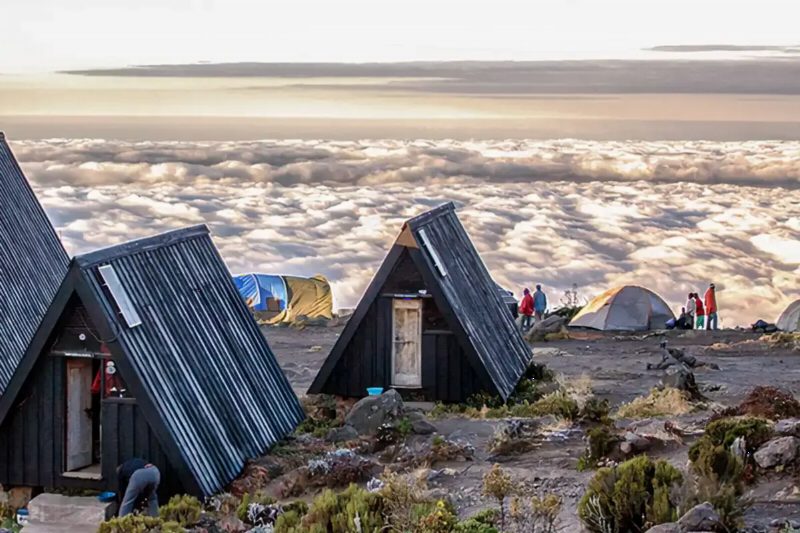
Marangu is the only route with huts, and it is why some people choose it. There are three groups: Mandara at 2,700 metres in the forest, Horombo at 3,700 metres in the moorland, and Kibo at 4,700 metres below the summit slope.
Mandara and Horombo are clusters of small A-frame huts with bunk beds and mattresses, four to eight people to a hut, plus a larger dining hall. Kibo is a single stone building with dormitories. All have cold-water washrooms and flush or long-drop toilets.
A hut means a solid roof, a bed off the ground, and a dry place in the rain. It also means sharing with strangers, noise, and the busiest accommodation on the mountain. Bring earplugs.

Machame Camp, at about 3,000 metres, is the first night on the Machame route, right at the edge of the rainforest. Damp and mild.
Shira Camp, at about 3,800 metres, sits on the open plateau with Kibo in view. Cold once the sun goes, and often the first place people feel the altitude.
Barranco Camp, at about 3,900 metres, is in a valley below the Barranco Wall, among giant groundsels. Many people's favourite camp on the mountain.
Karanga Camp, at about 4,000 metres, is a short day on from Barranco on the seven-day schedule, on a ridge with wide views south.
Barafu Camp, at about 4,600 metres, is the high camp. Bare rock, wind, no water source, and everyone in bed by six for the midnight start.
Mweka Camp, at about 3,100 metres, is the last night, back in the forest after the summit. Warm, and the first proper sleep in days.
Lemosho starts lower and quieter, with Mti Mkubwa at about 2,800 metres in dense forest, then Shira 1 and Shira 2 on the plateau before joining the Machame camps at Barranco.
Rongai's camps are on the drier northern side: Simba Camp, then Kikelewa, then Mawenzi Tarn at 4,300 metres, one of the most dramatic sites on the mountain, in a bowl beneath the jagged peaks of Mawenzi. From there it joins Kibo Hut.
The Northern Circuit passes Moir Hut, Buffalo Camp, Third Cave and School Hut on the quiet northern slopes. You will often have these camps almost to yourself.
On the way down, Mweka Camp for the southern routes and Horombo for the eastern ones. Every route ends at a gate, a signing-out, and a drive to a hotel bed.

Bring a sleeping bag rated to at least minus ten, and a proper sleeping mat, because the cold comes up through the ground. Hire both in Moshi if you do not own them.
Keep a dry set of clothes just for sleeping, and put tomorrow's clothes in the bag with you so they are not freezing at dawn.
A head torch is the one thing you use every night. Keep it where your hand falls.
Use the private toilet tent if your operator provides one. Ask before you book whether they do.
And go to bed early. It is dark by seven, the mess tent empties by eight, and the mornings start at six. The mountain runs on the sun.
Kilimanjaro
Six routes go up Kilimanjaro. They differ in days, scenery, crowds and how well they help you get used to the altitude. This page…
Kilimanjaro
Kilimanjaro is a walk, not a climb. The altitude, the cold on summit night, and the length of the days make it hard. This page…
Kilimanjaro
Altitude sickness is why people turn back on Kilimanjaro. This page explains what it is, what it feels like, how to lower your…
Kilimanjaro
Wake-up tea at six, breakfast, walk, lunch, walk, camp by mid-afternoon. Here is how a day on the mountain runs, from the first…
Kilimanjaro
Three cooked meals a day, snacks on the trail, and more of it than you expect. This page covers what the crew cooks, how, and why…
Kilimanjaro
A Kilimanjaro climb is carried by a crew that outnumbers the climbers. Here is who they are, what they do, how they are…
Kilimanjaro
You do not need to have climbed a mountain before. Most people on Kilimanjaro have not. This page covers what a first-timer needs…
Kilimanjaro
Three months of regular walking, some hills, a loaded daypack, and two long days back to back. Here is a training plan that…
Kilimanjaro
You leave camp at midnight, climb for six hours in the cold and dark, reach the roof of Africa at sunrise, and then descend for…
Kilimanjaro
Daily health checks, trained guides, emergency oxygen, and a park rescue system. Here is how safety works on the mountain, and…
Kilimanjaro
Warm forest, cold nights above 3,000 metres, and a summit that can be twenty below with wind. The weather on the mountain, zone…
Kilimanjaro
Every month on the mountain, in one place: weather, crowds, summit snow and which route works best. Pick your dates from this.
Kilimanjaro
The porters carry your main bag. Each day you carry a small pack with water, layers, snacks and a few essentials. Here is exactly…
Kilimanjaro
Your insurance must cover trekking to 6,000 metres, and many ordinary policies stop far lower without saying so. The warning…
Kilimanjaro
Fly into Kilimanjaro International, stay in Moshi or Arusha, and drive to the gate on the first morning. Here is how the arrival…
Kilimanjaro
Three points on the crater rim count as the summit of Kilimanjaro. Here is where each one is, what it takes to reach it, and why…
Kilimanjaro
Two landmarks on the southern routes that every climber asks about. One is a scramble with your hands. The other is the day that…
Kilimanjaro
Nobody climbs Kilimanjaro unaccompanied, but plenty of people arrive alone. Private climb or join a group, what each costs you…
Kilimanjaro
There is ice on the equator, and it is disappearing. What the glaciers are, why they exist, how much has gone, and what you…
Kilimanjaro
The numbers people ask for: how high, how wide, how old, how many climb it, and why it stands alone. Clear answers, one fact at a…
Kilimanjaro
The questions people ask before they book a climb, in one place, with short honest answers and links to the pages that go deeper.
Kilimanjaro
Most climbers add a safari, and the order, the rest day and the route between mountain and parks decide how well the two fit. A…
Kilimanjaro
Meru is 4,566 metres, four days, and an hour from Arusha. Climbing it first is the best acclimatisation there is. This page…
Wildlife
Where the wildebeest herds are through the year, and what that means for when to travel.
Planning
What to bring on safari and up Kilimanjaro, and what you can leave behind.
Planning
Most visitors need a visa, and most can get one on arrival or online in advance. What the visa covers, what to bring to the desk…
Planning
Park fees are the largest fixed cost of any safari or climb, and they are the same for every operator. Who sets them, how they…
Planning
Fly into Kilimanjaro International for the northern circuit, Dar es Salaam for the south, Zanzibar for the beach. Airports…
Planning
A permanent lodge, a tented camp, a mobile camp that follows the migration, or a tent you camp in yourself. Each level described…
Planning
Tipping is customary in Tanzania and it is a real part of what your guide and camp staff earn. Who to tip, how it is usually…
Planning
Malaria, yellow fever, the routine jabs, and the small things that spoil a trip. What to discuss with your doctor or travel…
Planning
Tanzanian shillings for small things, US dollars for the big ones, and cash for almost everything outside the cities. How money…
Planning
An enquiry, a conversation, a draft itinerary, a quote, a deposit, and then the details. What happens between your first message…
Planning
Early mornings, long quiet stretches, a vehicle that becomes home, and hours that pass in a way nothing else does. What the days…
Planning
Medical cover with a high limit, evacuation from the bush, cancellation, and the activity clauses. What a safari policy has to…
Places
A national park on the doorstep, a crater lake, coffee farms, the markets and Mount Meru. The best ways to spend a day or a half…
Places
Materuni waterfall, Kikuletwa hot springs, Marangu, Lake Chala and the coffee cafés. What to do with a day or two in Moshi before…