Safaris
Kilimanjaro
Destinations
Experiences
Travel guide
About
Contact Call +255 764 006 061 Plan Your Safari
Kilimanjaro · 5 min read

Training for Kilimanjaro

Three months of regular walking, some hills, a loaded daypack, and two long days back to back. Here is a training plan that actually matches what the mountain asks.

You cannot train for altitude, but you can train for everything else, and it makes the climb far more enjoyable. The mountain asks you to walk for five or six hours a day, for a week, on rough ground, with a small pack, and then to do one very long day at the end. Training for exactly that, over three or four months, is enough for most people.

This page gives a plan. It assumes you are reasonably active but not an athlete. Check with your own doctor before starting any training programme, especially if you have a medical condition or have not exercised for a while.

Itineraries

Kilimanjaro climbs we run

Compare all routes
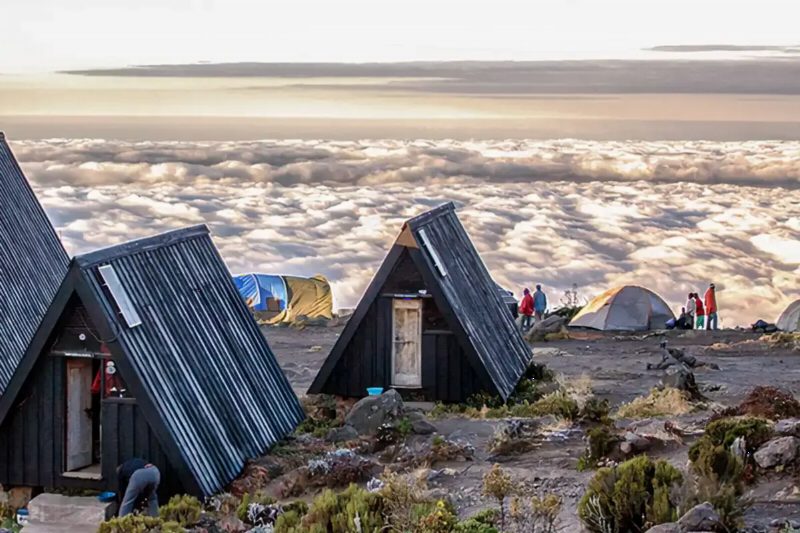
Wooden A-frame huts on a bare ridge above a sea of cloud.

At a glance

Lead time
Three to four months is plenty. Six if you are starting from nothing.
The core activity
Walking. On hills. With a daypack.
How often
Three or four sessions a week, one of them long.
The key test
Two long walking days on consecutive days, a month before you fly.
What not to bother with
Sprinting, heavy lifting, altitude tents.
The thing training cannot fix
Altitude. Days on the mountain do that.
A line of trekkers in bright jackets on a stony path, with Kibo's summit rising behind them.

Walk, mostly uphill

The best training for walking up a mountain is walking up hills. Nothing in a gym matches it.

Start with what you can do now, and add time and height gradually. If you can walk for an hour on the flat, make it ninety minutes with some slopes. Then two hours. Then find real hills and stay out for three or four.

Carry a daypack from the start, with a few kilograms in it, and work up to about six or seven kilograms, which is roughly what you will carry on the mountain with water. Wear the boots you will climb in. Every hour in them now is a blister you do not get later.

By the last month you want to be doing one walk a week of five or six hours on hilly ground, and feeling fine the next day.

Two climbers in bright jackets scrambling up a steep rock face.

Build endurance for long days

Kilimanjaro is slow. The guides keep you to a pace that feels far too easy at the bottom, because it is the pace that still works at 5,000 metres. So the fitness you need is the ability to keep going for a long time, not the ability to go fast.

Running, cycling and swimming all help build that base, especially for summit night when you are on your feet for twelve hours or more. Two or three sessions a week of thirty to sixty minutes, at a steady effort where you can still talk, is the right kind.

Interval training and sprints do very little for this. If you enjoy them, fine, but they are not the point.

A group of trekkers with poles and heavy packs walking up a rocky mountain path.

Legs for the descent

Most people train for going up and forget that the descent hurts most. You lose over 4,000 metres of height in a day and a half, on steep, loose ground, on legs that are already tired. It is the knees and the thighs that suffer.

Walking downhill in training helps more than anything. If your hills have a steep way down, use it. Stairs work too, going down as well as up.

Simple leg strength helps: squats, lunges, step-ups onto a bench, a couple of times a week. Nothing heavy. The aim is legs that can brake for hours, not legs that can lift a lot once.

And learn to use walking poles before you go. They take a large share of the load off your knees on the way down, and they are much more useful when you already know how to plant them.

Kilimanjaro's summit seen from the air, rising above a thick layer of cloud.

A three-month plan

Month one. Three sessions a week. Two walks of one to two hours, gradually adding hills and a light daypack. One session of steady cardio, thirty to forty-five minutes. Start wearing the boots.

Month two. Four sessions a week. One long walk of three to four hours on hills with the daypack loaded. One shorter hilly walk. One or two cardio sessions. Add some leg strength work.

Month three. The long walk goes to five or six hours. About four weeks before you fly, do two long walks on consecutive days. If you feel fine on the second morning, you are ready. Keep the other sessions going. Practise with the poles.

The last week. Ease off. Short walks only. Rest, eat well, and get your kit sorted. You arrive fresher that way, and nothing you do in the last few days will add fitness anyway.

Trekkers crossing high, bare desert on the mountain, with a dusty ridge behind them.

What does not help

Altitude tents and masks. They are expensive, the evidence for them is thin, and they cannot replicate a week of living at height. Days on the mountain do what they claim to do, for free.

Heavy weight training. Strength beyond what you need to carry a daypack and walk downhill is dead weight to carry up.

Crash fitness in the last fortnight. It leaves you tired, not fit. Taper instead.

Training through an injury. A niggle at home becomes a problem at 4,000 metres. Rest it.

And assuming fitness will beat altitude. It will not. Fit people fail on five-day routes every week. Train, and then book enough days.

A long line of climbers crossing deep snow on Kilimanjaro's upper slopes under a pale, misty sky.

If you are starting from nothing

You can still do this. Give yourself six months instead of three, and start smaller.

Begin with walks of thirty to forty-five minutes on the flat, most days. After a month, add gentle slopes and go to an hour. After two months, add a daypack and find some real hills. Then follow the three-month plan.

See your doctor first, and be honest with them about where you are starting from. The mountain rewards patience, on the trail and in the months before it.

Questions

How long should I train for Kilimanjaro?
Three to four months is enough for most reasonably active people. Six months if you are starting from very little. The last week before you fly should be easy.
What is the best exercise for Kilimanjaro?
Walking on hills with a loaded daypack, in the boots you will climb in. Nothing in a gym matches it. Steady cardio and some leg strength work support it.
Do I need to train for altitude?
You cannot. Nothing you do at sea level prepares your body for 5,000 metres. Choosing a route with enough days does that. Train for the walking, and book the days for the altitude.
Are altitude tents worth it?
Not for Kilimanjaro. They are expensive, the benefit is uncertain, and a week on the mountain does the job properly. Spend the money on an extra day on the route instead.
Should I train going downhill?
Yes. The descent hurts on Kilimanjaro, and most people never train for it. Walk down steep hills and stairs, do some leg strength work, and learn to use walking poles.
I am over 60. Can I train for this?
Yes, and people your age reach the top every week. Give yourself more time, build up gradually, see your doctor first, and choose a long route. Age matters far less than days on the mountain.
Keep reading

Other guides

All guides

Still have a question?

Ask us directly — we answer every message ourselves.

Talk to a safari expert on WhatsApp (opens in a new tab)