Safaris
Kilimanjaro
Destinations
Experiences
Travel guide
About
Contact Call +255 764 006 061 Plan Your Safari
Journal · · 7 min read

What Drives the Cost of a Kilimanjaro Climb

A large share of any Kilimanjaro price is fixed for every operator. Understanding which part is fixed is how you compare quotes properly.

Last updated

Kilimanjaro quotes vary widely, and unlike a safari the variation isn't mostly about comfort. A large part of it's about whether the operator is paying its crew properly.

What nobody controls

Kilimanjaro National Park charges conservation fees per person per day, camping or hut fees per night, and a rescue fee. These are set by the government, they're the same for every operator, and on a week-long climb they add up to a substantial part of the total.

They also scale with route length. An eight-day route costs more than a six-day route in park fees alone, before anything else is counted. Keep this in mind when you compare an eight-day Lemosho against a six-day Machame. A real chunk of that gap isn't profit.

The crew

A Kilimanjaro climb runs on a support team: guides, assistant guides, a cook, and porters carrying tents, food, water and equipment. There are much more of them than there are of you.

Their wages and tips are the part of the price that varies most between operators, and it's where an unusually cheap quote is usually coming from. Porter welfare on Kilimanjaro has a long and well-documented history of problems: underpaying, overloading, and sending people up the mountain without adequate clothing or shelter.

This is the one part of a Kilimanjaro quote we would encourage anyone to interrogate, whoever they book with. Ask how many crew, what they're paid, and what they carry. An operator that can't answer plainly is telling you something.

Route and length

More days means more park fees, more crew days and more food. It also means a better chance of summiting, which is the trade-off. Adding a day is the most reliable buy you can make on this mountain, and it's worth more than better equipment.

Group size

Some fixed costs divide across the group, so a larger party pays less each. A private climb for two costs more per person than joining a group of eight.

What is usually excluded

Check any quote for these, because they're commonly left out and they aren't small: flights, visa, travel insurance with high-altitude and evacuation cover, personal equipment hire, tips for the crew, and anything before or after the mountain.

How to compare two quotes

  1. Same route and same number of days? A six-day and a seven-day Machame aren't comparable.
  2. Are park fees included, or payable separately?
  3. How many crew, and what are they paid?
  4. Private climb or joining a group?
  5. Anything excluded, such as tips and insurance?

A quote far below the others isn't a bargain on this mountain. It is a signal to ask where the difference is coming from.

Our routes

We quote each climb individually instead of publishing a single figure, because group size and season both change it. The six routes we run are listed with prices where they're set. Two are quoted on request.

Itineraries

Kilimanjaro climbs we run

Compare all routes
Climbers in heavy jackets walking across snow near the summit.
Where the money goes

What makes up the price of a climb

The cost structure of a Kilimanjaro climb is unusually rigid, which is why legitimate prices cluster in a fairly narrow band.

Park fees are the largest component by a wide margin. TANAPA charges conservation fees per person per day, camping or hut fees per night, a rescue fee, and a fee for each guide and porter entering the park. These are set by a government agency, they're identical for every operator, and they rise with every day you add to the itinerary.

Crew wages come second. A climb is carried by a team that outnumbers the climbers several times over: guides, assistant guides, a cook and porters. There are minimum wage guidelines for the mountain that responsible operators observe.

Food, equipment, transfers and hotel nights in Moshi make up most of the rest.

The consequence is a floor. Because the fees are fixed and identical for everyone, there's a price below which the only thing left to cut is the crew's pay. That is why a quote well below the others should be a question, not a bargain.

Longer routes cost more mainly because of fees, not profit.

Two climbers in red and green jackets on a snowy slope above the clouds.
Comparing

How to read a climb quote

Which route and how many days
Fees are per day, so an eight-day Lemosho costs meaningfully more than a six-day Machame before anything else is counted.
The crew ratio
How many porters, guides and assistant guides per climber. This is the clearest signal of whether the crew is being properly resourced.
Whether park fees are itemised
Reputable quotes show them. A single undifferentiated number makes comparison impossible.
What hotel nights are included
Usually one before and one after, in Moshi. Some quotes exclude them.
What equipment is provided
Tents, mess tent, sleeping mats and cooking gear should be included. Sleeping bags and personal kit usually aren't.
Whether tips are included
They generally aren't, and they're a real part of crew income, not a bonus. Guideline totals are discussed at the briefing.
If you have to descend early
Whether an assistant guide accompanies you down and what that costs.
The sun setting behind a jagged peak, seen from high on the mountain's snowy slopes.
Practical

Costs beyond the quote

A few real costs sit outside almost every climb quote. Budget for them.

Tips are the largest. They are customary, they form a substantial part of what the crew earns, and guideline totals for the whole crew are discussed at the briefing. Bring the cash with you in small denominations. There's no cash machine on the mountain or at the gate, and Moshi's can be unreliable.

Insurance that covers trekking to your route's maximum altitude. Standard travel policies frequently stop at 4,000 or 5,000 metres, which doesn't cover Uhuru Peak. Check the altitude limit explicitly.

Hire gear, if you're renting in Moshi. Modest, but real.

The Tanzanian visa, and any vaccination requirements for your route of arrival.

Extra hotel nights if you build in a rest day before or after, which is usually a good idea.

And drinks and meals in Moshi outside the included nights.

You shouldn't budget for a summit guarantee. Nobody sells one, and any operator implying otherwise should be avoided.

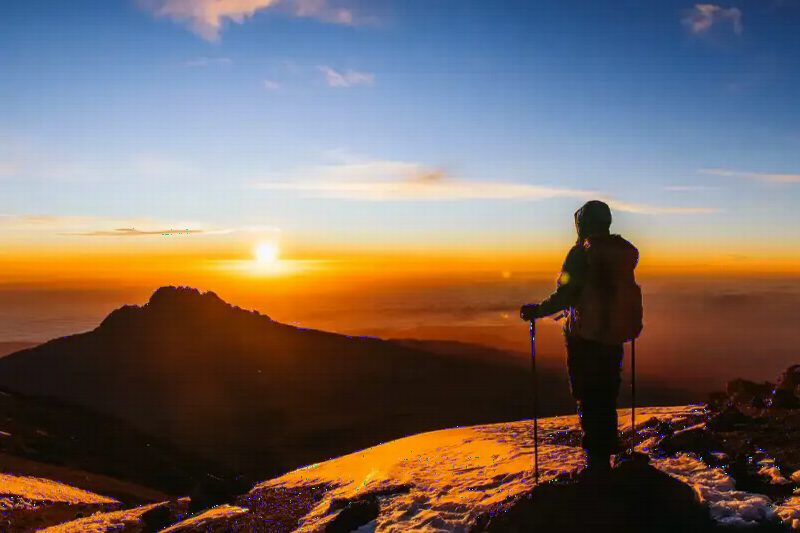
A climber silhouetted against a blazing sunrise high on the mountain, a jagged peak beyond.
Common mistakes

What people get wrong about climb pricing

The most consequential mistake is reading a low quote as efficiency. Park fees are set by TANAPA, charged per person per day, and identical for every operator. So they set a floor. Below it, the only thing left to cut is the crew's pay, and that shows on the trail.

The second is comparing routes, not quotes. An eight-day Lemosho costs more than a six-day Machame mostly because of two extra days of fees, not because of margin. Compare like with like.

The third isn't budgeting for tips. They are customary, substantial and a real part of crew income, not a bonus, and there's no cash machine on the mountain.

The fourth is buying insurance that stops at 4,000 or 5,000 metres. It doesn't cover the summit, and this is the most common admin failure on a climb.

The fifth is choosing on price and then paying for a second attempt. The difference between a six-day and an eight-day itinerary is a fraction of the cost of coming back.

A group of trekkers walking through green heath toward Kilimanjaro's snow-capped summit.
Planning

Where a bigger budget actually helps

If you've more to spend on a climb than the minimum, the places it makes a real difference aren't the obvious ones.

Days. This is the best use of extra money by a wide margin. Moving from six days to eight buys two more nights of acclimatisation and a materially better chance of summiting.

Crew ratio. More assistant guides means that if one person has to descend, somebody qualified goes with them and the rest of the group continues. On a small group that isn't a given at the bottom of the market.

Private group. Climbing with people you know instead of joining a scheduled departure means the pace is yours, which matters enormously at altitude where the wrong pace is the main risk.

Food and equipment. Better tents, better mess arrangements and better food sound like comfort and are actually recovery.

It doesn't buy a summit. No operator can guarantee one, and the mountain doesn't price-discriminate.

Green and yellow tents in a high camp below the snow-streaked summit of Kibo.

What is not in the price

Four costs sit outside almost every climb quote and each catches people out.

Tips for the crew, which are customary and substantial and must be brought as cash from home. There's no cash machine on the mountain or at the gate, and Moshi's aren't always working.

Insurance that covers trekking to your route's maximum altitude. Standard travel policies frequently stop at 4,000 or 5,000 metres, which doesn't cover Uhuru Peak at 5,895. This is the most common administrative failure on a climb and it's entirely avoidable.

Hire gear, if you're renting in Moshi instead of bringing your own. Modest, but real.

And extra hotel nights if you build in a rest day either side, which you should. A summit night takes more out of most people than they expect, and starting a safari at dawn the following morning is a decision people regret.

More from the journal

Keep reading

All stories

Journal

Altitude on Kilimanjaro

Altitude, not fitness, stops most people. The way acclimatisation is managed on the mountain, and why this article…

Talk to a safari expert on WhatsApp (opens in a new tab)