Safaris
Kilimanjaro
Destinations
Experiences
Travel guide
About
Contact Call +255 764 006 061 Plan Your Safari
Journal · · 8 min read

Best Time to Visit the Serengeti

Which part of the park to be in, month by month. The Serengeti is large enough that the answer changes by region as well as by season.

Last updated
The usual advice, "come in the dry season", is true for Tanzania generally and not very useful for the Serengeti specifically. The park is large enough that the better question is which part of it to be in, and that changes through the year.

The short answer

  • Calving and dense predator action: the southern plains and Ndutu, early in the year.
  • River crossings: the north, later in the dry season.
  • Dependable game viewing whatever your dates: the centre, any month.
  • Fewest vehicles: the west, or the north outside the crossing window.

Early in the year

The herds are usually on the short-grass plains in the south and around Ndutu, and this is calving season. An enormous number of calves are born in a compressed window, and the predators concentrate accordingly. Cheetah in particular do well on this flat, open ground.

This is arguably the best time of the whole cycle for wildlife behaviour, and it's quieter than the crossing season. Off-road driving is permitted on the Ngorongoro Conservation Area side around Ndutu, which matters if you're photographing.

The long rains

The herds begin drifting northwest through the central park. The columns can be spectacular, but this is the wettest stretch of the year, some camps close, and it's the least predictable period to plan around. Prices are at their lowest and the park is at its emptiest, which suits some travellers very well.

Mid-year

The herds push into the Western Corridor and meet the Grumeti River. Crossings here are smaller than the Mara crossings and watched by far fewer vehicles. Meanwhile the central park is drying out and game is concentrating around permanent water.

The second half of the dry season

The famous window. Herds are usually in the north, crossing the Mara River, sometimes repeatedly and in both directions depending on grazing. This is also peak season across the whole country. The north is busy, and accommodation inside the park is booked months ahead.

If you are coming for the crossings, give yourself at least three nights in the north. One night is a lottery ticket.

Toward the end of the year

With the short rains the herds turn south again across the eastern plains. The park greens up, migrant birds arrive, and visitor numbers drop before the year-end peak. A good compromise window if you want reasonable weather without peak crowds.

The caveat that matters

All of the above follows rainfall, and rainfall varies year to year. The herds don't read calendars, and no operator can promise you a river crossing on a particular date. We can tell you where the herds have actually been in recent weeks, not where a chart says they should be.

If your dates are fixed

Stay central. Seronera holds resident game in every month of the year, and a fixed-date trip built around the centre is far more robust than one built around catching the migration in a specific place.

Itineraries

Safaris we run

All safaris
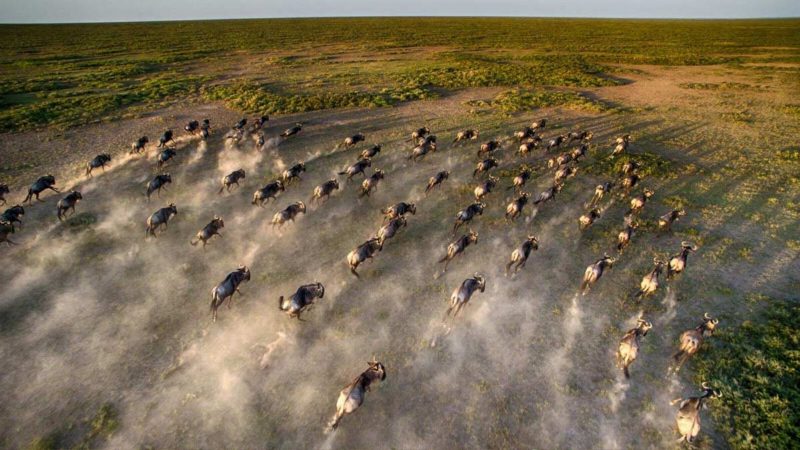
A small group of wildebeest standing close together in tall grass.
By region

The best month depends which part you mean

There is no single best time to visit the Serengeti, because the park is large enough that its regions have different seasons.

The central Serengeti around Seronera is good in every month. Permanent water in the river valley supports resident lion, leopard and cheetah year-round, so the centre is the answer whenever your dates are fixed. June to October is easiest for visibility. December to March is greener with better light.

The southern plains and Ndutu are at their best from December to March, when the herds are there and the calving peaks in February. Outside that window the plains are largely empty.

The northern Serengeti is a July-to-October destination, when the herds are on the Mara River. It is very quiet for the rest of the year.

The western corridor has a narrow window from late May to July for the Grumeti, and is otherwise a quiet, green, resident-game area.

So the question to answer first isn't "when" but "which part". Then the month follows.

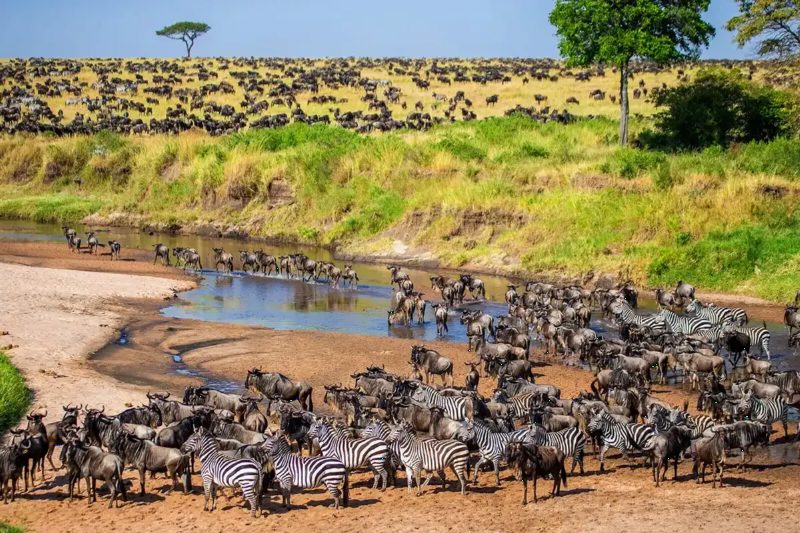
Zebra and wildebeest crowding a shallow pool in a dry riverbed, with more herds on the grass above.
Weather

What the weather actually does

The Serengeti sits at around 1,500 metres, which shapes the climate more than its position near the equator does.

Mornings from June to August are genuinely cold. Cold enough that an open vehicle at six in the morning needs a fleece and a windproof, which surprises people who packed for Africa. Days in the same period are warm and dry, and the air is full of dust by September.

The long rains, from around mid-March to May, bring heavy afternoon storms, not continuous rain, but enough of them to make black-cotton roads difficult and to close some camps.

The short rains around November and early December are typically an hour of heavy afternoon rain and clear skies either side of it. They are the least disruptive rain of the year.

December to March is warm, green and humid, with dramatic skies and short storms.

Whatever the season, the working day is the same: out at first light, back through the middle of the day while the animals lie up, out again in the late afternoon.

The Serengeti, month by month

Dry Shoulder Green Long rains

January

Green, warm, and busy in the south. The herds are on the short-grass plains. The centre around Seronera holds its resident lion, leopard and cheetah as it does all year.

February

Calving on the southern plains and the strongest predator month of the year. The centre is quieter than the south this month, which suits anyone who wants space.

March

Green and thinning out. The herds begin moving north, the rains build, and rates fall from mid-month.

April

The long rains. The western corridor roads can become genuinely difficult and some camps close. Very few vehicles, very green, very cheap.

May

Wet and quiet, with the herds moving through the centre and west. The Grumeti area starts to matter toward the end of the month.

June

Drying out. The western corridor is at its brief best, the centre is reliable as always, and the first herds may reach the north late in the month.

July

Dry and busy. The north begins its season. Seronera carries the most vehicles of any region because it's the most accessible.

August

Peak. The Mara River crossings in the far north, the highest vehicle numbers of the year everywhere, and the best visibility.

September

The second crossing month and marginally quieter than August. Dust in the air makes for good backlit photography at dawn.

October

Dry until the short rains break late in the month. The north empties as the herds turn south.

November

Short rains, green country and thin traffic. The herds move south through the centre and east. Under-booked and good.

December

Greening fast, with the herds arriving on the southern plains. Christmas and New Year are the most expensive fortnight of the year.

A cheetah licking its cub's face as they sit in the grass.
Practical

Crowds, prices and booking

Vehicle numbers matter more in the Serengeti than most people expect, because they concentrate in the same places.

July to October is the busiest, and the central Serengeti carries the most traffic of any region because it's the most accessible. A good leopard sighting near the Seronera river in August will attract a queue.

February at Ndutu is busy in a different way: concentrated, because everybody is there for the calving, but spread over open plains that absorb vehicles better than a river track.

April, May and November are close to empty, and that's a real part of their appeal.

Rates follow the same curve. High season is roughly June to October plus Christmas and New Year. Low season is April and May. The shoulders are November and much of December to March.

Booking windows differ by region. Mobile camps in the north for August and September, and at Ndutu for February, fill roughly twelve months ahead. The central Serengeti has options much later, which is another argument for it when your plans are late.

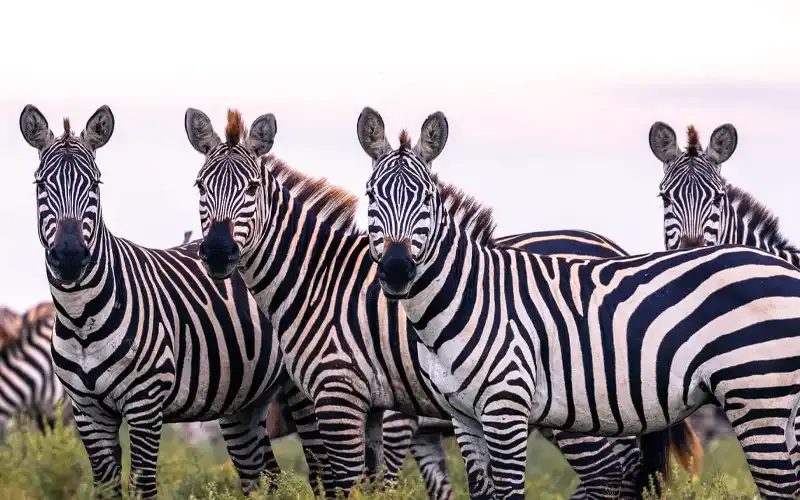
A line of zebras standing close together, looking straight at the camera.
Common mistakes

What people get wrong about Serengeti timing

The first mistake is booking a month without booking a region. The Serengeti is large enough that "July in the Serengeti" isn't a plan. The herds may be in the far north while you're based eight hours away in the centre. Choose the region for your dates, then the camp.

The second is assuming the dry season is always better. It is easier, with short grass, animals on water and predictable weather, but the green season has better light, fewer vehicles, lower prices and the calving. For photographers it's clearly superior.

The third is treating the migration as the only reason to be there. The central Serengeti holds one of the densest big-cat populations in Africa in every month, whether or not the herds are anywhere near.

The fourth is booking one night. Two is the minimum, three to be unhurried.

The fifth is underestimating the cold. At 1,500 metres, mornings from June to August in an open vehicle are genuinely cold, and a fleece matters more than another shirt.

A striped hot-air balloon floating over golden grass and a lone acacia at sunrise.
Practical

Booking by region and season

Availability moves differently in each part of the park. Keep that in mind when you're deciding how far ahead to book.

The northern Serengeti in August and September is the tightest window on the circuit. The camps are small, mostly mobile, and they fill roughly twelve months ahead.

Ndutu and the southern plains in February are equally tight, and for the same reasons.

The central Serengeti has the widest range of accommodation and the latest availability, which is another argument for it when plans are late or dates are fixed.

The western corridor rarely sells out at all.

Christmas and New Year fill early everywhere and carry the year's highest rates.

April, May and November have availability close to departure and rates well below the peak.

If your dates are flexible by even a week, ask what's available before fixing the route. Camp position affects your game viewing more than almost any other decision, and a slightly different week is often the difference between the camp you want and a compromise.

More from the journal

Keep reading

All stories

Journal

Altitude on Kilimanjaro

Altitude, not fitness, stops most people. The way acclimatisation is managed on the mountain, and why this article…

Talk to a safari expert on WhatsApp (opens in a new tab)