
Half day · from Moshi
Materuni Waterfalls
Around twenty to thirty minutes outside Moshi are the Materuni waterfalls. Because it is so close, it fits…

Single-day trips from Arusha and Moshi, useful either side of a climb or as a gentle first day.
Lake Chala is a crater lake on the border of Tanzania and Kenya, on the eastern side of Kilimanjaro. It is about an hour from Moshi and 8 kilometres north of Taveta. The water changes colour through the year, from deep blue to turquoise and green, and the crater rim standing above it is about 100 metres high. You walk down into the crater with a guide, which takes about half an hour, and how long you stay at the water is up to you. People swim.
Njoro Forest is about an hour outside Moshi. You go through it on foot or by bicycle with a guide. The animals people usually see are colobus and blue monkey, and Kirk's dik-dik lives here too, though it is rarely seen. The route also passes a rice plantation and the large tree known locally as the magical tree. Most groups stop there for lunch before heading back to Moshi.
Chemka Hot Springs are about 40 kilometres from Moshi, at the village of the same name. Warm water comes up from underground into a clear pool under fig trees. The pool is deep, up to about 10 metres in places, and you can still see the bottom. There is shade on the bank to eat and dry off afterwards.
A Kilimanjaro day hike is the first day of the Marangu route and back down again. From the gate it is three to four hours of walking to the first huts, at about 2,700 metres. It suits people who want a day on the mountain without climbing it. Park entry is charged at the same daily rate as it is for a full climb.
Materuni waterfalls are twenty to thirty minutes from Moshi. The falls are about 150 metres high, and the walk in goes through village farmland and coffee plots on the lower slopes of Kilimanjaro. The pool at the base is cold.
Half day · from Moshi
Around twenty to thirty minutes outside Moshi are the Materuni waterfalls. Because it is so close, it fits…
Full day · from Moshi
The Chemka Hot Springs lie about 40 kilometres from Moshi, in the village of the same name. They are…
Full day · from Moshi
Lake Chala is a crater lake in a caldera on the border of Tanzania and Kenya, on the eastern edge of Mount…
Full day · from Moshi
Approximately one hour outside Moshi town lies Njoro Forest. By bicycle or simply on foot, you explore the…
3–4 hours of hiking · from Marangu Gate
Get a real taste of Mount Kilimanjaro if you don't have time for the whole thing. If you're only in Tanzania…

Day trips solve two problems that most safari itineraries create and then ignore: the day you arrive and the day before you fly home.
Most international flights land at Kilimanjaro International in the evening and leave late at night. That gives you a first morning and a last full day with nothing much in them, and most people spend both in a hotel garden. Every trip on this page fits into one of those slots, with no risk to your flight.
They also fill the gap between a Kilimanjaro climb and a safari, or the rest day after coming off the mountain. Your legs will not take another early start, but you do not want to waste the day either.
And they work for travellers who are not doing a safari at all: people in Moshi or Arusha for work, for a project, or visiting family, who have a free day and a driver.
The practical limit is how far you are from your base. Materuni and Chemka are within reach of Moshi. Arusha National Park and Njoro are closer to Arusha. Lake Chala sits east, toward the Kenyan border. Which town you stay in narrows the sensible list more than anything else.

None of these days is a game drive, and that is the appeal. They are walking days, water days and village days, and they get you out of a vehicle.
Expect to walk. Materuni means a descent to the falls and a climb back out. Njoro is a forest walk to a waterfall. The Kilimanjaro day hike is three to four hours on the lower slopes of the mountain. Closed shoes matter on all of them, and a light rain layer is sensible in any month on Kilimanjaro's southern slopes.
Expect to get wet where there is water. Chemka is a swimming trip and the pool is warm. The plunge pool at Materuni is very cold. Bring a towel and something to change into. Do not assume there will be somewhere to do it.
Expect a local guide as well as your driver at most of these sites. That is how the community fees work, and it is a good thing. The village guides know the paths and the plants.
Expect the drive to be a real part of the day. Two to three hours in the vehicle each way is normal, and the road is often the roughest part of it.
Bring cash in small notes for entrance fees, guides and coffee.
The five trips here differ mostly by where they start from and how much walking they involve, and those two things decide which one fits your day.
Materuni is the fullest day: a drive up Kilimanjaro's southern slopes from Moshi, a walk down to a high waterfall, a cold plunge pool, and a coffee-farm visit with the whole process from picking to cup. It involves a genuine climb back out.
Chemka Hot Springs is the swimming day. A turquoise spring-fed pool in a fig grove, warm year-round, with very little walking. It is the easiest of the five on a rest day after a climb.
Njoro Forest is a shorter forest walk to a waterfall, closer to Arusha and gentler than Materuni.
Lake Chala is the quietest: a deep crater lake on the Kenyan border, east of Moshi, with a rim walk and a long drive.
The Kilimanjaro day hike goes up to the first hut on one of the standard routes and back. Three to four hours of walking, a park fee, and the only way to set foot on the mountain without committing to a climb.
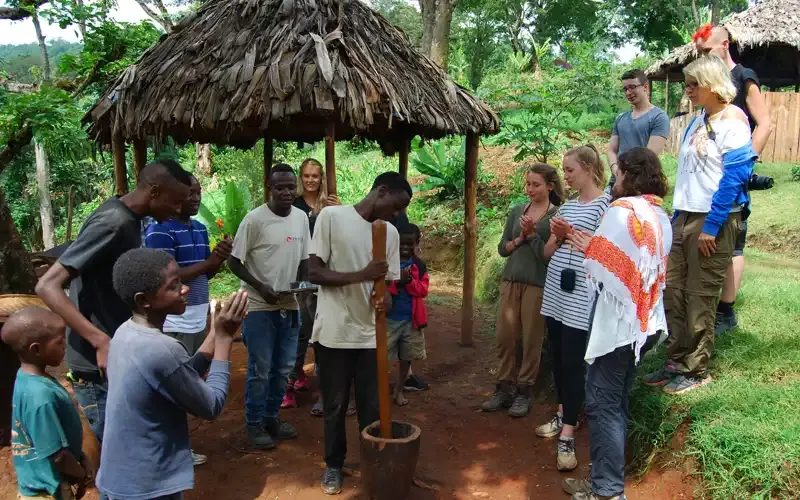
Day trips solve two problems that every safari itinerary creates and then ignores.
The first is the arrival day. Most international flights land at Kilimanjaro International in the evening, so the next morning is usually spent sitting in a hotel garden waiting for the safari to start. Any of these trips fills that slot.
The second is the departure day. Long-haul flights leave late at night, which leaves you a whole final day with nothing in it. A day trip turns that into something, and all of these are close enough to the airport to put your flight at no risk.
They also work as the rest day between coming off Kilimanjaro and starting a safari. Your legs will not take another early start, but sitting still all day is a waste. Chemka is the usual answer here.
And they work for anyone in Moshi or Arusha who is not on a safari at all, whether visiting, working, or between other plans.
More than anything else, the choice depends on which town you are staying in. Materuni and Chemka run from Moshi. Njoro and Arusha National Park run from Arusha. Lake Chala is east of Moshi.
A day trip has no spare days in it, so weather matters more here than on a longer itinerary.
In the wet months the waterfall walks get slippery and the forest tracks get muddy. That doesn't cancel the day, but it changes the footwear you need and it slows everything down. Hot springs and lake trips are less affected. Views from high ground are the most affected of all. A clear morning and a cloudy one are completely different days.
If your schedule allows any flexibility at all, keep the day with the view in it loose and go when the sky is clear.

Use them for the arrival day, the departure day, or the rest day after a climb. Those are the three days most safari itineraries waste. Which town you're staying in narrows the choice more than anything else.