Safaris
Kilimanjaro
Destinations
Experiences
Travel guide
About
Contact Call +255 764 006 061 Plan Your Safari
Destination

Lake Eyasi

Hadzabe and Datoga country, south of the crater highlands

A boy carrying a bow and arrows walks across dry bush country at the foot of a hill.
Hadzabe men with bows standing on rocks above a wide green valley.
Lake Eyasi seen from the escarpment, the water pale in the haze beyond green woodland.
A group of Hadzabe men sitting around a fire in a rock shelter.
Best time Year-round. The lake itself shrinks a lot in the dry months and can be almost empty by the end of the dry season.
About the park

Lake Eyasi lies in a branch of the Rift Valley below the Ngorongoro highlands, a shallow, seasonal soda lake fringed by acacia and doum palm. Its level swings a long way through the year. After the rains it spreads wide. In a dry year it shrinks to a bare pan.

Most people come here for the communities, not for the wildlife. The country around the lake is home to the Hadzabe, one of the last communities in East Africa still living much by hunting and gathering, and to the Datoga, pastoralists and metalworkers who have long lived alongside them.

Why visit Lake Eyasi

A visit to Eyasi normally means an early morning walk with Hadzabe hunters and time at a Datoga homestead, where blacksmithing is still done by hand. It is a genuinely different day from the rest of a northern circuit trip, and for many travellers it's the part they remember most clearly.

It is also the part of a Tanzanian itinerary that most deserves a word of caution. Cultural visits of this kind vary enormously in how they're run. The difference between a respectful encounter and an uncomfortable performance comes down to the operator and the guide, not the place. Go early, keep the group small, ask before photographing people, and be prepared for a morning that's unpolished, not staged.

Eyasi appears on our 7-day safari, where it follows the Ngorongoro Crater and precedes the return to Arusha.

Itineraries

Safaris that visit Lake Eyasi

All safaris
Before you go

Practical notes

Wildlife

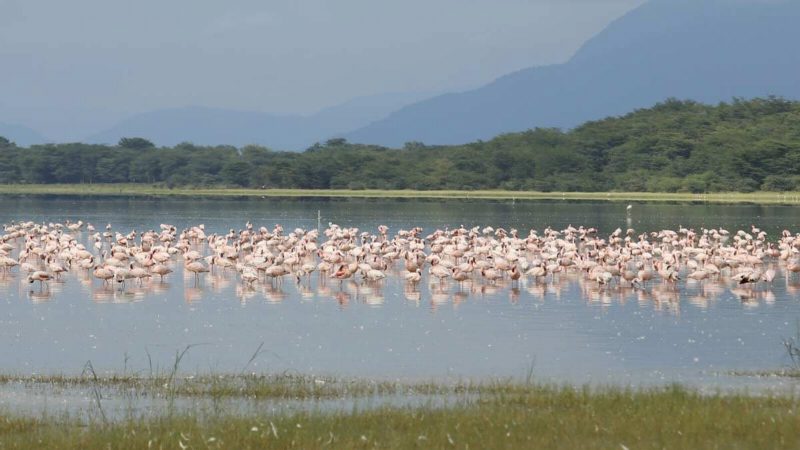
This isn't a big-game destination. Birdlife around the lake is good, including flamingo and pelican when water levels allow. The interest here is cultural, not wildlife.

What to do there

Morning walks with Hadzabe hunters, visits to Datoga homesteads and blacksmiths, birdwatching along the lake shore.

Getting there

By road south from the Ngorongoro Conservation Area, usually as a leg between the crater and the return to Arusha.

Best time to visit

Year-round. The lake itself shrinks a lot in the dry months and can be almost empty by the end of the dry season.

A visitor walking with Maasai men and women in bright shukas on a green hillside.
On the ground

What a morning at Eyasi involves

An Eyasi visit starts before dawn. The early start is not about the light. The Hadzabe hunt in the first hours of the day, and there is no point arriving after they have gone.

You meet a group at their camp. That is likely to be a few grass shelters and a fire, not a village, because the Hadzabe move often and build for days, not years.

Then you walk. The pace is fast and the ground is thorny, and the walking is the activity itself. You track. You check baobabs for honey. You dig up tubers. They shoot at birds and small game with bows that are far heavier to draw than they look. Whether anything gets caught varies enormously.

Later in the morning most trips move on to a Datoga homestead. The Datoga are herders and metalworkers, and the part visitors usually see is the blacksmith at work. He takes scrap metal, most often from vehicle parts, and works it over a charcoal fire with goatskin bellows into arrowheads, bracelets and knife blades. The arrowheads are traded to the Hadzabe. You can see the relationship between the two groups in that one object.

Afternoons are usually spent at the lake or driving on. Eyasi is a shallow soda lake in the western arm of the Rift Valley. It is dramatic in the wet season and reduced to cracked flats and heat shimmer by the end of the dry.

There is no real game viewing here. Do not come for animals.

Before you go

Being a decent visitor

This is a commercial arrangement. Money changes hands, the community expects it, and pretending otherwise helps nobody.

Ask your operator before the day what is being paid, to whom, and whether it goes to the group as a whole or to individuals. A straightforward conversation beforehand is much better than an uncomfortable negotiation in front of everybody.

Ask before you photograph people. Every time. And accept it when someone says no. A camera pushed into someone's face without a word is the single most common complaint communities make about visitors.

Please do not hand out sweets, pens or money to children. It is kindly meant, and it reliably creates begging that the community has to live with after you leave.

Expect some of the day to be arranged. The hunt happens because you booked it. The bows would have been picked up that morning anyway, but the timing is yours. That does not make it fake. It makes it a job, in the same way a guided walk anywhere is a job. Expecting untouched authenticity is a fantasy, and no living community can meet it.

Dress as you would for a walk through thorn scrub: closed shoes, long trousers, and something over your shoulders.

Young dancers in grass skirts performing on a stage.
Planning

Where Eyasi fits, and how long it takes

Lake Eyasi lies south-west of the Ngorongoro highlands, roughly an hour and a half from Karatu on a road that's tarmac for part of the way and rough for the rest. That position makes it a natural single night between the crater and the drive back east, and it's exactly where the seven-day itinerary places it.

One night is the standard and it's enough: you arrive in the afternoon, do the early morning with the Hadzabe and Datoga, and drive on by late morning. A second night only makes sense if you want to spend proper time at the lake itself or walk further into the escarpment country.

Accommodation is limited and mostly simple. There are a handful of small lodges and tented camps near Ghorofani village. Do not expect the standards of a Serengeti camp. Expect solar power, basic plumbing and a good deal of dust.

It is hot. Eyasi sits low, at around 1,000 metres, and the middle of the day in the dry season is genuinely uncomfortable in a way the highlands aren't. Plan activity for the morning and rest through the afternoon.

The wider Eyasi basin is also one of the more important fossil areas in East Africa, with early human fossils found on its shores. There's no visitor site of the kind Olduvai has.

Practical

Getting there, and what to bring

Eyasi is roughly an hour and a half from Karatu, tarmac for part of the way and rough for the rest. It sits at around 1,000 metres, which makes it much hotter than the highlands you've come from.

One night is standard and is enough. You arrive in the afternoon, do the early morning with the Hadzabe and Datoga, and drive on by late morning.

Accommodation is limited and simple. There are a handful of small lodges and tented camps near Ghorofani. Expect solar power, basic plumbing and a great deal of dust.

Bring closed shoes and long trousers. The morning walk is through thorn scrub at a fast pace.

Bring cash in small denominations for community fees and anything you buy.

Plan activity for the morning and rest through the afternoon. The middle of the day in the dry season is genuinely uncomfortable here in a way it isn't in the highlands.

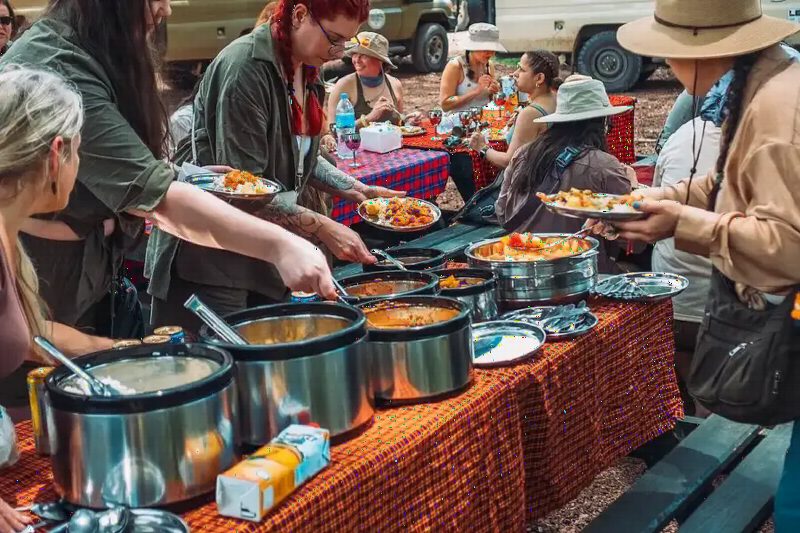
Travellers helping themselves to local dishes from steaming pots at an outdoor buffet.

Nearby places

Eyasi sits at the bottom of the escarpment south-west of the crater highlands, which puts a few other things within reach on the same leg of a trip.

Karatu, an hour and a half back up the road, is the farming town between the crater rim and Lake Manyara. It has coffee estates, wheat and maize on red volcanic soil, and the last reliable shops and fuel before the conservation area. Coffee-farm visits and short walks in the surrounding hills are easily arranged.

Lake Manyara National Park is roughly two hours away and combines naturally with Eyasi on the drive back east.

The Ngorongoro Crater is two to three hours by road, which is why Eyasi is almost always taken either immediately before or immediately after a crater day.

Mto wa Mbu, at the foot of the escarpment, is on the same route and adds a cultural half day.

Questions

Visiting Lake Eyasi

What happens on a visit to Lake Eyasi?
Visits centre on time with Hadzabe and Datoga communities. There is an early-morning walk with Hadzabe hunters and a visit to a Datoga homestead and blacksmith. It is a cultural day, not a game drive. Eyasi isn't a wildlife destination.
Is a Hadzabe visit ethical?
It is a commercial arrangement and it's best approached as one. Agree what's being paid and to whom before the day, not afterwards. Ask before photographing people. And be realistic: what you see is arranged for visitors as well as being a real part of daily life.
When is the best time to visit Lake Eyasi?
Year-round. The lake itself shrinks a lot through the dry months and can be close to empty by the end of the dry season. The cultural activity doesn't depend on the water.
How does Lake Eyasi fit into a safari itinerary?
It sits south of the crater highlands and slots naturally between the Ngorongoro area and the drive back toward Arusha, usually as one night. It appears on the seven-day itinerary for exactly that reason.
Build it in

Want Lake Eyasi in your trip?

Tell us how long you have and we will build an itinerary around it.

Talk to a safari expert on WhatsApp (opens in a new tab)