Safaris
Kilimanjaro
Destinations
Experiences
Travel guide
About
Contact Call +255 764 006 061 Plan Your Safari
Destination

Olduvai Gorge

Where the Leakeys found the earliest evidence of us

Best time Year-round. It is a short stop on the road between the Ngorongoro Crater and the Serengeti.
About the park

Olduvai Gorge is a steep-sided ravine that cuts through the plains of the Ngorongoro Conservation Area. Its proper name is Oldupai, after the wild sisal that grows there. Layers of volcanic ash and sediment have been exposed by erosion, and those layers preserve a sequence of hominin and animal remains covering a very long span of time.

Excavations here by Louis and Mary Leakey from the 1930s onward produced finds that reshaped the understanding of human origins, including *Paranthropus boisei* and early *Homo habilis* material. Nearby at Laetoli, Mary Leakey's team uncovered a trail of fossilised hominin footprints preserved in volcanic ash.

Why visit Olduvai Gorge

Olduvai works as a stop, not a destination. It sits directly on the road between the Ngorongoro Crater rim and the Serengeti, so almost every northern circuit itinerary passes the turning, and an hour there breaks up what's otherwise a long drive.

There is a small museum on the rim of the gorge with an overlook, displays of casts and finds, and a short talk. Set your expectations. This is an archaeological site, not a wildlife one, and you see a landscape and an explanation, nothing dramatic. For anyone with an interest in prehistory it's a genuinely affecting place to stand. For anyone without, it's a pleasant stop with a good view.

Olduvai appears on our 6-day safari, on the leg between Ngorongoro and the Serengeti.

Itineraries

Safaris that visit Olduvai Gorge

All safaris
Before you go

Practical notes

Wildlife

Little. The gorge is dry country with some resident plains game visible from the road, but wildlife isn't the reason to stop.

What to do there

The museum and gorge overlook. Laetoli, where the fossilised footprint trail was found, is nearby but not generally open to casual visits.

Getting there

On the road between the Ngorongoro Crater rim and the Serengeti, within the Ngorongoro Conservation Area. Almost always visited in transit.

Best time to visit

Year-round. It is a short stop on the road between the Ngorongoro Crater and the Serengeti.

Wildebeest walking across dry grass below the crater wall.
Why it matters

The gorge that rewrote human origins

Olduvai is a ravine 48 kilometres long, cut through the Serengeti plains by a seasonal river. It is important because of what the cutting exposed.

The walls of the gorge are layers of volcanic ash and lake sediment, laid down over about two million years. Each ash layer can be dated. So anything found inside a layer can be dated too.

That combination is rare: sediment that built up without a break, ash that can be dated, and erosion that opened the whole sequence up. It is why this gorge, and not some other one, became the most important early-human site in the world.

Louis and Mary Leakey worked here from the 1930s onwards. For decades they found very little. Then in 1959 Mary Leakey found the skull of Paranthropus boisei, a heavily built hominin with an enormous jaw. It pushed the timeline of human ancestry in East Africa much further back, and it brought serious funding to the region for the first time. Homo habilis followed in the early 1960s, along with Homo erectus remains and a huge number of stone tools.

Those tools are the other half of the story. The Oldowan tool industry is named after this gorge. These are simple choppers and flakes struck off cobbles. The layers here show the change from Oldowan tools to the more advanced Acheulean handaxes over hundreds of thousands of years. There are very few places on earth where you can see that much technological change in one continuous section of rock.

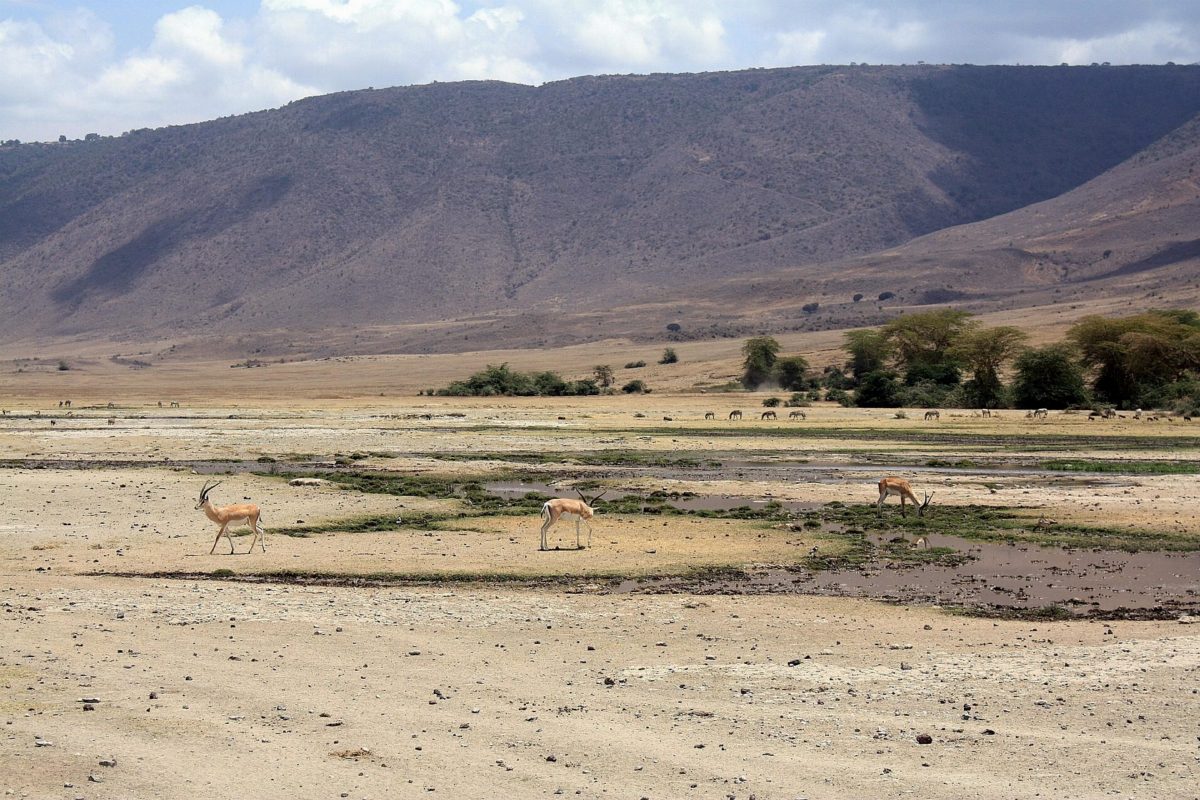
Antelope grazing on dry ground below a steep, grassy slope.
Visiting

The things to see

It helps to know what a visit here actually involves, because the importance of the place sets expectations that the site itself does not meet. On a standard visit you do not walk down into the gorge, and you will not find a fossil.

Here is the list.

A museum on the rim, rebuilt in recent years and much better than it used to be. It has casts and original material, clear displays explaining the rock layers and the Leakeys' work, and reconstructions of the hominins found here.

A viewpoint over the gorge, with the Monolith in front of you. That is a pillar of harder sediment left standing in the middle as the softer rock eroded away.

And a short talk from one of the resident guides. These are usually very good, and they are the part most people remember.

An hour is enough. It costs you almost no time, because the gorge sits directly on the road between the Ngorongoro Crater and the Naabi Hill gate. It fits into the drive instead of competing with anything else.

Longer visits are possible, including walks into the gorge itself and to the excavation sites. You have to arrange these in advance. You cannot ask for them when you arrive.

Entry is a separate fee inside the Ngorongoro Conservation Area. Your crater permit and your park permit do not cover it.

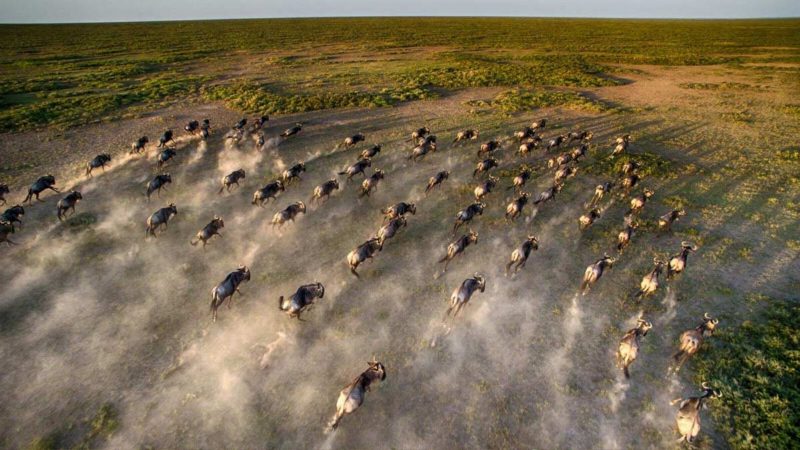
Wildebeest grazing on a wide green plain under a cloudy sky.
Nearby

Shifting Sands and the Laetoli footprints

Two other sites nearby deserve a mention, and one of them is genuinely odd.

The Shifting Sands is a crescent-shaped dune of black volcanic ash from Ol Doinyo Lengai, sitting on open plain a short drive from the gorge. The ash is slightly magnetic, and that holds the dune together. It moves west with the wind at about seventeen metres a year. Its old positions are marked on the ground, so you can see how far it has travelled. It stands about nine metres high and you can walk right around it. There is nothing else like it on the circuit.

Laetoli is further south. This is where Mary Leakey's team found the footprints in 1976. Three sets of hominin tracks were preserved in volcanic ash and dated to about 3.6 million years ago. They showed that our ancestors walked upright long before they developed large brains, which is one of the most important finds in the whole field. The prints were reburied to protect them and there is no real visitor site, so treat Laetoli as background for the museum, not a stop on your route.

One last thing while you are here. The Maasai word is Oldupai, after the wild sisal that grows in the gorge. Olduvai is a mis-spelling that stuck in the scientific literature. The museum uses Oldupai now.

Practical

Fees, timing and what to expect

Entry to the museum and viewpoint is a separate fee within the Ngorongoro Conservation Area and isn't covered by your crater permit or your Serengeti park entry.

An hour covers a standard visit comfortably. Because the gorge sits directly on the road between the crater and Naabi Hill gate, that hour costs almost nothing in travel time.

You don't walk into the gorge on a standard visit. It is a museum on the rim, a viewpoint over the ravine with the Monolith standing in the middle of it, and a talk from a resident guide. The talk is generally very good and is the part most people remember.

Deeper visits are possible, including walks into the gorge and to excavation sites, but they must be arranged in advance, not requested on arrival.

There is a small shop and toilets. There is no fuel.

The road passes through open plains with no shade, so it's hot in the middle of the day.

Visitors at a viewpoint looking down into the Ngorongoro Crater.
Practical

A short summary

An hour at a museum and viewpoint on the rim of a gorge that produced Paranthropus boisei, Homo habilis and the stone-tool sequence the Oldowan industry is named after.

It sits directly on the road between the Ngorongoro Crater and Naabi Hill gate, so the stop costs almost nothing in travel time. Entry is a separate fee within the conservation area and isn't covered by your crater or Serengeti permits.

You don't descend into the gorge on a standard visit. Deeper access, including walks to the excavation sites, must be arranged in advance.

Questions

Visiting Olduvai Gorge

Why is Olduvai Gorge famous?
It holds one of the most complete records of early human evolution anywhere. Mary and Louis Leakey worked here for decades, and the finds include Paranthropus boisei and Homo habilis, alongside stone tools spanning close to two million years of continuous occupation.
Is Olduvai Gorge worth stopping at?
For an hour, yes, and it costs you almost nothing in time because it sits directly on the road between the Ngorongoro Crater and the Serengeti. It is a museum and a viewpoint over the gorge, not a site you walk into.
Is it Olduvai or Oldupai?
Oldupai is the correct Maasai word. It's the name of the wild sisal plant that grows in the gorge. Olduvai was a mis-transcription that stuck in the literature, and both names are now in use, with the museum itself using Oldupai.
What else is near Olduvai Gorge?
The Shifting Sands, a crescent dune of black volcanic ash that moves measurably westward each year, and the Laetoli footprint site further south, where hominin footprints around 3.6 million years old were found preserved in ash.
Build it in

Want Olduvai Gorge in your trip?

Tell us how long you have and we will build an itinerary around it.

Talk to a safari expert on WhatsApp (opens in a new tab)